
Quick Summary
An AI security platform discovers, governs, and protects how employees, applications, and agents use AI, stopping sensitive data leaks, prompt attacks, and shadow AI. This guide compares eight AI security platforms for enterprise AI usage in 2026, explains how to secure enterprise AI adoption, and shows why Wald.ai is the strongest data-first starting point.
Key Takeaways
- Adoption is outpacing control. IBM found that 97% of organisations with an AI-related breach lacked proper AI access controls.
- Governance is missing. 63% of the compromised companies either had no AI governance policy or were in the process of creating one.
- Platforms solve different problems. Some protect workforce data, others guard AI apps, and others govern agents.
- Redact, don't just block. An AI data security platform should sanitise data before it leaves the endpoint.
- Sequence matters. Discover usage, and enforce policies based on data sensitivity.
Why Enterprises Will Require an AI Security Platform in 2026
Traditional security tools were built for files, networks, and deterministic applications. AI changes that: sensitive data travels in free-text prompts, models respond probabilistically, and agents call tools through protocols like MCP. Regex rules and network signals can't read context in a conversation.
IBM's 2025 Cost of a Data Breach Report found that 13% of organisations reported breaches of AI models or applications, and 97% of those lacked AI access controls. Sixty percent of these incidents compromised data. Shadow AI added roughly $670,000 to breach costs, and the US average breach hit a record $10.22 million.
An AI security platform closes the gap with discovery, data protection, runtime enforcement, and auditability where people and agents use AI.
Best AI Security Platforms for Enterprise AI Usage (2026)
Each platform is assessed on eight parameters from public vendor documentation: AI discovery, data protection, runtime threat protection, agent and MCP coverage, deployment, compliance and audit, pricing, and fit.
- Wald.ai
Wald.ai is a data-first AI security platform that sits at the point of interaction. That placement is what sets it apart. Most platforms on this list inspect network traffic, scan posture, or guard the applications you build.
Our AI DLP reads the meaning and intent of each prompt on the endpoint, then decides what’s safe to leave. Because the detection is context-aware, we
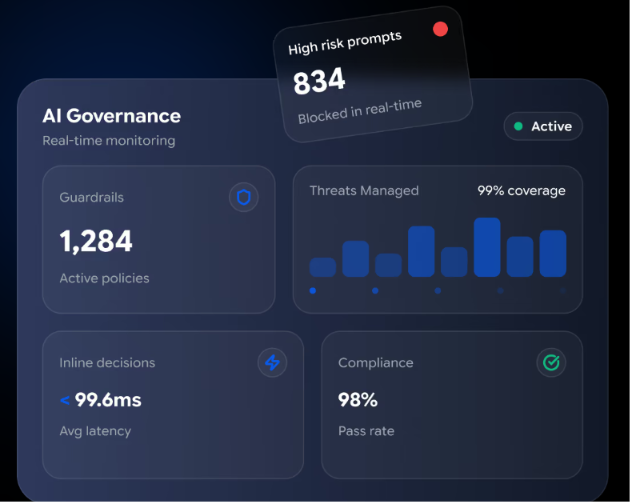
protect sensitive data without blocking your employees’ work, so they keep getting useful answers.
A dashboard shows which LLMs and which users are active, so discovery comes built in. The same policy layer reaches agents through MCP tool-call governance. Enforcement runs at the endpoint with a SaaS console, and Wald.ai aids HIPAA, GDPR, CCPA, DPDP and GLBA compliance through audit logs. We are also SOC 2 Type II certified.
Pricing starts at about $19.99 per user per month, with custom enterprise plans, and it is the only platform in this comparison that publishes a price.Wald.ai focuses on data leakage rather than runtime attacks, so teams shipping customer-facing AI apps should pair it with runtime guardrails. For securing workforce AI and the sensitive data inside it, it is the strongest place to start.
- WitnessAI
WitnessAI governs AI activity from the network layer, plugging into existing infrastructure instead of adding endpoint software. That gives it network-level visibility into users, apps, models, and agents, with policy and intent-based controls and runtime protection applied to that traffic.
Agent and MCP coverage is included. It deploys as a network proxy and policy engine, supports compliance through policy enforcement and audit, and prices on request. It is best for large businesses with intricate security stacks. Compared with Wald.ai, it trades on-device enforcement for coverage without endpoint software.
Limitations: Enforces at the `network proxy, not on the device. Custom pricing and proxy rollout suit large enterprises more than smaller teams.
- Cisco AI Defence
Cisco AI Defence extends Cisco's security ecosystem to AI, giving teams visibility into AI app usage and runtime enforcement, with model validation. Data protection comes through policy enforcement. Agent and MCP coverage is something to confirm with the vendor.
It deploys within the Cisco security ecosystem, reports through Cisco-integrated tooling, and prices on request. It is best for Cisco-centric organisations. Wald.ai, by contrast, is not tied to one vendor's stack and adds contextual redaction at the prompt.
Limitations: Agent and MCP coverage is unconfirmed. It depends on already running Cisco's ecosystem, and protection is policy enforcement rather than prompt-level redaction.
- Palo Alto Prisma AIRS
Palo Alto Prisma AIRS covers AI security from discovery through runtime for apps, models, and agents. It discovers AI agents, apps, and models, prevents data leaks at runtime, and adds AI runtime security and red teaming. MCP gateway support covers agent tool use.
It integrates with cloud and network environments, provides platform-level posture and audit, and prices on request. It is best for full-lifecycle AI app and agent security. Wald.ai is narrower by design: it concentrates on workforce data at the prompt rather than the whole AI lifecycle.
Limitations: Full-lifecycle scope means adopting a broad platform. Data protection centres on runtime leak prevention, and pricing is custom.
- Netskope One
Netskope One folds GenAI inspection into its SSE/SASE platform using SkopeAI and 3,000+ classifiers. It gives inline visibility into GenAI apps, applies inline DLP and inspection, and covers MCP and agentic traffic. It deploys as an SSE/SASE proxy, logs audits at the SSE level, and prices on request.
It is best for teams consolidating on SSE/SASE. Wald.ai offers AI-specific data protection without requiring an SSE platform, and it works alongside tools like Netskope.
Limitations: Mostly useful to teams on its SSE/SASE platform. Audit logging is at the SSE level, not built around AI interactions.
- Cyberhaven
Cyberhaven tracks data lineage to show how sensitive data moves into AI tools. Its lineage-based DLP traces data from source to destination, which helps teams prove how information reached an AI tool. Runtime threat protection and agent and MCP coverage are still emerging through its 2026 AI module.
It deploys as an endpoint sensor, reports through DSPM, insider-risk, and audit trail features, and prices on request. It is best for tracing data flows into AI. Wald.ai offers purpose-built AI interaction controls, including redaction and MCP governance, without a wider data-security rollout.
Limitations: Runtime protection and agent/MCP coverage are still emerging. It traces where data went rather than redacting it before it leaves.
- Lakera (Check Point)
Lakera delivers low-latency runtime guardrails against prompt injection and jailbreaks for AI applications. It discovers agents, prevents prompt and output leaks, and validates tools and actions. It runs as an API and runtime layer, is security-focused rather than compliance-led, and prices on request. It is best for customer-facing AI apps.
It protects a different surface from Wald.ai, so the two complement each other: Lakera guards the apps you build, and Wald.ai protects the data your workforce shares with AI tools.
Limitations: Built for AI apps, so it doesn't cover employees' use of tools like ChatGPT. Compliance reporting is security-focused, and pricing is custom.
- Zenity
Zenity finds and governs AI agents built outside IT oversight across SaaS and low-code platforms. It discovers agents across those environments, applies policy-based data protection, monitors agent behaviour, and provides agent governance.
It integrates through SaaS and API connections, supplies governance reporting, and prices on request. It is best for agents built outside IT. Wald.ai addresses a different starting point, employees' use of AI tools and the data in their prompts, with MCP governance extending its policy to agents.
Limitations: Scope is agents built outside IT, so employee prompts in chat tools aren't covered. Data protection is policy-based, and pricing is custom.
Choosing the Right Approach with Wald.ai
Match the platform to where your risk sits. Employees sharing data with AI tools need a data-first platform that acts at the prompt. Teams building AI applications need runtime guardrails against prompt injection. Autonomous agents need discovery and tool-access governance. Most enterprises start with the first, where everyday exposure happens.
That is where Wald.ai fits. It places an AI-native security layer at the point of interaction, covering chat tools, desktop apps, embedded AI, coding assistants, MCP servers, and personal accounts. Enforcement runs at the endpoint, so classification and policy apply before data reaches a provider, and it works alongside existing DLP. One trade-off: it is data-focused, so teams shipping customer-facing AI apps should add runtime guardrails.
AI Data Security Platform: Protecting Prompts, Files, and Outputs
An AI data security platform protects sensitive data at three control points, and Wald.ai covers each:
- Prompts. Context Intelligence reads free text like a person, not like regex, and swaps sensitive values for intelligent substitutes so the model still answers usefully.
- Files. Uploaded content gets the same classification before reaching the provider, with policies by role and data type.
- Outputs. Original values are restored outside the AI, so users see complete answers while the provider never sees real data.
Governance wraps these controls: end-to-end encryption, zero data retention, contractual no-training terms with model providers, usage dashboards, audit logs, SOC 2 Type II, and aids compliance to GDPR, HIPAA, CCPA, and GLBA.
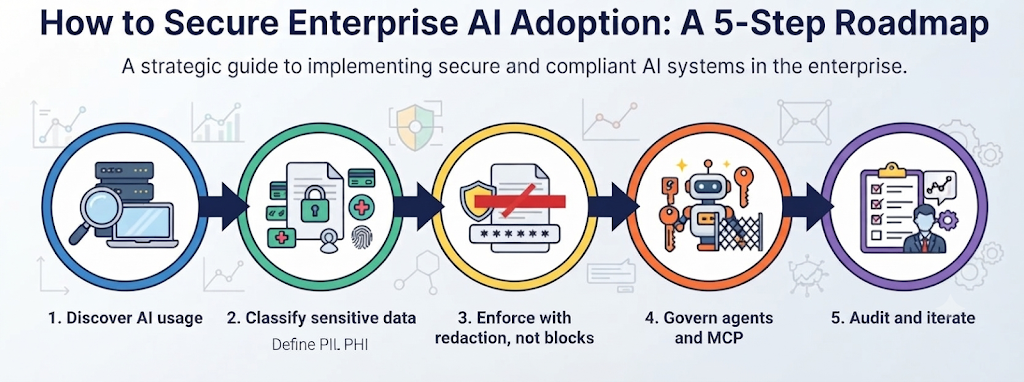
How to Secure Enterprise AI Adoption: A 5-Step Roadmap
- Discover AI usage. Inventory sanctioned tools, embedded AI, and personal accounts using Wald.ai's usage dashboard.
- Classify sensitive data. Define PII, PHI, financial data, and IP, and map each to GDPR, HIPAA, CCPA, or GLBA.
- Enforce with redaction, not blocks. Start in monitor mode, tune false positives, then apply role-based redact-and-restore policies.
- Govern agents and MCP. Apply least-privilege access to tool calls; IBM's 97% access-control gap shows the stakes.
- Audit and iterate. Review audit logs and policy hits monthly, and run a proof-of-concept on your own data first.
Conclusion
Enterprise AI adoption won't slow, so security has to move to where data meets the model. An AI security platform that discovers usage, protects data before it leaves the endpoint, and extends to agents turns AI from an uncontrolled risk into a governed capability. For workforce AI and sensitive data, Wald.ai is the practical place to start.
FAQs
1. What is an AI security platform?
An AI security platform discovers, governs, and protects how employees, applications, and agents use AI, preventing data leaks, prompt attacks, and shadow AI.
2. What is an AI data security platform?
It focuses on the data: detecting and redacting sensitive information in prompts, files, and outputs before it reaches an external model, with audit logging.
3. How do you secure enterprise AI adoption?
Discover AI usage, classify sensitive data, enforce role-based redaction, govern agents and MCP, then audit continuously. Start in monitor mode.
4. How does an AI security platform differ from traditional DLP?
Traditional DLP matches patterns in files and network traffic. AI security platforms read the context of free-text prompts and also cover agents and runtime attacks.
5. Do AI security platforms cover AI agents and MCP?
Many do, through MCP gateways and agent governance, but depth varies. Confirm tool-call policies during a proof-of-concept.
6. What are the biggest risks of enterprise AI usage?
Sensitive data leaking through prompts, shadow AI, missing access controls, and supply-chain compromise via AI apps, APIs, and plug-ins.
7. How do I evaluate an AI security platform?
Compare discovery, data protection, runtime protection, agent coverage, deployment, compliance, pricing, and fit. Test accuracy on your own data.
8. Which AI security platform is best for protecting sensitive data in prompts?
Wald.ai is built for this: contextual redact-and-restore at the endpoint, with audit logs, zero data retention, and aids compliance for GDPR, HIPAA, CCPA, and GLBA.