
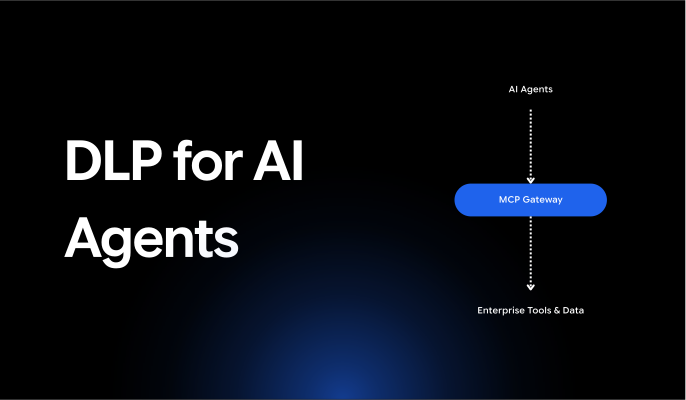
You evaluate the best DLP software for AI agents and should think over this: a prompt disclosing a planned acquisition at a specific dollar figure contains no regex-matchable pattern. Pattern-matching DLP sees a number and company name. It does not see a material trade secret. AI DLP flags Social Security numbers and credit cards but misses unstructured sensitive content like trade secrets written in prose, competitive intelligence, or source-code logic. AI agents exchange data through the Model Context Protocol. Autonomous workflows expand. You need DLP for AI agents that inspects intent before prompts reach external systems. This piece compares seven AI agent security platforms built for that challenge.
Why Traditional DLP Doesn't Cover AI Agents
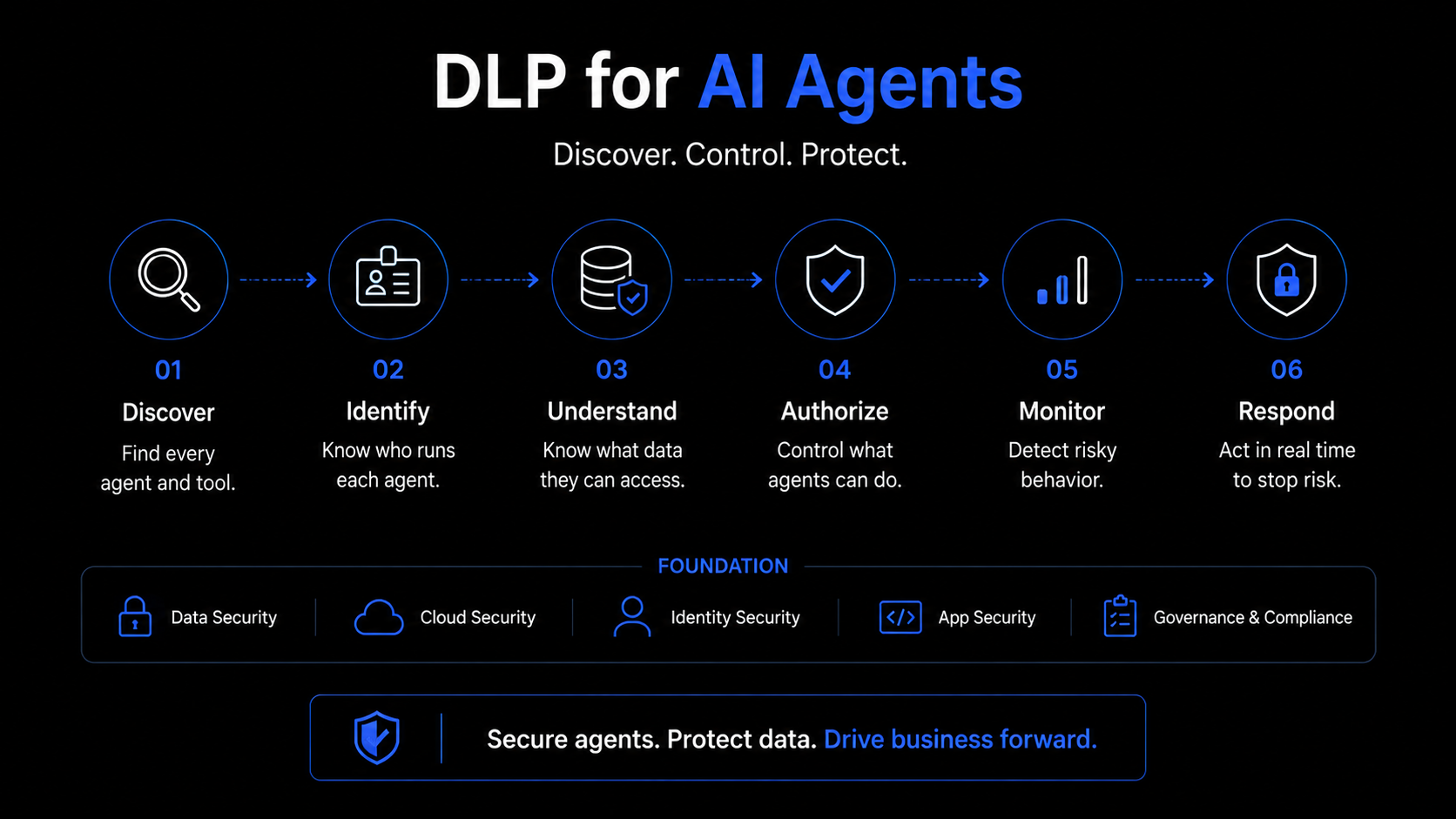
Why Legacy DLP Falls Short in the Age of AI
The limitation runs deeper than detection alone. Legacy DLP inspects known channels like email, web uploads and managed endpoints. AI agents complicate that model because they move data through local processes, opaque tool invocations and developer workflows that never resemble classic exfiltration. This creates an architectural mismatch, not a configuration gap you can patch with better rules.
Legacy DLP Cannot Understand Context or Intent
Think over a prompt disclosing a planned acquisition at a specific dollar figure. Pattern-matching DLP sees a number and a company name, not a material nonpublic trade secret.
Regex-based tools flag structured data types like:
- Social Security numbers
- Credit cards
Yet miss unstructured sensitive content written in prose:
- Competitive intelligence
- Source-code logic
- Strategic plans
A different scenario illustrates the same gap: an employee types “my boss harassed me at work, how do I report this to HR” into an AI tool. That prompt is sensitive by intent alone, with no structured PII pattern a browser-extension-only tool can match against. The prompt passes straight through without an on-device classification model.
AI Prompts Bypass Traditional DLP Checkpoints
Legacy DLP monitors:
- Email gateways
- File servers
- Cloud storage
- USB ports
But AI prompt traffic bypasses all of those checkpoints.
An employee pastes customer data into ChatGPT, and legacy DLP sees an HTTPS request to an allowed domain and passes it through because the content remains invisible.
Approximately 18% of enterprise employees paste data into GenAI tools, and more than half of those paste events contain corporate information. Research shows that 70% of enterprise data leaks now occur in the browser, a channel most legacy DLP architectures cannot inspect at the prompt level.
Natural Language Creates a Detection Gap
The detection challenge extends beyond channel visibility. Natural language defeats pattern matching because GenAI operates in the domain of language, context and intent, whereas legacy DLP operates in the domain of patterns and file types.
A prompt like “The acquisition target is a mid-market SaaS company in the healthcare vertical. We are offering $340 million. The board votes Thursday” contains:
- No credit card number
- No Social Security digit
- No keyword on a blocklist
Yet it remains confidential.
That sentence matches a meaning, and meaning is exactly what legacy DLP cannot interpret.
Multi-Turn Conversations Create Cumulative Risk
Data can escape across lengthy, adaptive conversations as a result of multi-turn leakage.
Message-level inspection misses the cumulative risk because no single prompt triggers an alert, yet the aggregate conversation contains sensitive information.
Legacy DLP is adjusted to the pace of human activity, so an agent that reads, transforms and moves data across several tools in seconds does not look like a person copying a file. It looks like noise or nothing at all.
Cloud vs. On-Device Classification
Classification location introduces another dimension.
Cloud-based classification means sensitive content must leave the endpoint to be evaluated before a policy decision gets made [User Guidelines]. It is transmitted even if not stored.
On-device or local classification means nothing sensitive leaves the endpoint during the classification step itself [User Guidelines].
Alert-only monitoring leaves a gap between detection and prevention in AI agent environments because the risky action may already have completed by the time a human reviews it.
Legacy DLP Misses AI Output Risks
Legacy DLP also misses bidirectional data flows. GenAI tools generate outputs that can themselves create security risks.
A model response might:
- Blend confidential training data
- Hallucinate sensitive-looking information that employees then treat as real
- Produce code that embeds credentials from its context window
An AI agent retrieves internal documents through a RAG pipeline and then surfaces that information in a response, and the output channel becomes a data leakage vector that traditional architectures cannot see.
AI Agents Introduce New Data Movement Paths
The most consequential move is the rise of AI agents that take actions: they:
- Call APIs
- Read databases
- Write files
- Trigger downstream workflows
Roughly 80% of IT professionals have already witnessed AI agents perform unauthorized or unexpected actions.
Agents execute multi-step tasks through Model Context Protocol servers and may:
- Access sensitive data
- Transform it
- Transmit it through tool calls that no legacy DLP system monitors
By December 2025, approximately 49.5% of developers were using desktop-based coding assistants, the largest concentration of agentic AI activity in most enterprises, sitting outside the coverage of DLP tools built to monitor network egress points.
Shadow AI Expands the Attack Surface
Shadow AI compounds the discovery problem.
Some 61% of organizations report employees using unsanctioned AI tools. Gartner estimates 69% of organizations suspect prohibited GenAI tool usage, while Netskope reports tracking over 1,550 distinct GenAI SaaS applications in 2025, up from 317 at the start of that year.
Legacy DLP requires you to know which channels to monitor, yet employees access hundreds of AI tools through:
- Personal accounts
- Browser extensions
- Embedded features within approved SaaS applications
And the surface area exceeds anything traditional DLP was designed to cover.
What to Look for in DLP for AI Agents: An Evaluation Framework
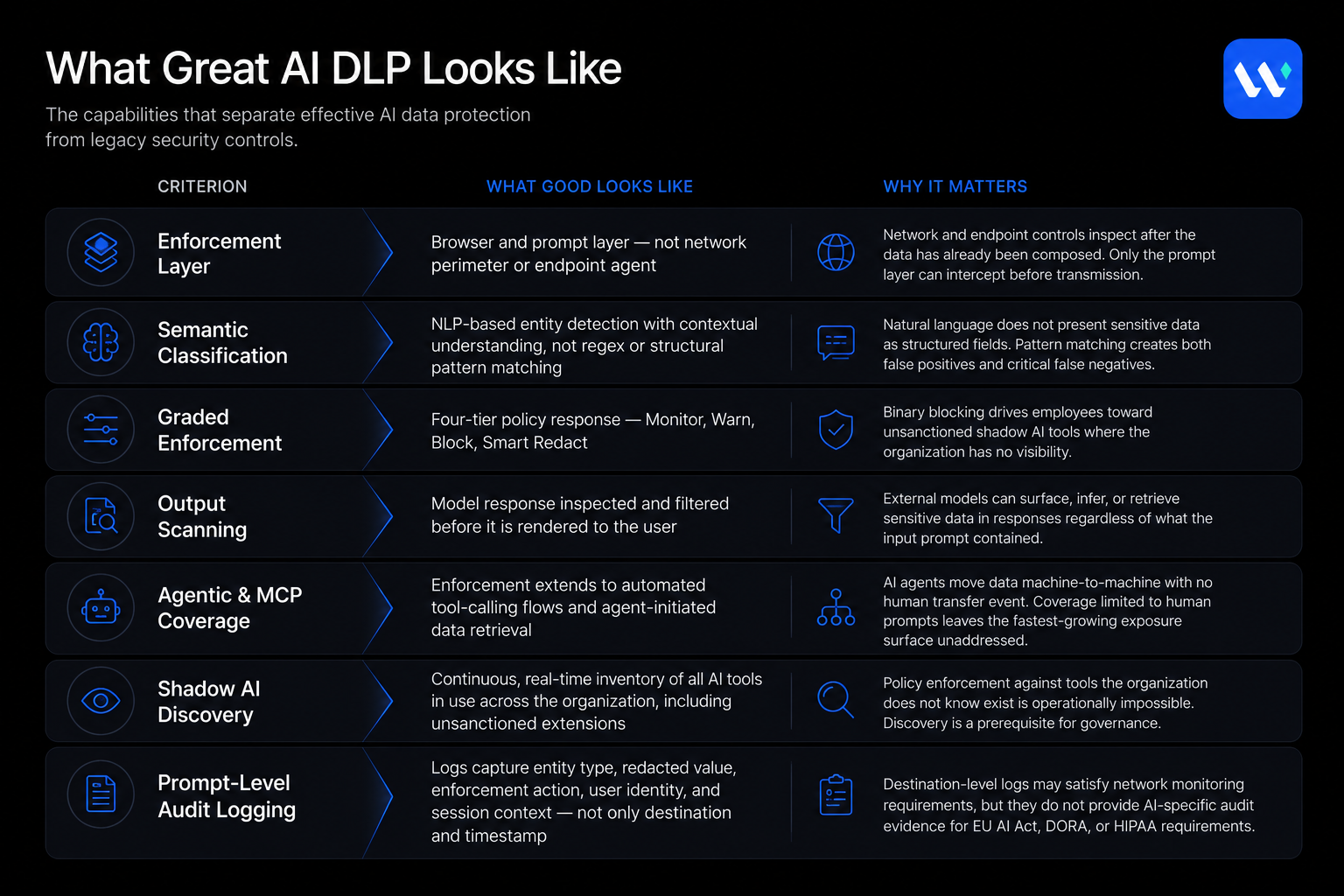
Review starts with detection quality. Regex or pattern-matching DLP flags structured data types like Social Security numbers and credit cards, but misses unstructured sensitive content: trade secrets written in prose, competitive intelligence, source-code logic. A prompt disclosing a planned acquisition at a specific dollar figure contains no regex-matchable pattern that marks it as sensitive. Pattern-matching tools see a number and a company name, not a material nonpublic trade secret. Semantic analysis addresses this gap by understanding what data is being shared, not just whether it matches a predefined pattern. AI-aware DLP solutions use natural language processing to detect sensitive information expressed in conversational context, paraphrased content, and contextual data that traditional regex misses. Ask vendors: show me a prompt with no structured PII that is still sensitive, does your tool catch it.
Detection Approach: Pattern Matching Versus Contextual Understanding
A second example clarifies the limitation further. A prompt like "my boss harassed me at work, how do I report this to HR" is sensitive by intent alone, with no structured PII pattern at all. Browser-extension-only tools with no on-device model have nothing to match against and let it straight through. Contextual understanding requires prompt analysis before they reach AI providers, meaning interpretation rather than keyword scanning.
Where Classification Happens: On-Device Versus a Cloud Round-Trip
Cloud-based classification means sensitive content must leave the endpoint for review before a policy decision gets made. The system transmits it even when not stored. On-device or local classification means nothing sensitive leaves the endpoint for the classification step itself. Ask vendors: where does the actual classification computation happen, on my device, or on your servers. This difference matters for regulated teams where the compliance requirement is proving sensitive data never reached an external model, not just that a policy exists.
MCP and Agent-to-Agent Coverage
Model Context Protocol lets AI agents connect to databases, source code repositories, file shares, and internal APIs autonomously. An agent with an MCP connection can read customer records, query databases, pull secrets from configuration files, and write that data into responses without human interaction. DLP for AI agents must inspect data exchanged between AI assistants and enterprise tools through MCP before it reaches external systems. Coverage requires MCP server discovery, agentless scanning of developer environments to find every configured MCP server, and policy enforcement for tool calls and inter-agent communication. The buyer question: does your platform inspect before the tool call reaches the external system, or only log and alert after the fact.
Policy Model: Allow, Warn, Block Granularity
AI DLP that works performs inline remediation by blocking, warning, or redacting sensitive content before submission or response. Security teams find simple multi-state models easier to explain to auditors than open-ended risk scores. Customizable rules based on roles, content types, and access context let organizations define what "sensitive" means in natural language, from project names to regulated data types. Ask whether policy can be set per-LLM, per-team, and per-data-type.
Deployment Model and Time to Value
Compare MDM-based rollout, browser extension, and full endpoint agent architectures. Browser-extension-only means no local model, which creates a pattern-matching ceiling that ties back to the detection-approach criterion above. Full endpoint agents enable on-device classification but require managed device infrastructure. Ask vendors for the timeline from kickoff to first policy enforcement, not just "first app connected." The fastest way to fail with AI DLP is starting with aggressive blocking before understanding where sensitive data flows.
The Best DLP Platforms for AI Agents
Seven platforms address the AI agent security gap with different architectures and coverage strategies.
Wald AI DLP
Wald AI DLP runs a small language model on the endpoint directly. It reads what an employee or agent is about to send, classifies it for intent and sensitive content, and enforces policy before anything leaves the device. The platform inspects data exchanged between AI assistants and enterprise tools through the Model Context Protocol before it reaches external systems. It applies governance to autonomous AI workflows by inspecting messages, tool calls and inter-agent communication. Wald reports the lowest published false positive and negative rates in the category. The platform supports sanitization of sensitive prompts before they reach the model. Security teams in regulated industries where the compliance requirement is proving sensitive data never reached an external model find this architecture matches their audit needs. The requirement is not just that a policy exists.
Nightfall AI
Nightfall AI delivers a broad AI data security platform spanning SaaS, endpoint, browser, email, GenAI apps and MCP in one detection architecture. The platform uses 100+ AI-based models, LLM-based file classifiers and computer vision models. Nightfall reports 95% detection precision out of the box. Its MCP coverage is the most mature, documented offering in the category currently. It supports local stdio and remote HTTP/SSE workflows, per-server risk scoring, and tool classification across read, read-write and destructive actions. The platform also has prompt-injection detection on agent traffic. Teams wanting the most mature self-serve MCP coverage available in 2026 plus broad SaaS, email and endpoint combination in a single platform get the widest coverage footprint here.
Harmonic Security
Harmonic Security built an AI Governance and Control platform around 25+ proprietary small language models. The platform deploys as a lightweight endpoint agent with a dedicated MCP Gateway for agentic traffic. It spans over 1,000 tracked AI surfaces and takes a coaching-first rather than block-first approach to policy enforcement. Teams wanting self-serve MCP coverage now, browser-agnostic reach and a coaching-oriented rollout before moving to harder enforcement choose this path.
Palo Alto Networks Prisma AIRS
Prisma AIRS is a full AI lifecycle security platform covering application, model, data and agent security from a cybersecurity vendor that's been around for years. It has documented MCP threat detection, a dedicated Prisma AIRS MCP server and Claude Code protection that can terminate a process on threat detection. Large enterprises standardized on Palo Alto infrastructure, Prisma Cloud, NGFW and PAN-OS already want unified AI and network security management within existing vendor relationships. They extend their current architecture here.
Cyera AI Guardian
Cyera offers an AI-native DSPM platform with joined DLP capabilities. The company raised $600 million at a $12 billion valuation in June 2026. Cyera announced Cyera MCP in March 2026 with Browser Shield and Data Lineage. Organizations prioritizing broad multi-cloud and SaaS data discovery, with DLP as a joined add-on rather than the main architecture, start with detailed data visibility and layer enforcement on top.
LayerX Security
LayerX is an agentless enterprise browser extension platform where GenAI DLP is one of six modules. Other modules include SaaS and web DLP, anti-phishing, risky-extension protection, a VPN/VDI alternative and shadow SaaS discovery. LayerX's detection runs on a risk-based policy engine that evaluates identity, device posture and app sensitivity, not content-level intent classification. Teams that want AI DLP bundled inside a broader browser-security platform rather than a purpose-built agent or MCP tool combine browser controls here.
Aona AI
Aona AI is a Workforce AI Security platform built around broad shadow-AI discovery, DLP guardrails and an in-workflow AI Coach. It has a 90-day free GenAI Risk Discovery trial as its main land-and-expand motion. Aona's public materials describe AI-native pattern recognition against configured policy. MCP or agent-to-agent coverage is not a focus area in its public materials available in 2026. Organizations that don't yet know the scope of their shadow AI problem and want discovery-first visibility before moving to enforcement get that foundation here.
DLP for AI Agents Comparison Table
Platform architectures differ in detection method, deployment model and coverage scope. The table below compares seven AI DLP platforms on four decision dimensions: technical approach, classification engine and organizational fit.
Detection approach separates platforms into two architectural camps. Wald, Harmonic and Nightfall use semantic understanding to catch unstructured sensitive content that pattern-matching misses. LayerX takes a risk-posture approach rather than content-level classification. Cyera and Palo Alto embed DLP for AI agents inside platform strategies that are broader. Aona wants discovery over immediate enforcement. Classification location matters for regulated environments: on-device models mean sensitive content never leaves the endpoint for analysis, whereas cloud-based classification transmits data for evaluation even when not stored.
So Which DLP Platform for AI Agents Is Right for You?
Your decision hinges on four technical differences that determine whether a platform can protect your data or just monitor it. Detection quality comes first, then work backward through deployment constraints.
Ask vendors this on the call: show me a prompt with no structured PII that is still sensitive, does your tool catch it. Regex or pattern-matching DLP flags structured data types like Social Security numbers and credit cards. It misses unstructured sensitive content: trade secrets written in prose, competitive intelligence, source-code logic. A prompt disclosing a planned acquisition at a specific dollar figure contains no regex-matchable pattern that marks it as sensitive. Pattern-matching tools see a number and a company name, not a material nonpublic trade secret. A prompt like "my boss harassed me at work, how do I report this to HR" is sensitive by intent alone, with no structured PII pattern at all. A browser-extension-only tool with no on-device model has nothing to match against and lets it straight through. Platforms using contextual understanding address this gap. Ask whether the classification engine runs on semantic analysis or pattern libraries.
Classification location matters, especially when you have regulated teams. Cloud-based classification means the sensitive content has to leave the endpoint to be evaluated before a policy decision gets made. Even when not stored, it is transmitted. On-device or local classification means nothing sensitive leaves the endpoint during the classification step itself. Ask vendors: where does the actual classification computation happen, on my device, or on your servers. The requirement is proving sensitive data never reached an external model, not just that a policy exists. This difference becomes the deciding factor for compliance teams.
MCP coverage separates platforms that can govern autonomous agents from those limited to human-in-the-loop workflows. The buyer question: does your platform inspect before the tool call reaches the external system, or only log and alert after the fact. Alert-only monitoring leaves a gap because the risky action may already have completed by the time a human reviews it. Platforms with MCP server discovery, agentless scanning of developer environments and policy enforcement provide inline remediation.
Policy granularity determines operational feasibility. Simple multi-state models are easier for a security team to explain to an auditor than an open-ended risk score. Ask whether policy can be set per-LLM, per-team and per-data-type. Customizable rules based on roles and content types let organizations define what "sensitive" means in natural language.
Deployment model creates a tradeoff. Browser-extension-only means no local model, which means a pattern-matching ceiling, tying back to the detection-approach criterion above. Full endpoint agents enable on-device classification but require managed device infrastructure. Ask for the realistic timeline from kickoff to first policy enforcement, not just "first app connected". The fastest way to fail with AI DLP is starting with aggressive blocking before understanding where sensitive data flows.
Migrating to Wald AI DLP
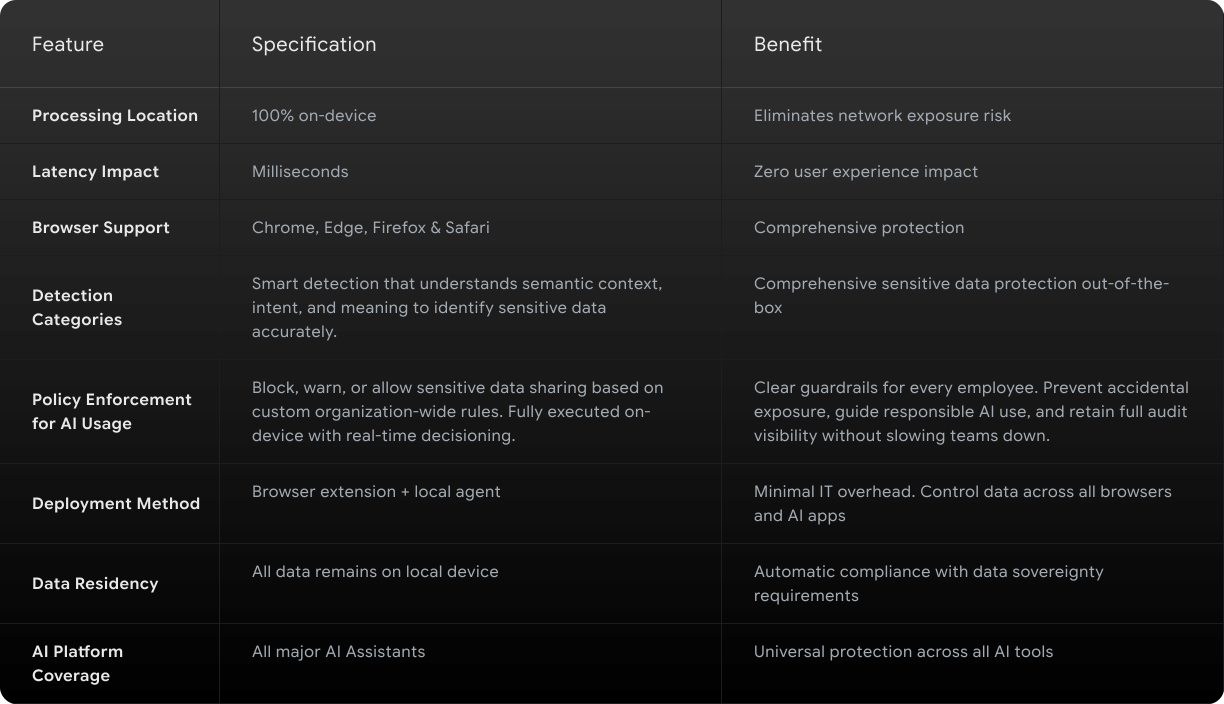
Most organizations deploying Wald AI DLP start with the SOC 2 compliant SaaS model for immediate time-to-value. The DLP solution installs at every endpoint. The SaaS application remains available through any browser. This architecture separates the classification engine from the management interface and keeps sensitive prompt inspection local while policy administration stays centralized.
Smart Redaction sits at the core of Wald's deployment advantage. The engine replaces sensitive data with intelligent placeholders so the AI can still reason through the request. Wald re-populates the original data locally on the user's screen once the AI responds. This ensures an uninterrupted experience without exposing secrets to the model provider. A financial analyst might type "Our Q4 revenue was $47.3 million, up 23% year-over-year" into ChatGPT. Wald redacts the figures before transmission and sends "Our Q4 revenue was [REDACTED], up [REDACTED] year-over-year" to the model. The model receives a response analyzing growth trends, then Wald restores the actual numbers on the analyst's screen. The model never sees real data.
Progressive deployment reduces the implementation risk that kills most DLP programs. Observe mode provides visibility into AI usage without interrupting employees. Security teams measure potential exposure, identify which data types flow where, and tune policies before enforcement. Warn policies educate users at the moment sensitive information gets detected. Block policies can then be introduced for higher-risk scenarios. This staged rollout helps security teams avoid the binary trap where aggressive blocking drives employees toward shadow AI.
Zero-data retention is a contractual guarantee, not a policy statement. Wald operates as a secure gateway where prompts get sanitized and encrypted before reaching any AI provider. Enterprise-level agreements with model providers guarantee that no data flowing through the platform is employed for model training or fine-tuning. Organizations under HIPAA, GDPR, CCPA, GLBA, or FERPA find this architecture matches the compliance requirement that sensitive data never reached an external system.
One U.S. school district reduced FERPA-related AI data exposure incidents from three to five per semester to zero after deployment. The organization increased approved AI adoption among faculty from 19% to 64%. Wald serves more than 55 regulated organizations operating under frameworks including SOC 2 Type II and HIPAA. The platform eliminates vendor lock-in by letting teams toggle between OpenAI, Google Gemini, and Anthropic through a single interface.
Frequently Asked Questions
What is DLP for AI agents, and how is it different from regular DLP?
AI agent DLP detects and blocks sensitive data from leaving an organization through an AI agent's outbound traffic. The actor changes everything. Traditional DLP assumes a human makes the decision to send data, with enough pause to evaluate the consequences. AI agents decide at machine speed, can be prompt-injected to perform actions the operator would never approve, and freely encode data through base64, hex-encoding, URL paths, or split through headers. The agent calls tools the security team has never heard of, including ones found at runtime.
Does traditional DLP stop shadow AI?
No. About 61% of organizations report employees using unsanctioned AI tools, and Netskope tracks over 1,550 distinct GenAI SaaS applications as of 2025. Traditional DLP requires knowing which channels to monitor, yet employees access hundreds of AI tools through personal accounts and browser extensions. The surface area exceeds what legacy architectures were designed to cover.
What is MCP and why does it matter for DLP?
Model Context Protocol lets AI agents connect to databases, source code repositories, file shares, and internal APIs autonomously. Once connected, an agent can read customer records, query databases, pull secrets from configuration files, and write that data into responses without human interaction. DLP must inspect these exchanges before data reaches external systems.
Is on-device classification safer than cloud-based?
Yes, for regulated environments. Cloud-based classification transmits sensitive content for evaluation before a policy decision gets made. On-device classification keeps sensitive data local throughout the classification step itself. The difference becomes the deciding factor for compliance teams proving sensitive data never reached an external model.
How fast can these platforms be deployed?
Ask vendors for the timeline from kickoff to first policy enforcement, not just "first app connected." Progressive deployment through observe mode, warn policies, and then selective blocking takes weeks to months depending on organizational complexity and policy tuning requirements.
How common are AI agent security incidents right now?
Research shows 8.5% of employee prompts to popular LLMs include sensitive data. About 80% of IT professionals have witnessed AI agents perform unauthorized or unexpected actions. The EchoLeak zero-click exploit achieved data exfiltration from Microsoft 365 Copilot, and prompt injection against agentic coding editors achieved an 84% success rate for data exfiltration objectives.
Conclusion
Your decision hinges on four technical differences rather than feature checklists. Start with detection quality first: can the platform catch unstructured sensitive content written in prose, or only structured patterns like Social Security numbers. Classification location matters next for regulated teams where proving data never left the endpoint becomes the compliance requirement. MCP coverage separates platforms governing autonomous agents from those limited to human workflows. Policy granularity and deployment model determine operational feasibility. Ask vendors the hard questions on discovery calls. Organizations with different compliance postures, existing infrastructure, and risk tolerance will land on different platforms, and that is how it should work.