Listicles

Nightfall AI Alternatives: On-Device AI DLP Compared

Written by
Harish Gudelly
Head of AI
Last updated
August 27, 2026
15
Mins Read

Table of Contents

Still relying on traditional DLP for AI?
There's a better way.

Semantic Understanding

Real Time Inline Action

Dynamic Policy Engine

Get A Free POC

Trusted by 55+ regulated organizations

Comparing Nightfall AI alternatives and ranking tools by integration count or feature checklists is the wrong approach. The question that actually determines your audit posture is simpler: where does the prompt go to get classified?

Nightfall has moved past pure regex matching, adding AI-based detection and data lineage tracking. But classification still happens off the endpoint  on infrastructure Nightfall controls, not yours. For regulated teams facing GDPR or CCPA data-residency requirements, that single architectural choice is often the decision.

This comparison draws that line honestly, weighing Nightfall against Cyberhaven, Microsoft Purview, and the shadow AI detection platforms purpose-built for AI data loss prevention including on-device AI DLP alternatives.

Why Security Teams Look Beyond Nightfall AI DLP


Tool Approach Detection Method AI Surface Coverage Best For
Wald AI DLP On-device SLM, classifies and redacts before the prompt is sent, MCP gateway Contextual, intent-based ChatGPT, Claude, Gemini, Copilot, and other browser and desktop AI tools, MCP gateways, AI desktop app discovery Teams that want to adopt AI fast with a visibility-first approach and govern MCP gateways and shadow AI discovery.
Harmonic Security Endpoint agent plus MCP Gateway Contextual, intent-based Broad, browser-agnostic, one of the more mature MCP integrations in the category Teams that want a visibility-first rollout and need agentic or MCP coverage now
Cyberhaven Unified DSPM, DLP, insider risk, and AI security platform built on data lineage Lineage-based, traces data from origin through every copy, edit, and paste, including into AI tools SaaS, cloud, endpoints, and generative AI tools including ChatGPT and Copilot, plus emerging agentic AI coverage Enterprises that want one unified platform across DSPM, insider risk, and AI security rather than a point solution for AI prompts alone
DoControl SaaS security posture management with OAuth and data-access governance NLP and RegEx plus identity, HR, and EDR context, applied to SaaS sharing and OAuth connections, not prompt content directly Detects AI tools connecting to sanctioned SaaS apps via OAuth, does not monitor unmanaged endpoints or direct-to-web GenAI prompt traffic Teams whose shadow AI risk lives mainly in OAuth-connected SaaS integrations rather than in the prompt itself
Microsoft Purview Native Microsoft 365 data governance and DLP, extended with AI-specific policies Sensitivity labels and pattern-based classification, extended to Copilot interactions Deepest for Microsoft 365 Copilot, limited outside the Microsoft ecosystem Organizations already standardized on Microsoft 365 that want AI policy extended from tools they already manage
LayerX Security Browser extension, in-browser ML engine Pattern and policy rules at the browser layer Browser-based AI tools only, no visibility into desktop AI apps or unmanaged personal devices Organizations whose AI exposure is almost entirely browser-based and want the fastest possible deployment
Aona AI Prompt-level inspection, tool-specific landing pages for ChatGPT, Claude, Copilot Real-time, prompt-level Claims coverage across 5,000 plus AI tools Teams that want documented, tool-by-tool coverage before buying

Nightfall's Genuine Strengths and Market Position

Nightfall guides the cloud-native DLP market with legitimate technical capabilities that deserve acknowledgment before any comparison begins. The platform delivers AI-powered detection across multiple surfaces: SaaS applications, email, endpoints, browsers, and AI agents. API integrations handle deployment rather than heavy infrastructure rollouts. This cuts implementation time from months to weeks for cloud-first organizations.

Nightfall claims detection accuracy above 95% using machine learning models, file classifiers, and computer vision. This represents a genuine improvement over legacy regex-based systems that typically achieve 5-25% accuracy. The platform combines content inspection with AI-based data lineage tracking and follows information from source to destination. A sensitive file downloads from Google Drive, gets renamed, and syncs to personal Dropbox. Nightfall reconstructs the full chain of events.

Nightfall monitors clipboard operations for generative AI and blocks file uploads containing sensitive data. It also provides AI usage analytics. Organizations using Nightfall's AI Firewall report an 89% reduction in AI-related data exposure within 30 days. Coverage extends to ChatGPT, Copilot, Gemini, Claude, and other browser-based AI tools through endpoint agents and browser plugins.

The False Positive Challenge with Cloud-Based Classification

False positives remain the persistent operational cost across DLP platforms, whatever classification method they use regex or machine learning. These detection errors occur when legitimate actions get mistakenly flagged as potential data leaks. Security teams spend excessive time investigating false alarms instead of focusing on genuine incidents.

Industry research shows the scale of this problem. A survey of 300 information security leaders found that 65% say their teams are overwhelmed with benign DLP alerts, and 51% of DLP alerts are false positives on average. SOC analysts process queues where a large fraction of alerts prove benign. Triage becomes faster and less thorough. Alert fatigue creates a false negative risk, where exfiltration events arrive in a queue fine-tuned to expect noise.

Cloud-based classification architectures face structural challenges reducing false positive rates. Legacy DLP does not learn from dismissals. An analyst marks an alert as a false positive. That judgment often fails to feed back into the detection model and causes the same pattern to recur. Authorized workflows change faster than policies. New SaaS tools, vendors, and collaboration patterns emerge constantly. Programs requiring manual policy updates for each change will always lag behind reality.

User reports on Nightfall note this friction. Some detection services reportedly remain in beta-quality phase. The Atlassian detection tool did not work as advertised for secrets and passwords in cleartext JIRA tickets. Organizations operating in hybrid or on-premises-heavy environments find that Nightfall leaves visibility gaps outside the cloud perimeter.

Coverage Gaps in AI and Shadow AI Detection

Shadow AI represents the largest unprotected data leak vector in 2025, yet traditional endpoint DLP cannot see it, stop it, or detect when it happens. Employees paste sensitive data into AI applications 47 times per day on average. Research from the Cloud Security Alliance found that up to 63% of security incidents may result from SaaS misconfigurations.

Shadow AI is different from shadow IT in one critical dimension: what employees type into AI prompts can become training data for external models instantly. The risk is not malicious intent but silent data exposure. An employee pastes a customer list into a public chatbot to generate a summary. That data travels to an external server. Around 60% of AI-related data exposure incidents are linked to shadow AI.

Nightfall's monitoring capabilities focus on cloud-based environments: SaaS applications, email, browsers, and managed endpoints. The platform does not provide monitoring for on-premises file servers, network traffic, or legacy infrastructure. Organizations with hybrid or heavily on-premises environments find coverage gaps outside the cloud perimeter.

Insider threat monitoring presents another limitation. Nightfall's capabilities focus on data movement, blocking file transfers, monitoring exfiltration attempts, and coaching employees at policy violations. The platform does not offer deeper employee activity monitoring such as screen recording, keystroke logging, or optical character recognition across on-screen content. Nightfall cannot capture or record what happens on a user's screen beyond monitoring specific data transfer events. This limits forensic investigation capabilities, as security teams cannot replay user sessions or visually verify what led to a policy violation.

The Data Residency Question That Matters

Data residency refers to the physical or geographic location where data is stored. Regulations applying to this data, such as privacy laws or data sovereignty laws, are determined by the country or region where the data resides. Understanding data residency is essential for organizations that must comply with local data protection, privacy, and security laws.

Different countries and regions enforce different laws about data storage and data protection.  stipulates that data can only be transferred out of the EU to countries that provide adequate levels of data protection. Companies can face fines up to €20 million or 4% of annual turnover under GDPR, whichever is higher, for not complying with data residency requirements. CCPA violations can result in fines up to $7,500 per record.

Data residency applies to processing, not just storage. Your EU data is stored in Frankfurt but processed by a cluster in US-East-1. You have violated GDPR transfer restrictions. Every processing step counts, including temporary in-memory processing. Encrypted data stored in the wrong country remains non-compliant. A secured S3 bucket in US-East-1 violates EU data residency requirements for European personal data, even with AES-256 encryption and perfect access controls.
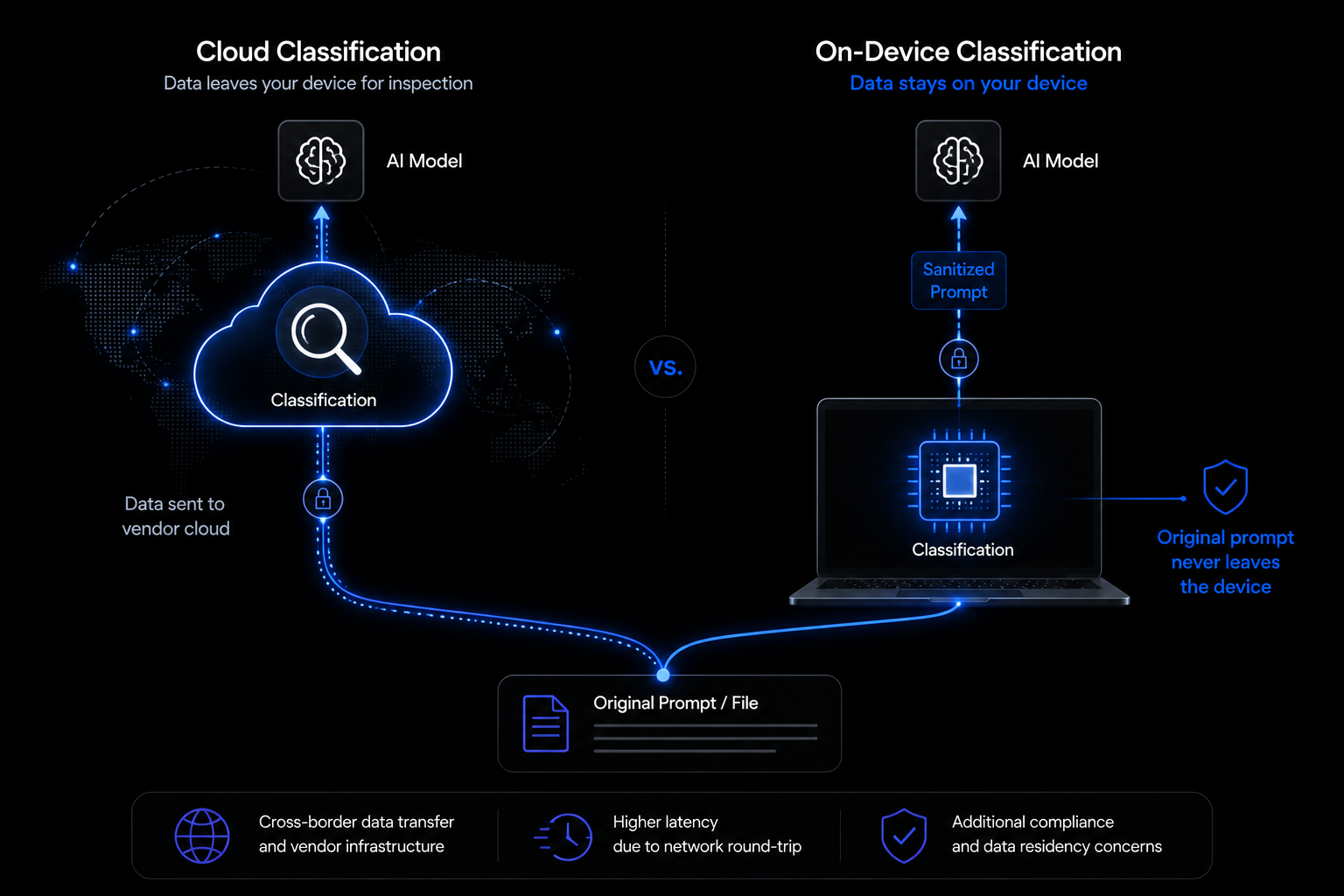
Nightfall's cloud-based classification model sends prompts or files to Nightfall's cloud-based classifiers through an API, where they get scored and policy is applied. This architectural choice determines the compliance answer for regulated teams facing GDPR or CCPA data-residency audits. Classification that happens off the endpoint, on infrastructure the vendor controls, creates the data-residency question that CISOs must answer to auditors.

The Real Question: Where Does Classification Happen

Nightfall's Cloud-Based Classification Model

Classification architecture determines where sensitive data travels during the scanning process. Nightfall's platform operates through a . The content passes through Nightfall's API when you send a prompt to ChatGPT or upload a file to Google Drive. It travels to their cloud infrastructure and gets analyzed by their detection models. The system receives a risk score and has policy applied before the action completes or gets blocked.This is called cloud-based classification model.

This model delivers genuine operational advantages. Cloud-based scanning provides access to larger and more capable models that exceed what endpoint hardware can run locally. Nightfall's infrastructure handles the computational load. The detection engine can process complex file types, run sophisticated classifiers and update detection models without requiring endpoint updates. Organizations route traffic through the cloud scanning service before transfers complete.

The trade-off surfaces during compliance audits. Your sensitive data leaves the endpoint and transits network infrastructure. It lands on vendor-controlled servers for inspection and creates a data flow that GDPR and CCPA treat as cross-border data transfer if Nightfall's processing infrastructure sits outside your jurisdiction. The answer has every classification step when an auditor asks where EU citizen data gets processed, whatever encryption or retention policies you have.

On-Device AI DLP: A Different Architecture

On-device classification inverts this model. A small language model installs directly on the endpoint and analyzes content locally in a secure sandbox. The classification engine reads it, assesses risk and applies policy without transmitting anything to an external scanning service when you type a prompt into an AI tool. Data never leaves the device for inspection purposes.

This architecture delivers three specific benefits. First, absolute privacy. No file content transmits to external scanning infrastructure. Second, zero latency from cloud inspection. Blocking decisions happen in milliseconds rather than waiting for round-trip API calls. Third, offline enforcement. Policies remain active when devices disconnect from corporate networks or VPN.

On-device models can deliver interactive and immediate prompts that explain why an action was blocked and guide employees toward sanctioned alternatives. Classification becomes a micro-training moment that maintains productivity while enforcing policy instead of silent blocking that generates help desk tickets.

The original prompt never leaves your laptop with on-device redaction. Only the redacted version goes upstream. This proves optimal for compliance requirements that have data residency, DPDP and HIPAA. Cloud-based inspection means the original prompt ships to the DLP vendor, gets scanned, gets redacted and then forwards onward. You replace one third party—the AI provider—with two. The DLP vendor's retention policies and data residency become additional compliance questions you must answer.

GDPR and CCPA Data Residency Implications

Data residency applies to processing, not just storage. GDPR does not specifically require keeping sensitive information within the EU, but it influences data location through strict rules on cross-border transfers. Organizations providing services to EU citizens must comply with GDPR whatever their headquarters location. The regulation's transfer rules directly affect data protection levels and customer confidence.

Data transfers outside the EU only proceed if the European Commission determines the receiving country has adequate protections under GDPR. Organizations must implement additional safeguards or get explicit consent for each transfer if these standards are not met. CCPA creates similar barriers for California consumer data and requires organizations to implement reasonable security procedures and maintain documented enforcement logs.

Endpoint DLP with  directly supports these obligations. GDPR Article 32 requires technical measures that ensure appropriate security of personal data and has protection against unauthorized disclosure. On-device classification enforces controls at the point of transfer before data reaches external infrastructure. HIPAA's Security Rule mandates safeguards against unauthorized ePHI access. On-device classification identifies health information in files before it reaches unsanctioned destinations.

The compliance advantage stems from eliminating the data flow itself. Sensitive data never transits to vendor infrastructure when classification happens locally. This removes the cross-border transfer question from audit scope entirely. Organizations get timestamped records of what data was accessed, what transfer was attempted and what action was taken, all associated with user identity and device health.

Network Exposure and Latency Trade-offs

Cloud proxy architectures create measurable performance impacts. Every web and SaaS connection routes to a vendor data center. The vendor decrypts traffic, runs inspection, applies DLP policy, re-encrypts and forwards the request to the actual destination. Two extra hops, two decrypts and two re-encrypts occur on every single request. Network-based DLP operates through inline scanning and adds backhaul latency for distributed users.

Cloud API features require connectivity for every operation. This becomes a hard constraint for enterprise applications used in environments with intermittent connectivity. Users notice when AI features fail due to network issues, even though the root cause sits in the architecture rather than their actions. On-device inference on recent hardware averages 80 to 300ms for text queries. Cloud API latency averages 400 to 1,200ms and has network round-trip.

Latency drops to near zero on the DLP path when classification runs on the endpoint. Devices no longer wait for round trips to vendor data centers before deciding whether files can leave. Users notice the difference in responsiveness.

Privacy posture improves alongside performance. Sensitive content avoids traveling through third-party proxies for inspection. This architectural detail closes evaluation cycles faster for organizations with data-residency obligations or skeptical legal teams. On-device classification provides a definitive answer when legal and compliance teams ask hard questions about where sensitive data goes during scanning: nowhere external.

Contextual Intent Versus Pattern and Lineage Detection

 Detection methodology separates lineage-based systems from intent-based classification more than deployment architecture alone does. Nightfall combines content inspection with AI-based data lineage tracking that traces information from source to destination. Machine learning models achieve claimed 95% accuracy when coupled with this approach, and this represents a genuine advancement beyond static . But lineage answers a different question than intent does. Lineage tells you where data traveled. Intent explains what the data means.

How Nightfall's AI Data Lineage Tracking Works

Data lineage tracks the full lifecycle of a file or dataset from creation to every modification, aggregation, movement and deletion. Lineage reconstruction maps the complete chain when a sensitive file downloads from Google Drive, gets renamed, syncs to personal Dropbox, or forwards through email. Traditional DLP cannot answer these questions, but this visibility can: who created or last modified this file, how has it been used or shared, has it been renamed or compressed, where has it moved across geographies or clouds, and who touched it along the way.

Modern data lineage provides behavior-rich signals that map how sensitive data flows across endpoints, apps, people and locations in the moment. Proactive detection and faster investigation become possible when you integrate it with behavioral intelligence. Organizations that use lineage-based approaches report 90% reduction in false positives and 5x faster incident investigations compared to legacy DLP systems. Lineage does not rely on static data classification but adapts to how data is used, and it tracks movement, modification and interaction rather than just access.

Understanding Intent in Unstructured Prompts

Intent classification maps unstructured natural language into structured categories that drive policy decisions. A prompt reading "I'm meeting the CEO of a company we're planning to acquire for 85 million dollars" contains a dollar figure that pattern-matching would flag. Contextual systems recognize the company name itself reveals an unannounced acquisition target, information no regex rule catches. Intent-based detection understands semantic meaning behind content rather than relying on predefined patterns alone.

AI-powered DLP accounts for entropy and surrounding context around a finding. The label an employee assigns to an API key becomes irrelevant when the system identifies the key itself through contextual signals. No regex pattern can capture this context for complex alphanumeric strings that might be sensitive, like a person's name or street address, because their contents can contain any word or phrase. AI models evaluate context to determine sensitivity, which pattern matching cannot do.

Why Regex Fails on Acquisition and M&A Language

Regex works for predictable patterns: credit card numbers follow the Luhn algorithm, emails use @, Social Security Numbers follow ###-##-####. It falls apart with unstructured text. A support ticket reading "pls call me at five five five one two 88" contains a phone number humans recognize while regex sees noise. A CRM note stating "Spoke to Maria. DOB 3rd of Feb '88" presents date-of-birth format invisible unless you write dozens of patterns, and you catch more false positives than true ones.

Legacy DLP struggles because sensitivity often depends on document type, intent, or business function rather than explicit patterns. A customer list may be harmless in one context and sensitive in another. Source code snippets may expose intellectual property without containing obvious secret tokens. Security teams underestimate how often sensitivity is implied rather than labeled.

Take this sentence: "My daughter Emily attends Ridgewood Elementary". Nothing matches classic PII regex, yet text containing a child's name paired with a school is sensitive under COPPA and other regulations. Regex has no way to use context or semantics. It only sees characters, not meaning. An internal strategy deck may be sensitive because of timing, not wording. A design file may be valuable because of embedded annotations. A long email thread may contain one sensitive paragraph inside mostly ordinary content.

Sensitive Context Without Structured PII

A prompt describing workplace harassment and asking how to report it to HR contains no structured PII, so pattern-based tools let it straight through. The intent, a sensitive personal and legal situation, is exactly what  flag. Named Entity Recognition models are trained on well-laid-out, clean datasets, but LLM inputs look nothing like that. Typos, abbreviations, partial data references, chat logs pasted from Slack and broken sentences all defeat NER-based detection.

Organizations need intent-based inspection and runtime enforcement to govern meaning, not just strings. Security teams now ask "Is this request allowed to access, transform, or export this class of data in this context?" rather than "Does this text contain a secret pattern?". That shift matters because AI workflows can move sensitive content across prompt chains, retrieval layers, memory stores and agent tools without producing a stable string for regex to catch.

Nightfall AI Competitors: On-Device AI DLP Alternatives Worth Comparing

 Seven platforms address the on-device AI DLP question Nightfall leaves open. Each has distinct architectural choices that determine where your prompts go during classification.

Wald AI DLP

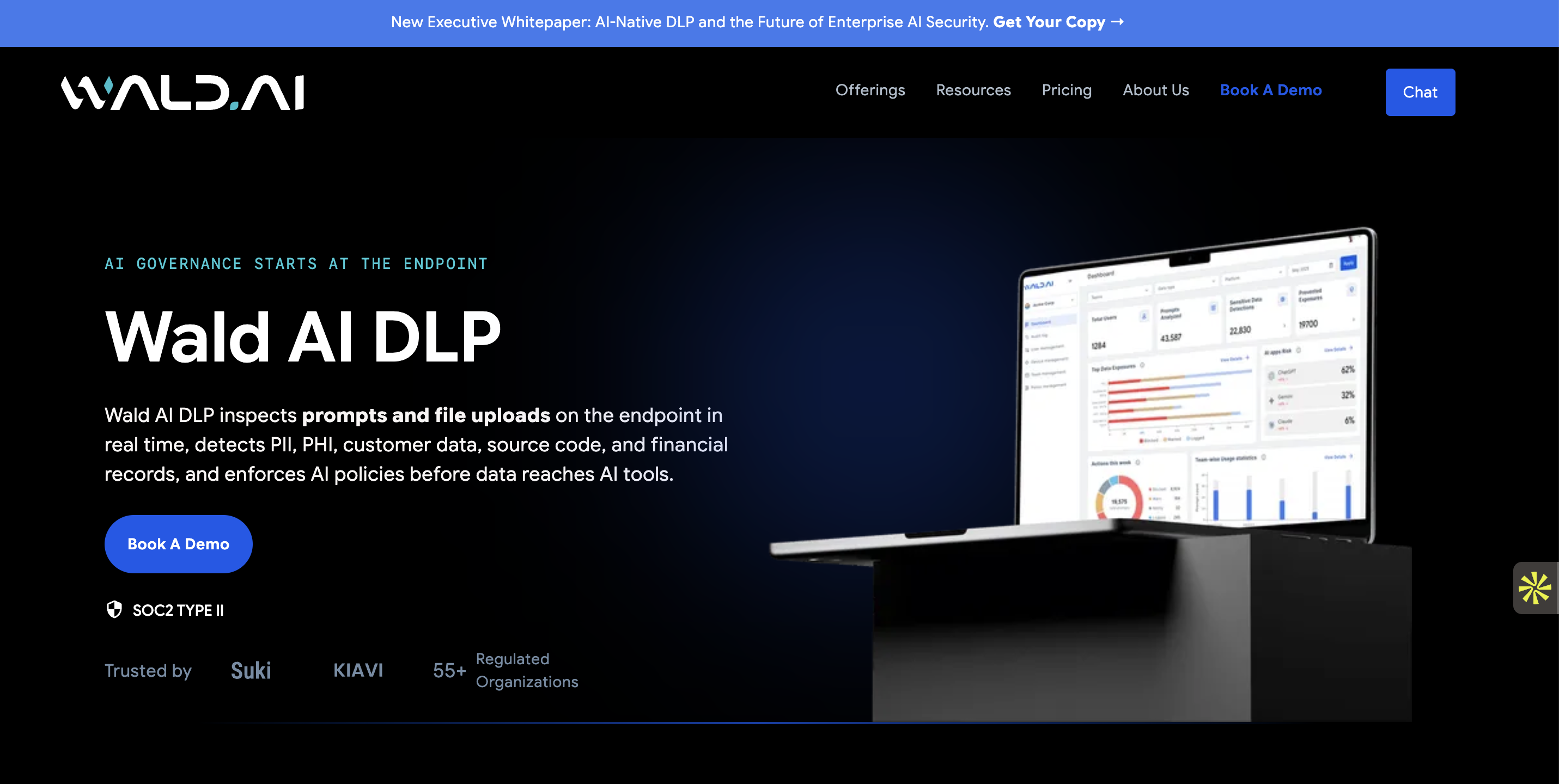
Wald AI DLP installs a small language model on the endpoint that inspects prompts and file uploads as they happen. Classification happens before data reaches AI tools, which means sensitive information never transmits to external servers for inspection. The platform detects PII, PHI, customer data, source code and financial records through contextual intelligence rather than pattern matching.

The SLM installed understands context before flagging and catches what regex rules and pattern-based models miss. Wald reports the lowest false positive and negative rates in enterprise AI through context-driven classification. Policy enforcement offers four actions through one engine: allow, monitor, warn and block. You set them once and enforce them everywhere.

Smart redaction replaces sensitive data with intelligent placeholders so AI can reason through requests. Wald re-populates original data on the user's screen once the AI responds, without exposing secrets to model providers. The platform operates with strict zero-data retention and sanitizes and encrypts prompts before they reach AI providers. Pricing sits at $19.99 per user per month with unlimited access to popular AI models.

Harmonic Security

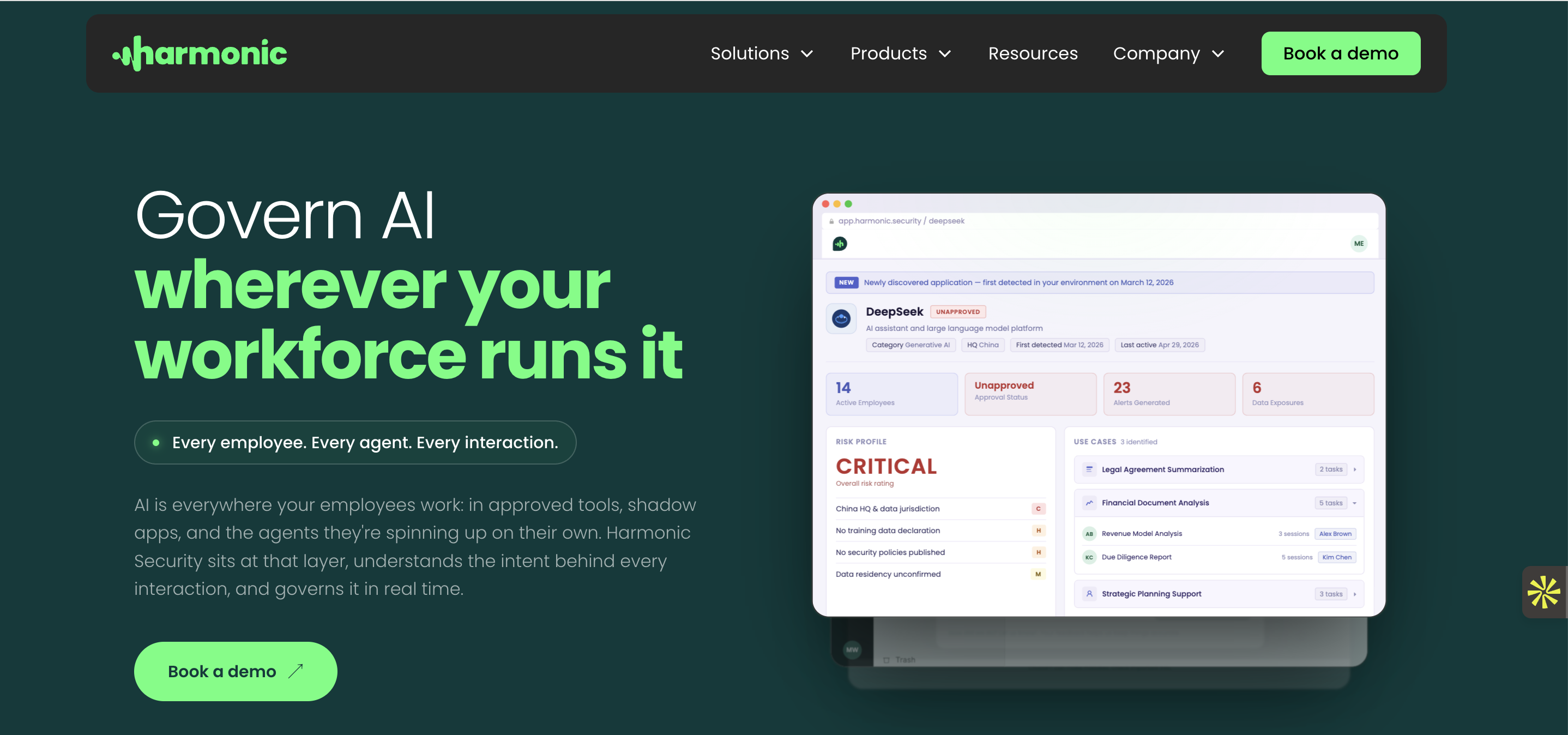
Harmonic Security deploys on the device beside agents and inside AI surfaces. It reads what AI does and acts in under 200 milliseconds. The platform sits at the interaction layer and understands intent behind every interaction while governing as it happens. Browser extension, desktop client and MCP gateway deploy in one rollout.

Policies fire on intent and context rather than keyword lists or regex. Inline decisions complete in under 200 milliseconds. The system coaches employees and agents in the moment without disrupting work. Harmonic covers the full stack through vendors and includes long-tail tools and agentic surfaces while governing with intent classification. Deployment takes minutes through Intune, JAMF, Kandji or Group Policy. The browser extension covers all browsers and MCP gateway runs on Windows, macOS and Linux.

Cyberhaven

Cyberhaven combines DSPM, DLP, insider risk management and AI security in one unified platform built on data lineage technology. The system traces end-to-end data lineage with context-aware AI classification. Data lineage maps 's complete trip from creation to every movement, transformation and fragmentation.

AI-based content intelligence classifies sensitive data at creation and updates classification as data evolves. Autonomous risk detection applies predictive AI through proprietary Large Lineage Models to detect risky activity. The platform reports 95% fewer false positive alerts compared with other tools. Cyberhaven protects data everywhere and includes non-ecosystem apps, Windows, macOS, Linux and proprietary file types.

DoControl

DoControl focuses on SaaS security posture management with OAuth and data-access governance. The platform uses NLP, custom keywords and RegEx combined with business context from IdP, EDR and HRIS to distinguish normal activity from actual data loss. DoControl quarantines or removes sensitive data shared in SaaS applications according to security policies.

The platform inventories assets, users and third-party apps in SaaS environments, identifies data exposure and enforces granular security controls. Anomaly alerts detect risky user behaviors through ML algorithms. DoControl provides complete visibility into Google Workspace and allows building highly customizable workflows.

Microsoft Purview AI DLP

Microsoft Purview implements data loss prevention through policies that identify, monitor and protect sensitive data in enterprise applications, devices and inline web traffic. DLP uses deep content analysis beyond simple text scanning. The platform monitors Microsoft 365 locations like Exchange and SharePoint, plus on-premises file shares, endpoint devices and non-Microsoft cloud apps.

Purview can restrict external web search when prompts contain sensitive data for Microsoft 365 Copilot and blocks sensitive information types from reaching external web services. The platform prevents Copilot from processing content with sensitivity labels when generating responses. DLP policies support simulation mode to evaluate their effect before restrictive deployment.

LayerX Security

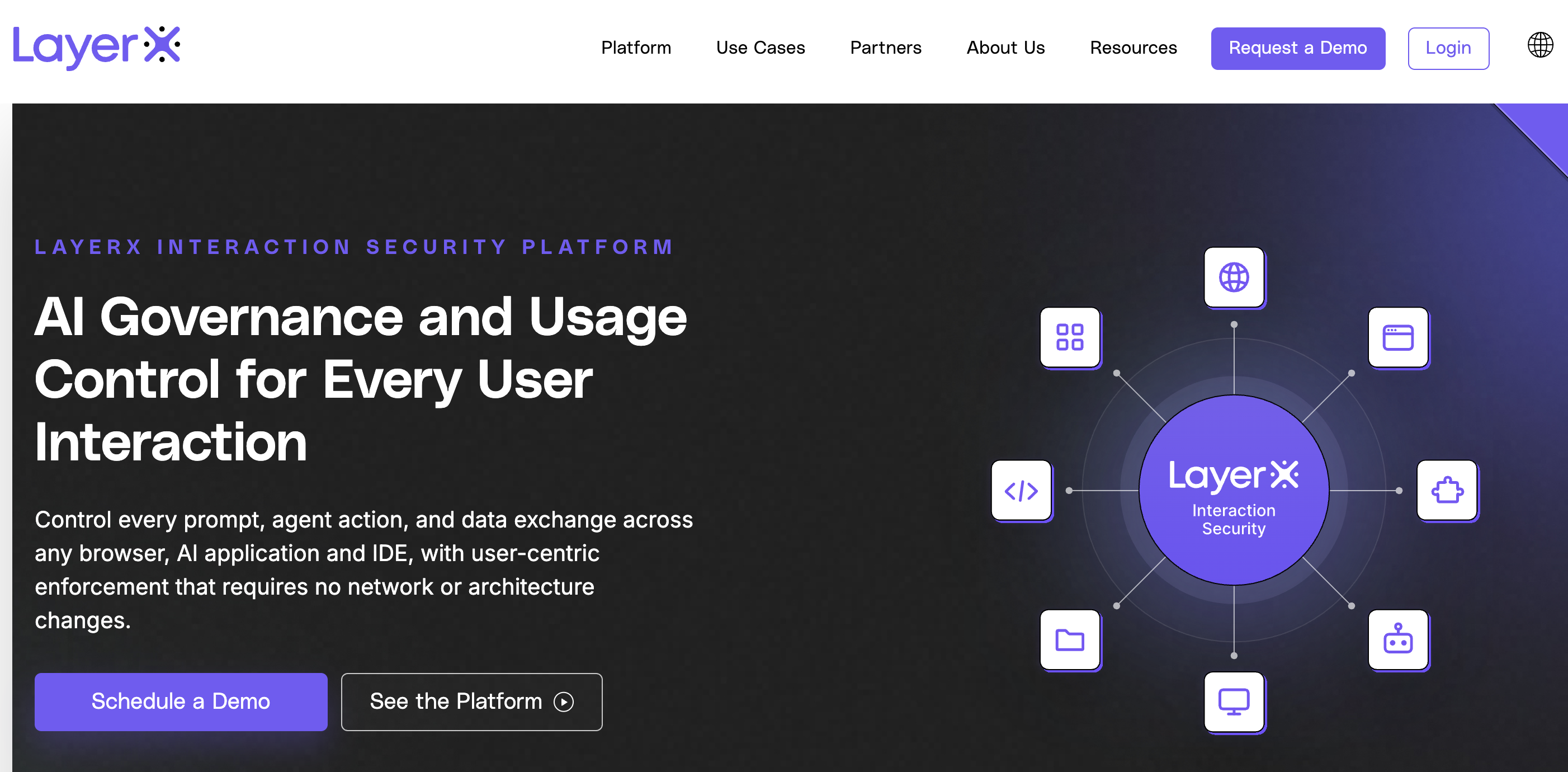
LayerX provides AI governance through all user and agentic interactions in any application, browser and IDE. The platform delivers instant visibility to all interactions through desktop, SaaS and AI apps. LayerX secures browsers through a lightweight extension without requiring browser replacement.

The system monitors installed extensions on managed and unmanaged devices and evaluates permissions, behavior, source and reputation with dynamic risk scoring. LayerX tracks file uploads, downloads, copy/paste operations and text input in prompts. Fine-grained identification classifies and redacts PII, source code and financial data before exposure to AI services.

Aona AI

Aona AI delivers prompt-level DLP through browser and desktop with hard-block on classified data and redaction in production. The platform intercepts every prompt before submission and inspects content in milliseconds with no latency. Classification identifies PII, financial data, source code and custom data types through AI-native pattern recognition.

Aona works with ChatGPT, Microsoft Copilot, Google Gemini, Claude, Perplexity and over 5,000 AI tools. The browser extension deploys via MDM in under five minutes with no endpoint agents, VPN or firewall changes. Coverage spans 5,600+ AI tools tracked through web extension, desktop app, admin dashboard and APIs.

So Which Nightfall Alternative Is Right for You?

Wald AI DLP

Choose Wald AI DLP if you’re in healthcare, financial services, legal, insurance, or education, and your priority is ensuring sensitive data never leaves the endpoint for inspection. It’s also a strong fit if your current DLP generates too many false positives and users have started ignoring alerts. Beyond prompt security, Wald adds governance for desktop AI applications like ChatGPT and Claude, along with an MCP gateway.

Harmonic Security

Harmonic Security is worth considering if your biggest challenge is understanding how employees are using AI agents before enforcing restrictions. It is particularly well suited for organizations preparing for MCP and agentic AI adoption and wanting visibility before policy enforcement.

Cyberhaven

Cyberhaven is a good choice if insider risk is your primary concern. Its combination of DSPM, data lineage, and DLP gives security teams much deeper context into how sensitive information moves across the organization than prompt inspection alone.

DoControl

If shadow AI is entering your environment through employees connecting third-party AI tools to sanctioned SaaS applications, DoControl is one of the more targeted solutions. It focuses on controlling unauthorized integrations rather than inspecting prompt content.

Microsoft Purview

For organizations already standardized on Microsoft 365, Microsoft Purview is often the most practical option. Its native integration with Microsoft services makes AI governance an extension of security controls you already manage.

LayerX

LayerX makes sense if most AI usage happens inside the browser and you need protection that can be deployed quickly. It is a strong browser security platform, though it is less suited for organizations looking for broader endpoint governance.

Aona AI

If you’re still evaluating vendors, Aona AI can help you compare documented capabilities across AI security products before investing time in multiple proof-of-concepts.

Staying with Nightfall

Don’t switch tools simply because alternatives exist. If your priority is a single platform that covers SaaS applications, email, and AI, Nightfall remains a reasonable choice. But if your security model requires proving that sensitive prompts never leave the endpoint for classification, it’s worth evaluating an on-device architecture before making your long-term decision.

FAQs

Is Nightfall AI a good fit for regulated industries?

Yes. Nightfall is widely used in regulated industries. However, if your compliance requirements demand that sensitive prompts never leave the endpoint for inspection, an on-device AI DLP may be a better fit.

What is the real difference between Nightfall’s detection and Wald’s?

The key difference is where classification happens. Nightfall inspects prompts in the cloud, while Wald classifies and redacts sensitive data on the endpoint before it reaches an AI provider.

Can Wald run alongside Nightfall instead of replacing it?

Yes. Many organizations use Wald for on-device AI security while continuing to use Nightfall for SaaS and cloud DLP.

Does switching from Nightfall to an on-device AI DLP tool require redeploying agents?

Usually, yes. On-device classification typically requires an endpoint agent, so deployment effort should be part of your evaluation.

Still relying on traditional DLP for AI?
There's a better way.

Semantic Understanding

Real Time Inline Action

Dynamic Policy Engine

Get A Free POC

Trusted by 55+ regulated organizations