INSURANCE · POLICYHOLDER DATA PROTECTION

Use AI in Claims and Underwriting Without Exposing Policyholders

Adjusters and underwriters paste claim files, medical records and loss runs into AI every day. Wald detects policyholder data on the device and stops it before it reaches ChatGPT, Copilot, Claude or Gemini.

Book A Demo

Built for insurers:

NAIC Model LawGLBANYDFS Part 500HIPAAAudit logs
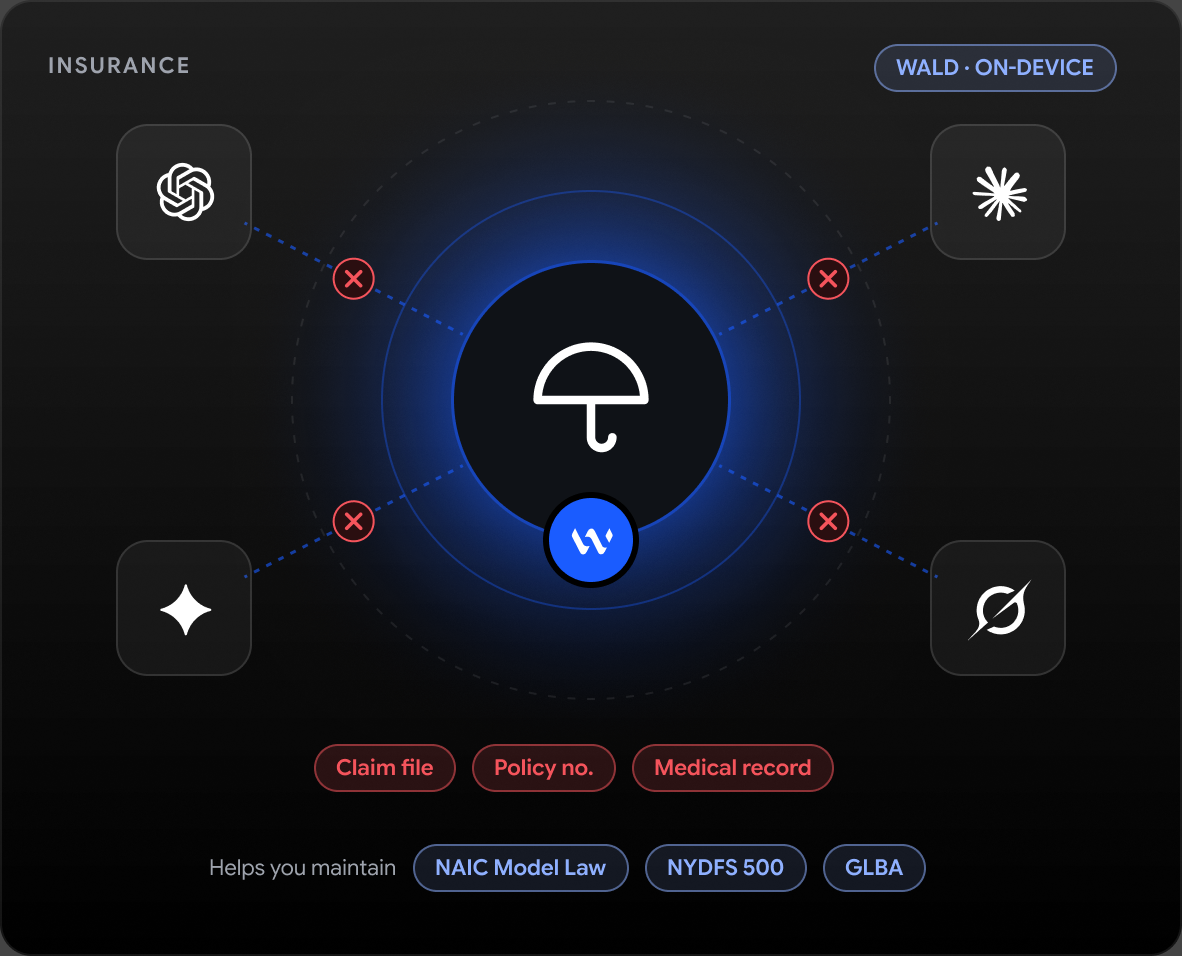
Insurance AI DLP: Wald blocks claim files, policy numbers and medical records on the device before they reach ChatGPT, Claude, Gemini or Grok

Trusted By

55+

Regulated Organizations

Symmetrical horizontal blue light streaks on a black background, creating a sense of motion and speed.
WHY AI IS THE NEW DATA SECURITY RISK

AI Is Now the Fastest Way Policyholder Data Leaves Your Business

Claims systems, email and file sharing have controls. AI prompts don't. Adjusters paste whole claim files into a browser tab, often from personal accounts, and legacy DLP never sees it.

#1

GenAI is now the top channel for corporate data moving to personal accounts, carrying 32% of it.

77%

of employees using GenAI paste data straight into prompts.

82%

of those pastes happen in unmanaged personal accounts your tools can’t see.

Source: LayerX, Enterprise AI & SaaS Data Security Report 2025

M
Megan · Claims adjusterFree ChatGPT · personal account · Tue 11:04 AM
TYPICAL SCENARIO

Write a polite denial letter for claim CLM-20931. Policyholder James Whitaker, policy DI-4471209, DOB 07/22/1971. His MRI shows a prior herniated disc, so the claim is excluded as pre-existing.

Nonpublic information in one prompt: NamePolicy numberDOBMedical recordClaim decision

What just happened

  • Policyholder data sent to an AI vendor you have never assessed
  • Outside the information security program state law requires
  • If it is exposed, you can’t trace where it went or who saw it
One prompt, sent in under a second. Instant regulatory exposure.
NAIC INSURANCE DATA SECURITY MODEL LAW
72 hours

In states that adopted the model law, licensees must notify the insurance commissioner within 72 hours of determining that a cybersecurity event occurred. Unmonitored AI tools make that determination far harder.

NYDFS Part 500Annual certification of compliance with cybersecurity requirements
NAIC AI Model BulletinInsurers are expected to govern the AI systems they use, including third-party tools

Why Employee AI Use Puts Insurers at Risk
‍

01

Every Claim File Is Sensitive

Claims mix identity, financial and medical data in one document. Paste one into AI and all of it goes at once.

02

Speed Pressure Drives Shadow AI

Claims and underwriting teams use AI to summarize files and draft letters. Bans just push it to personal accounts.

03

Regulators Are Watching AI

The NAIC AI Model Bulletin expects insurers to govern AI systems, including the third-party tools employees use.

04

No Record, No Defence

Without a log of what went to which AI tool, you can’t assess an event, certify to NYDFS or answer a market conduct exam.

The Policyholder Data Wald Protects

Insurance files carry identity, financial and health data together. These are the types that surface most often in AI prompts at carriers, MGAs and brokers. Wald detects each one on the device, by context, and you choose Allow, Warn or Block.

Policyholder identity

Identifiers in every application and claim.

  • Full name
  • SSN
  • Date of birth
  • Home address
  • Driver’s license

Policy data

Coverage details pasted into service emails.

  • Policy numbers
  • Coverage limits
  • Premiums
  • Beneficiaries
  • Endorsements

Claims data

The most sensitive files adjusters handle.

  • Claim numbers
  • Adjuster notes
  • Loss details
  • Settlement amounts
  • Fraud flags

Medical information

Health data in life, disability and health lines.

  • Medical records
  • Diagnoses
  • Treatment notes
  • Disability reports
  • Prescriptions

Financial data

Payment and credit details under GLBA.

  • Bank accounts
  • Card numbers
  • Credit-based scores
  • Income
  • Payment history

Underwriting

Risk data behind every quote.

  • Risk scores
  • Inspection reports
  • Loss runs
  • Underwriting notes
  • Rating models

Actuarial & pricing

Proprietary numbers competitors would want.

  • Pricing models
  • Reserve estimates
  • Loss ratios
  • Draft rate filings
  • Reinsurance terms

Agent & broker data

Distribution data that stays in-house.

  • Commissions
  • Producer licenses
  • Book of business
  • Contact lists
  • Contracts

State insurance data security laws expect you to protect nonpublic information wherever it goes. Today, that includes AI prompts.

Stop policyholder data before it reaches AI

Wald’s on-device models recognise policyholder identity, claims and medical details by context, so a claim file or loss run never leaves the laptop inside a prompt.

  • Policy, claim & SSN detection
  • Medical and financial details
  • Context, not just pattern matching

Apply insurance policies with Allow, Warn, or Block

Set rules per data type, line of business and AI tool. Block medical and claims data outright, warn on policy numbers, and coach staff in the moment instead of after an incident.

  • Per-data-type, per-team policies
  • Inline coaching before a block
  • Free and paid AI tools covered

Evidence for regulators and examiners

Every AI interaction is logged with user, tool, data type and policy outcome, so compliance can document your information security program, support NYDFS certification and answer market conduct exams fast.

  • Centralised audit trail
  • Exportable reports for examiners
  • Per-user, per-tool records

An Enterprise AI Plan Alone vs. Wald for Insurers

Enterprise AI plan alone
With Wald
Claim files still leave the device
Policyholder data stopped on the device
Medical and claims details pass unchecked
Medical and claims data caught by context
No record for NYDFS or market conduct exams
Exportable record for examiners
Covers only the one tool you license
Covers the AI tools adjusters actually use
Jonathan Antonio
Wald enables our employees to safely leverage leading AI models so they can reduce the time they spend on manual tasks. Our traditional DLP was built for email and file transfers and not AI prompts. Wald gave us real visibility and control over how our employees use LLMs without slowing productivity.
Jonathan Antonio
Jonathan Antonio
Vice President of Infrastructure @Suki

Stop Policyholder Data Leaking Into AI

Keep claims and policyholder data out of AI tools, and keep the proof that you did. See how Wald fits your compliance program in a 30-minute demo.

Book a Demo

3D illustration of Wald AI visibility and protection

Frequently Asked Questions

Talk to Sales

Can claims and underwriting teams safely use ChatGPT?

Yes, if policyholder data stays out of the prompt. Claim files and loss runs combine identity, financial and medical data, all of which state insurance laws expect you to protect.

‍

Wald lets teams keep using AI for drafting and analysis while stopping policyholder data on the device.

Which insurance regulations apply to employee AI use?

State laws based on the NAIC Insurance Data Security Model Law, NYDFS Part 500, GLBA and, for health insurers, HIPAA all cover nonpublic policyholder information, including data pasted into AI tools.

‍

The NAIC AI Model Bulletin adds expectations for governing AI systems, including third-party tools.

Is an enterprise AI plan enough for an insurer?

Enterprise plans typically stop the vendor from training on your data, but policyholder data still leaves the device and is stored by a third party. They also cover only the tool you license, not the free tools staff use on the side. Wald adds on-device detection and control across the AI tools your teams actually use.

Which policyholder data does Wald detect?

Policyholder identifiers such as names, SSNs and dates of birth, plus policy and claim numbers, medical records, financial details and underwriting notes.

‍

On-device models understand context, not just patterns, and you decide whether each type is allowed, warned on or blocked.

How does Wald help with NYDFS Part 500 and the NAIC Model Law?

Wald adds a technical safeguard for nonpublic information in AI prompts and an exportable record of every AI interaction.

‍

That record helps you investigate cybersecurity events quickly, support annual certifications and answer examiners.

How quickly can we roll out Wald across claims and underwriting?

Wald runs as a lightweight agent across browser and desktop, deployed through your existing MDM, so you can start seeing AI usage across claims, underwriting and service teams soon after rollout. We'll map out a deployment plan with you during your demo.

Helps you maintain:

SOC2 TYPE II
NAIC MODEL LAW
GLBA
NYDFS 500
HIPAA