Forcepoint brings your rules to AI. Wald brings understanding.
Forcepoint AI Data Security extends the classifiers and policies you already run to ChatGPT, Copilot and Claude. Wald reads what each prompt means and what the user is trying to do, on the device, before it’s sent. Keep Forcepoint DLP for your channels. Choose Wald for AI.
Book a Tailored DemoMaintains compliance with:
Trusted By
Regulated Organizations
Rules only catch what someone thought to write down.
Forcepoint’s AI security runs on the same classifier library it uses for email and endpoint. That works well for regulated identifiers. But much of what leaks into AI is plain language: a strategy memo, an unannounced reorg, a customer thread pasted in for a summary.
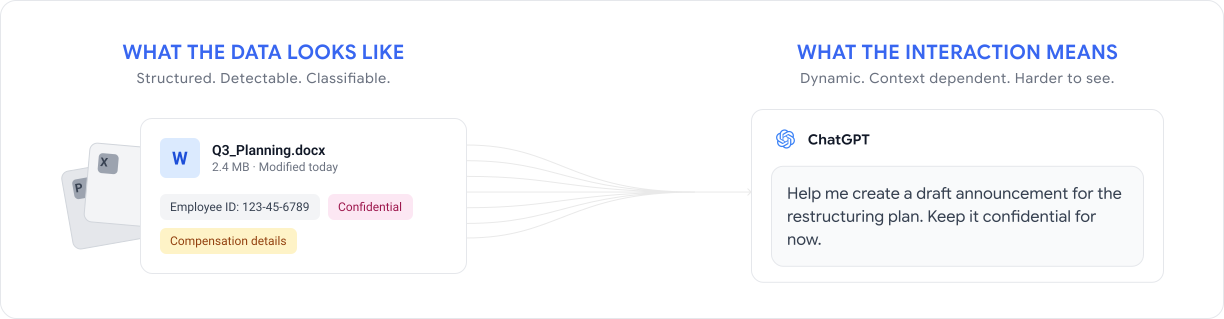
A match isn’t always a threat.
- A 9 digit SKU looks like an SSN.
- Synthetic data triggers a policy.
- Legitimate work gets flagged.
Risk doesn’t always look sensitive.
- An unannounced layoff.
- Pre-release financials.
- An M&A code name.
Detection isn’t preventionif it’s too late.
Audit-first rollouts and remediation that quarantines or deletes a conversation afterwards still leave the prompt with the model.
AI security needs to understand the interaction, not just match the data.
Keep Forcepoint DLP. Choose Wald for AI.
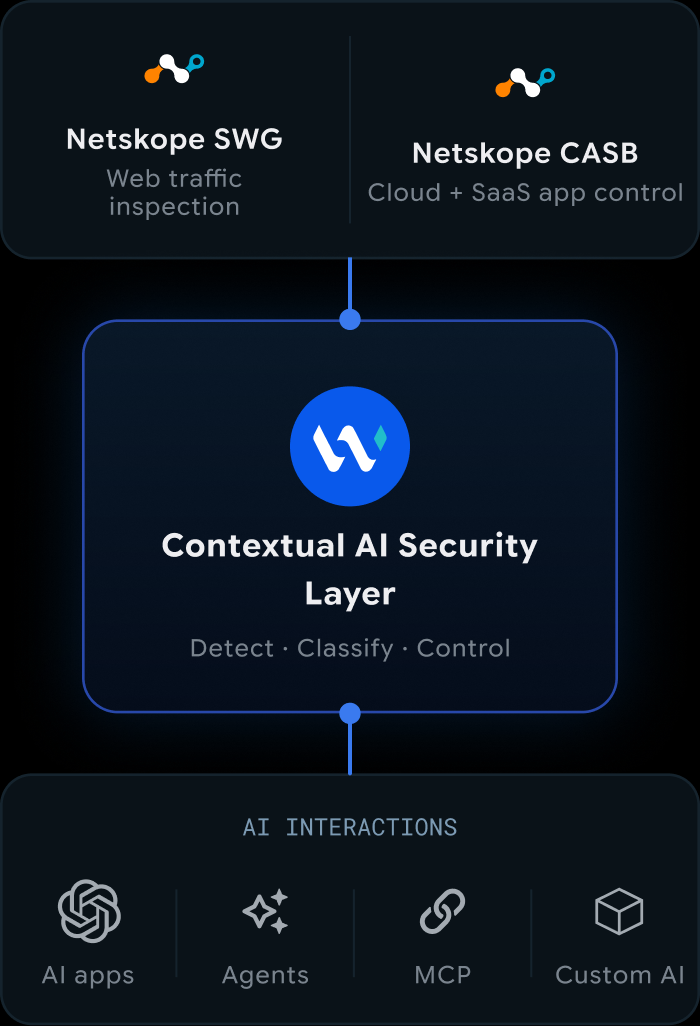
Forcepoint DLP keeps protecting email, web, endpoint and network exactly as it does today. Wald takes the AI layer: prompts, files, desktop apps, agents and MCP connections, judged by context on the device. You get AI coverage without another Forcepoint module or a new set of classifiers to tune.
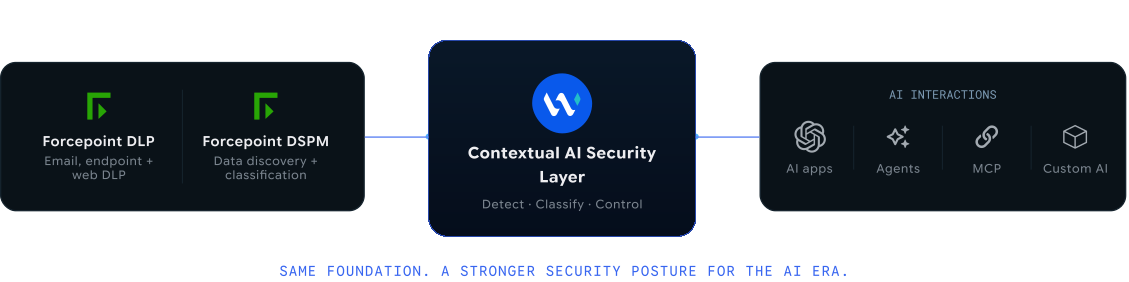
Same goal. Different approach.
Both inspect AI prompts and uploads in real time. The difference is how each one decides what’s risky, where that decision happens and what it takes to run.
 Forcepoint
 capabilities based on Forcepoint’s published product information, November 2026.
Make AI security work the way your teams need it to.
More protection. Less manual work. A smoother experience for every team.

No manual policy training needed.
Wald automatically understands the context of an AI interaction and enforces the right policy in real time.

Fewer false positives.Superior accuracy.
Context helps distinguish legitimate work from genuine risk, so security teams spend less time reviewing unnecessary alerts.

Seamless acrossplatforms.
Checked on the device, not in another cloud. Windows and macOS, with no traffic rerouting.

Scan and scale.
Scan unlimited files across AI workflows and static docs without any extra charges.
Forcepoint AI security FAQs
Talk to SalesDoesn’t Forcepoint already have AI security?
Yes. Forcepoint AI Data Security inspects prompts, responses and file uploads in tools like ChatGPT, Microsoft Copilot and Claude, using the same classifiers and policies as Forcepoint DLP.
Wald takes a different approach. An on-device language model judges each AI interaction by context and intent, not only by whether it matches a classifier.
Why choose Wald over Forcepoint AI Data Security?
Classifiers work well for regulated identifiers such as card numbers and health records. But much of what employees share with AI is plain language with no pattern: a reorg plan, pre-release numbers, a deal code name.
Wald catches that risk from context, with fewer false positives and no classifier library to maintain.
Can I use Wald alongside Forcepoint DLP?
Yes. Keep Forcepoint DLP on email, web, endpoint and network. Wald runs as a separate endpoint agent for the AI layer and doesn’t require changes to your Forcepoint policies or traffic routing.
Where does Wald inspect AI prompts?
On the endpoint. Wald’s small language model runs locally, so prompts and file uploads are evaluated before they leave the device and are never sent to another cloud to be checked.
Does Wald cover desktop AI apps, agents and MCP?
Yes. Wald covers ChatGPT, Claude, Gemini, Grok and Microsoft Copilot in the browser, desktop AI apps such as the ChatGPT desktop app, and AI agents and MCP connections, all under one policy approach.
What policy actions does Wald support?
Allow, Warn and Block, set by AI tool and by the sensitivity of the data being shared. Wald coaches employees inline when it warns or blocks, so legitimate AI work keeps moving.
How long does it take to deploy Wald?
Wald is rolled out through your existing MDM or endpoint management on Windows and macOS, with no proxy or traffic rerouting.
You can start by monitoring AI usage, then turn on Warn and Block policies for the riskiest tools and data.
Does Wald help with HIPAA, GDPR, CCPA and GLBA compliance?
Yes. Wald helps organizations maintain compliance with HIPAA, GDPR, CCPA, GLBA and other data protection laws, with an audit-ready record of AI interactions and a SOC 2 compliant platform.