Key Takeaways
- Anthropic’s Compliance API gives you visibility into Claude activity, but it is an audit plane, not a real-time control plane.
- Claude’s four attack surfaces, Web, Desktop/Code, Cowork, and MCP, create blind spots that a browser extension alone cannot solve.
- We compare seven leading Claude DLP tools across contextual detection, enforcement, MCP coverage, deployment, and where classification actually happens.
- The biggest differentiator is what happens after detection: block the user, or sanitize sensitive data while letting the AI interaction continue.
An executive whitepaper on how AI-Native DLP differs from legacy DLP, and what it means for enterprise security strategy.
Download WhitepaperAnthropic has built one of the most rigorously safety-tested models in production. What it has not built, and has never claimed to build, is a control that stops an employee from pasting a business sensitive prompt into Claude.
That is the gap. Claude’s safety layer governs what the model outputs. Your compliance obligation is about what your employees input. Different problems, different architectures.
This piece compares named tools that close that gap: Wald AI, Strac, dope.security, Aona AI, Harmonic Security, Nightfall AI, and LayerX (now Akamai Workforce Protector). I run engineering at Wald, so read our section with appropriate skepticism. In two places below I say plainly that another vendor is the better buy.
What “DLP for Claude” Should Actually Covers
Real-time inspection of what leaves your environment on the way to Anthropic, plus a durable audit trail of what left.
Four things concretely:
Prompt inspection. The free-text box is now your highest-volume egress channel. Claude’s context window actively encourages pasting whole contracts and customer exports.
Upload inspection. Files attached to a chat or project, before transmission.
Agent and connector inspection. MCP connectors and Claude Code move data with no human in the loop at the moment of transfer.
Evidence. Who sent what, when, under which policy decision, in a form an auditor accepts.
The four surfaces
- Claude web
- Claude Desktop and Claude Code
- Cowork (agentic sessions)
- MCP connectors
A browser extension covers surface one. It does not cover a developer running Claude Code against a local stdio MCP server.
Is Anthropic’s safety layer enough?
No, and Anthropic does not claim it is. Model safety training reduces harmful generation. It does not classify your PHI, enforce data residency, or produce a HIPAA-defensible record of a prompt that should never have been sent. Those are customer-side controls by design.
Claude Compliance API: What It Is, and Where It Stops
This is the most common source of false comfort I encounter in buyer conversations.
The Claude Compliance API is good engineering. It lets you programmatically pull activity feed events, chat data, and file content across Claude deployments to monitor and audit with your own DLP tools. Anthropic paired it with 28 security and compliance integrations spanning DLP, SASE, SIEM, identity, and eDiscovery, including CrowdStrike, Microsoft Purview, Netskope, Palo Alto Networks, Proofpoint, and Zscaler. Session endpoints return transcripts from Cowork, Claude Code, and Claude for Microsoft 365.
If your board asks “can we see what people are doing in Claude,” this is a legitimate answer.
Where it does not help you
It is an evidence system, not a permission boundary. It records activity after the fact and cannot replace runtime policy enforcement.
Three limits worth writing into your evaluation criteria:
It is retrieval, not interception. The API does not sit inline between the employee and the model. By the time a record exists, the prompt has been processed. For a regulated firm, that is a documented breach with excellent forensics attached.
Enforcement actions are constrained downstream. Check Point’s Claude integration documents that only the Detect action is supported, with Allow, Ask, Block, Prevent, and Redact unavailable for files inspected through the Compliance API. Nightfall’s own integration is monitor-only. Neither is a criticism of the vendor. It is a property of the interface.
Coverage has holes. Local-only actions never reach Anthropic. Session transcripts omit thinking blocks, binary content, tool definitions, and MCP configuration. Content disappears under retention policy or user deletion. And the API is scoped to your Enterprise tenant, so an employee on a personal Claude account generates zero records. That population is exactly where your shadow AI problem lives.
Anthropic is closing part of this itself. Inference hooks, in beta, act inline: your AI security server receives each governed prompt before inference and can deny it in real time. That confirms the point. Real-time enforcement is a different mechanism from the Compliance API, and today it still requires a security layer you supply.
In Short: the Compliance API is your audit plane, not your control plane. You need to buy for both.
How to Evaluate a Claude DLP Tool
Five criteria. Apply them before you look at a single logo.
1. Detection approach: pattern matching or contextual
Regex finds a 16-digit number. It does not find risk.
Consider a real prompt:
“Draft a response to the harassment complaint filed by [employee] against [director] in the Boston office, referencing the prior warning from March.”
Zero regex hits. No SSN, no card number, no PHI marker. And it is among the most damaging things that could leave your building. These prompts carry potent intent without containing a single regulated identifier.
Run that prompt in every POC during your evaluations. The answer tells you whether you are buying pattern matching with an AI label on it.
2. Where classification happens
On-device or cloud round-trip. This determines latency, data residency, and whether your prompt is copied to a third party in order to be checked. Some vendors classify by sending extracted prompt text to an external LLM API. That can be done responsibly with zero-retention terms, but you are solving a data exposure problem by creating a second exposure path. Put it in the security review.
3. What happens to a flagged prompt
- Audit. You learn about it later.
- Block. The prompt dies, the user switches to personal Claude. You created shadow AI rather than preventing it.
- Contextual redaction. Sensitive values replaced by contextual placeholders, the model still answers usefully, real values are masked.
Only the third survives contact with a productive workforce.
4. MCP and agent coverage
Ask precisely: does the tool inspect the MCP tool call before execution, or log it afterward? Does it cover local stdio servers as well as remote HTTP? A laptop running Claude Code against a local MCP server is invisible to anything living in a browser or cloud proxy.
5. Deployment model and policy granularity
MDM endpoint agent, browser extension, or API connector. Each has a different blind spot. Then ask whether policy can vary per model, per team, per data class. Legal should not inherit marketing’s policy.
Claude DLP Tools at a Glance
Wald AI DLP
Disclosure: I am the CTO here. Judge this entry against the same five criteria as the rest.
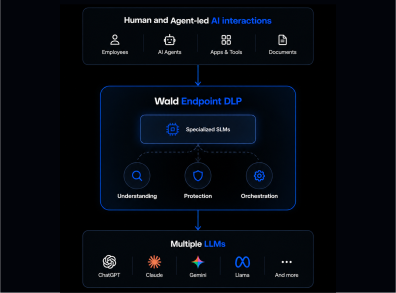
One early decision I am proud of: classification runs on the endpoint, not in our cloud. Harder to ship. It meant quantizing a small language model to run inside a laptop’s memory and thermal budget, batching inference against keystroke-level input, and holding the round trip low enough that users do not route around it. Detection and sanitization complete on-device before transmission, adding as little as 0.6 seconds. We never had to write “your data is safe with us,” because it never reaches us.
The second: blocking is not the primary control. Detected entities are swapped for type-consistent, reversible placeholders, so a salary figure stays a number and a patient name stays a name. Claude reasons over structurally intact input. The mapping never leaves the device, and the response is repopulated locally at render. Same policy engine across Claude, ChatGPT, Gemini, and Grok, plus an MCP gateway that inspects tool calls before execution rather than logging after.
An unplanned use case. Several customers asked to point the same agent at their databases and run classification and labelling across the full estate. We did not build it as DSPM, but the economics are unusual: the model is already on the machine, so a scan carries no per-scan or per-document metering. Those teams told us they preferred it to consumption-priced DSPM tooling they were evaluating, where the cost of re-scanning discouraged them from scanning often. Verify the pricing comparison against your own quotes.
What we do not do. Not full-estate DLP. No email, file shares, or SharePoint. Not prompt-injection defense for inbound content.
Honest tradeoff. On-device inference means an endpoint agent and MDM rollout. Browser-extension vendors will beat us to first signal in a POC.
Best fit: Organizations operating under data protection and privacy obligations, where the burden of proof is prevention rather than post-hoc evidence. That includes teams accountable to HIPAA and HITECH, PCI DSS 4.0, GDPR and UK GDPR, CCPA and CPRA, SOC 2 Type II, ISO 27001 and ISO 42001, GLBA, FINRA and SEC Rule 17a-4, FERPA, CMMC and FedRAMP, NYDFS Part 500, Australia’s Privacy Act, Canada’s PIPEDA, India’s DPDP Act, and the EU AI Act. Typically 200+ employees in financial services, insurance, healthcare and life sciences, legal, government contracting, and technology.
Strac
Strac publishes the broadest explicit Claude surface list here: Chat, Desktop, Code, Cowork, and MCP connectors, with real-time detection, redaction, and blocking. It is a full data-security platform covering SaaS, cloud storage, and endpoints, with agentless SaaS deployment. Its MCP DLP inspects data flowing between agents and connected SaaS before it reaches the model.
What it does not do. Its Claude content is single-vendor marketing, so you get no comparative view. Its Compliance API integration sits on the after-the-fact plane.
Honest tradeoff. Breadth means more surface to configure. If prompts are your only concern, you are buying more platform than you need.
Best fit: teams wanting AI DLP and SaaS DSPM from one vendor.
dope.security
Architecturally clean. DLP is built into an on-device Secure Web Gateway, so it sees Claude activity before the request leaves the laptop. It also solves the tenant problem: Cloud Application Control restricts access to your approved Claude tenant and blocks personal logins, syncing fleet-wide in under a minute.
What it does not do. Enforcement is binary, with no contextual redaction. Classification is not fully local either. Extracted text goes to the dope.cloud API, which uses OpenAI’s zero-retention endpoints. Contractually sound, but your security review will ask.
Best fit, and they beat us here: if you are consolidating onto an SSE and want shadow AI discovery, tenant lockdown, and prompt inspection from one agent, buy dope.security instead of us.
Aona AI
Aona positions on Claude governance and shadow AI visibility, and it ranks for this category, so it will land in your evaluation.
What it has not published. Public documentation is thin on the things that decide a deal: detection methodology, where classification executes, latency, MCP behavior, and enforcement beyond alerting.
Honest tradeoff. Less published detail means more of your evaluation happens in the POC. Get written answers on the five criteria before allocating engineering time.
Best fit: organizations at the discovery stage, establishing visibility before committing to inline enforcement.
Harmonic Security
The most complete published Claude coverage among Compliance API partners: Desktop, Web, Mobile, Claude Code, and Cowork, with proprietary detection models surfacing sensitive-data exposure, prompt injection, and adoption insights by team and department. Enforcement is unusually humane, with real-time coaching, nudging, justification, and redirect workflows.
What it does not do. Scope is AI surfaces only. Competitors covering email, SaaS, and endpoints argue the broader remit matters.
Honest tradeoff. Justification workflows change behavior and add friction some regulated environments will not tolerate on every flag.
Best fit: enterprises driving safe adoption with departmental analytics, not just stopping leaks.
Nightfall AI
The most complete agent-era coverage on this list: MCP discovery for local and remote configurations, IDE hooks for Cursor, VS Code, and Claude Code, shadow-MCP detection, and prompt injection detection. Remediation is granular across block, coach, redact, revoke, quarantine, and encrypt. The endpoint agent runs at roughly 1% CPU and 50MB RAM with macOS and Windows parity.
What it does not do. Its Compliance API integration is monitor-only, so inline control comes from the endpoint and browser layers.
Honest tradeoff. Published accuracy claims are vendor-measured. Validate on your own data, as you should with every number here, including ours.
Best fit, and the second place they beat us: if you need one control plane for AI, email, SaaS, and endpoints with deep Claude Code coverage, Nightfall is the stronger buy.
LayerX Security (Akamai Workforce Protector)
Now Akamai Workforce Protector, it secures interactions across existing browsers, SaaS platforms, and desktop apps through an extension, combining web DLP, GenAI protection, and shadow SaaS discovery. Fastest rollout on this list.
What it does not do. Browser-centric platforms cannot see native SaaS API traffic, local IDE workflows, or MCP servers. Claude Code lives entirely outside that model.
Honest tradeoff. Akamai completed the acquisition on July 2, 2026 for approximately $205 million. Post-acquisition roadmaps take time to settle. Ask about it.
Best fit: organizations where AI use is overwhelmingly browser-based and an endpoint agent is not viable.
Comparing the Top Claude DLP Tools in 2026
Three architectural camps, and the camp decides more than the feature list.
Compliance API consumers. Strong evidence and analytics, enforcement bounded by what the API exposes. Necessary, not sufficient.
Inline endpoint enforcers. Inspection before transmission. Requires MDM. The only camp that can prevent rather than record.
Browser-layer enforcers. Fastest to deploy, structurally blind to Claude Code and local MCP.
Inside camp two, the differentiator is what happens after detection. Block-only tools produce a measurable behavioral response: people move to personal accounts. Contextual sanitization keeps the productivity and removes the data.
How to Choose
Regulated and required to prove prevention, not detection: Wald AI. On-device classification, sub-second latency, contextual sanitization, one policy across Claude, ChatGPT, Gemini, and Grok. If your auditor asks what stopped it, an activity log is the wrong answer.
Already consolidating on an SSE: dope.security. One agent, one console, plus tenant control that stops personal Claude logins.
One DLP across AI, email, SaaS, and endpoints: Nightfall AI. Broadest remediation toolkit, deepest published MCP coverage.
Safe adoption and departmental analytics: Harmonic Security. Coaching changes behavior in ways a block page does not.
AI as one part of a SaaS and cloud program: Strac. Agentless deployment, most explicit Claude surface list.
Cannot deploy an endpoint agent: Akamai Workforce Protector. Accept the Claude Code and MCP blind spot knowingly, and document it.
Early and need visibility first: Aona AI, with written answers to the five criteria.
Whatever you shortlist, enable the Compliance API alongside it and turn each gap into a test. Run representative file, browser, connector, and MCP actions, then prove which records appear where. The gaps you find are your real requirements document.
Wald AI provides on-device, context-aware data protection across Claude, ChatGPT, Gemini, and Grok. Bring your five hardest prompts to a POC and run them against whatever you are comparing us to.
Frequently Asked Questions
What is Claude DLP, and do I need it if Anthropic already has safety controls?
Claude DLP is inspection and enforcement on what your people send into Claude: prompts, uploads, connector calls. Anthropic’s controls govern model behavior and output. They were never designed to know a string is your patient roster or your unannounced acquisition target. Under every shared responsibility model you have signed, input classification is your side of the line.
What is the Compliance API from Anthropic?
A REST API for programmatically pulling activity events, chat data, and file content across your Claude deployments, extended by session endpoints covering Cowork and Claude Code transcripts. Treat it as your audit plane. It records after the fact and cannot replace runtime enforcement. Inference hooks, in beta, are the inline counterpart.
Is DLP obsolete now that AI vendors have safety controls?
The opposite. Vendor safety reduces harmful output. DLP governs your data crossing an organizational boundary. What is obsolete is regex-driven DLP pointed at free-text prompts, which generates noise no team can triage while missing sensitive content that carries no pattern.
Does regular DLP stop shadow AI use of Claude?
No. Email and file-transfer DLP inspect channels employees are no longer using for this. A prompt is not an attachment, and a personal Claude session on a corporate laptop generates no tenant-side record. You need discovery, tenant control, and content inspection on what gets typed.
Is it worth switching from rule-based DLP to AI-based DLP?
For AI channels, yes, but not as a rip-and-replace. Keep rule-based detection for structured identifiers where it is already tuned. Add contextual classification for prompts, where meaning rather than format determines sensitivity. Run five real prompts through both engines and compare false positives against catches.
Does Claude DLP work with Claude Code and MCP connectors?
It depends entirely on architecture, and this is where most tools quietly fail. Browser extensions cannot see a terminal session or a local stdio MCP server. Only endpoint agents and MCP gateways inspect before a tool call executes. Ask two questions: local stdio as well as remote HTTP, and inspect-before-execution or log-after.
Did Claude leak data?
There is no public incident of Anthropic exposing customer prompt data through a breach. The realistic exposure is your own users. Separately, Anthropic disclosed three incidents in which Claude models gained unauthorized access to real computer systems, with independent review planned. That is agent behavior, not a data breach, and it reinforces the same conclusion: as Claude gains reach into real systems, the boundary controls have to be yours.