After starting his career in networking, while in PhD program at Stanford, Ritesh has worked on many different aspects of security; ranging from network security, to security analytics, to cloud and mobile security, and even automotive security for making a smartphone work as a secure key for cars; playing the role of CTO or Chief Architect at either some cutting-edge startups or some innovative division of big companies like Google, Ericsson, and Continental. Currently he is serving as the co-founder and CTO of Wald.ai, which enables enterprise employees to have secure conversations with AI Assistants.
Anthropic has built one of the most rigorously safety-tested models in production. What it has not built, and has never claimed to build, is a control that stops an employee from pasting a business sensitive prompt into Claude.
That is the gap. Claude’s safety layer governs what the model outputs. Your compliance obligation is about what your employees input. Different problems, different architectures.
This piece compares named tools that close that gap: Wald AI, Strac, dope.security, Aona AI, Harmonic Security, Nightfall AI, and LayerX (now Akamai Workforce Protector). I run engineering at Wald, so read our section with appropriate skepticism. In two places below I say plainly that another vendor is the better buy.
What “DLP for Claude” Should Actually Covers
Real-time inspection of what leaves your environment on the way to Anthropic, plus a durable audit trail of what left.
Four things concretely:
Prompt inspection. The free-text box is now your highest-volume egress channel. Claude’s context window actively encourages pasting whole contracts and customer exports.
Upload inspection. Files attached to a chat or project, before transmission.
Agent and connector inspection. MCP connectors and Claude Code move data with no human in the loop at the moment of transfer.
Evidence. Who sent what, when, under which policy decision, in a form an auditor accepts.
The four surfaces
Claude web
Claude Desktop and Claude Code
Cowork (agentic sessions)
MCP connectors
A browser extension covers surface one. It does not cover a developer running Claude Code against a local stdio MCP server.
Is Anthropic’s safety layer enough?
No, and Anthropic does not claim it is. Model safety training reduces harmful generation. It does not classify your PHI, enforce data residency, or produce a HIPAA-defensible record of a prompt that should never have been sent. Those are customer-side controls by design.
Claude Compliance API: What It Is, and Where It Stops
This is the most common source of false comfort I encounter in buyer conversations.
The Claude Compliance API is good engineering. It lets you programmatically pull activity feed events, chat data, and file content across Claude deployments to monitor and audit with your own DLP tools. Anthropic paired it with 28 security and compliance integrations spanning DLP, SASE, SIEM, identity, and eDiscovery, including CrowdStrike, Microsoft Purview, Netskope, Palo Alto Networks, Proofpoint, and Zscaler. Session endpoints return transcripts from Cowork, Claude Code, and Claude for Microsoft 365.
If your board asks “can we see what people are doing in Claude,” this is a legitimate answer.
Where it does not help you
It is an evidence system, not a permission boundary. It records activity after the fact and cannot replace runtime policy enforcement.
Three limits worth writing into your evaluation criteria:
It is retrieval, not interception. The API does not sit inline between the employee and the model. By the time a record exists, the prompt has been processed. For a regulated firm, that is a documented breach with excellent forensics attached.
Enforcement actions are constrained downstream. Check Point’s Claude integration documents that only the Detect action is supported, with Allow, Ask, Block, Prevent, and Redact unavailable for files inspected through the Compliance API. Nightfall’s own integration is monitor-only. Neither is a criticism of the vendor. It is a property of the interface.
Coverage has holes. Local-only actions never reach Anthropic. Session transcripts omit thinking blocks, binary content, tool definitions, and MCP configuration. Content disappears under retention policy or user deletion. And the API is scoped to your Enterprise tenant, so an employee on a personal Claude account generates zero records. That population is exactly where your shadow AI problem lives.
Anthropic is closing part of this itself. Inference hooks, in beta, act inline: your AI security server receives each governed prompt before inference and can deny it in real time. That confirms the point. Real-time enforcement is a different mechanism from the Compliance API, and today it still requires a security layer you supply.
In Short: the Compliance API is your audit plane, not your control plane. You need to buy for both.
Five criteria. Apply them before you look at a single logo.
1. Detection approach: pattern matching or contextual
Regex finds a 16-digit number. It does not find risk.
Consider a real prompt:
“Draft a response to the harassment complaint filed by [employee] against [director] in the Boston office, referencing the prior warning from March.”
Zero regex hits. No SSN, no card number, no PHI marker. And it is among the most damaging things that could leave your building. These prompts carry potent intent without containing a single regulated identifier.
Run that prompt in every POC during your evaluations. The answer tells you whether you are buying pattern matching with an AI label on it.
2. Where classification happens
On-device or cloud round-trip. This determines latency, data residency, and whether your prompt is copied to a third party in order to be checked. Some vendors classify by sending extracted prompt text to an external LLM API. That can be done responsibly with zero-retention terms, but you are solving a data exposure problem by creating a second exposure path. Put it in the security review.
3. What happens to a flagged prompt
Audit. You learn about it later.
Block. The prompt dies, the user switches to personal Claude. You created shadow AI rather than preventing it.
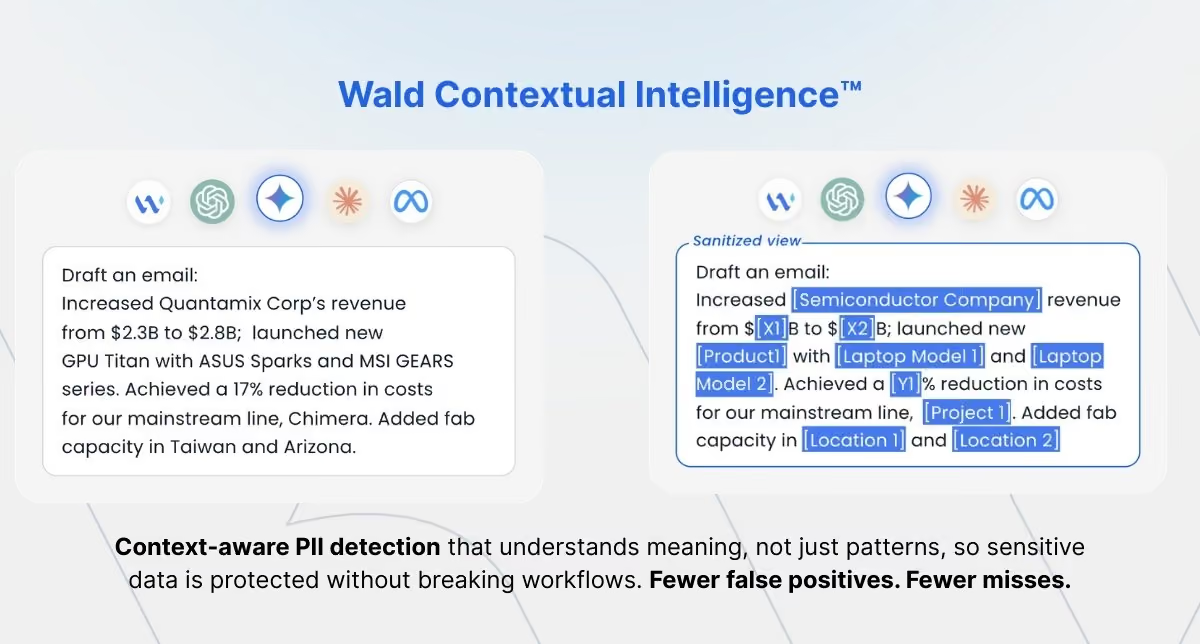
Contextual redaction. Sensitive values replaced by contextual placeholders, the model still answers usefully, real values are masked.
Only the third survives contact with a productive workforce.
4. MCP and agent coverage
Ask precisely: does the tool inspect the MCP tool call before execution, or log it afterward? Does it cover local stdio servers as well as remote HTTP? A laptop running Claude Code against a local MCP server is invisible to anything living in a browser or cloud proxy.
5. Deployment model and policy granularity
MDM endpoint agent, browser extension, or API connector. Each has a different blind spot. Then ask whether policy can vary per model, per team, per data class. Legal should not inherit marketing’s policy.
Disclosure: I am the CTO here. Judge this entry against the same five criteria as the rest.
One early decision I am proud of: classification runs on the endpoint, not in our cloud. Harder to ship. It meant quantizing a small language model to run inside a laptop’s memory and thermal budget, batching inference against keystroke-level input, and holding the round trip low enough that users do not route around it. Detection and sanitization complete on-device before transmission, adding as little as 0.6 seconds. We never had to write “your data is safe with us,” because it never reaches us.
The second: blocking is not the primary control. Detected entities are swapped for type-consistent, reversible placeholders, so a salary figure stays a number and a patient name stays a name. Claude reasons over structurally intact input. The mapping never leaves the device, and the response is repopulated locally at render. Same policy engine across Claude, ChatGPT, Gemini, and Grok, plus an MCP gateway that inspects tool calls before execution rather than logging after.
An unplanned use case. Several customers asked to point the same agent at their databases and run classification and labelling across the full estate. We did not build it as DSPM, but the economics are unusual: the model is already on the machine, so a scan carries no per-scan or per-document metering. Those teams told us they preferred it to consumption-priced DSPM tooling they were evaluating, where the cost of re-scanning discouraged them from scanning often. Verify the pricing comparison against your own quotes.
What we do not do. Not full-estate DLP. No email, file shares, or SharePoint. Not prompt-injection defense for inbound content.
Honest tradeoff. On-device inference means an endpoint agent and MDM rollout. Browser-extension vendors will beat us to first signal in a POC.
Best fit: Organizations operating under data protection and privacy obligations, where the burden of proof is prevention rather than post-hoc evidence. That includes teams accountable to HIPAA and HITECH, PCI DSS 4.0, GDPR and UK GDPR, CCPA and CPRA, SOC 2 Type II, ISO 27001 and ISO 42001, GLBA, FINRA and SEC Rule 17a-4, FERPA, CMMC and FedRAMP, NYDFS Part 500, Australia’s Privacy Act, Canada’s PIPEDA, India’s DPDP Act, and the EU AI Act. Typically 200+ employees in financial services, insurance, healthcare and life sciences, legal, government contracting, and technology.
Wald’s Endpoint DLP Uses Local SLMs to Understand Data Sensitivity in Under 100ms. This goes beyond traditional identification of PII, PHI, SSN.
Strac
Strac publishes the broadest explicit Claude surface list here: Chat, Desktop, Code, Cowork, and MCP connectors, with real-time detection, redaction, and blocking. It is a full data-security platform covering SaaS, cloud storage, and endpoints, with agentless SaaS deployment. Its MCP DLP inspects data flowing between agents and connected SaaS before it reaches the model.
What it does not do. Its Claude content is single-vendor marketing, so you get no comparative view. Its Compliance API integration sits on the after-the-fact plane.
Honest tradeoff. Breadth means more surface to configure. If prompts are your only concern, you are buying more platform than you need.
Best fit: teams wanting AI DLP and SaaS DSPM from one vendor.
dope.security
Architecturally clean. DLP is built into an on-device Secure Web Gateway, so it sees Claude activity before the request leaves the laptop. It also solves the tenant problem: Cloud Application Control restricts access to your approved Claude tenant and blocks personal logins, syncing fleet-wide in under a minute.
What it does not do. Enforcement is binary, with no contextual redaction. Classification is not fully local either. Extracted text goes to the dope.cloud API, which uses OpenAI’s zero-retention endpoints. Contractually sound, but your security review will ask.
Best fit, and they beat us here: if you are consolidating onto an SSE and want shadow AI discovery, tenant lockdown, and prompt inspection from one agent, buy dope.security instead of us.
Aona AI
Aona positions on Claude governance and shadow AI visibility, and it ranks for this category, so it will land in your evaluation.
What it has not published. Public documentation is thin on the things that decide a deal: detection methodology, where classification executes, latency, MCP behavior, and enforcement beyond alerting.
Honest tradeoff. Less published detail means more of your evaluation happens in the POC. Get written answers on the five criteria before allocating engineering time.
Best fit: organizations at the discovery stage, establishing visibility before committing to inline enforcement.
Harmonic Security
The most complete published Claude coverage among Compliance API partners: Desktop, Web, Mobile, Claude Code, and Cowork, with proprietary detection models surfacing sensitive-data exposure, prompt injection, and adoption insights by team and department. Enforcement is unusually humane, with real-time coaching, nudging, justification, and redirect workflows.
What it does not do. Scope is AI surfaces only. Competitors covering email, SaaS, and endpoints argue the broader remit matters.
Honest tradeoff. Justification workflows change behavior and add friction some regulated environments will not tolerate on every flag.
Best fit: enterprises driving safe adoption with departmental analytics, not just stopping leaks.
Nightfall AI
The most complete agent-era coverage on this list: MCP discovery for local and remote configurations, IDE hooks for Cursor, VS Code, and Claude Code, shadow-MCP detection, and prompt injection detection. Remediation is granular across block, coach, redact, revoke, quarantine, and encrypt. The endpoint agent runs at roughly 1% CPU and 50MB RAM with macOS and Windows parity.
What it does not do. Its Compliance API integration is monitor-only, so inline control comes from the endpoint and browser layers.
Honest tradeoff. Published accuracy claims are vendor-measured. Validate on your own data, as you should with every number here, including ours.
Best fit, and the second place they beat us: if you need one control plane for AI, email, SaaS, and endpoints with deep Claude Code coverage, Nightfall is the stronger buy.
LayerX Security (Akamai Workforce Protector)
Now Akamai Workforce Protector, it secures interactions across existing browsers, SaaS platforms, and desktop apps through an extension, combining web DLP, GenAI protection, and shadow SaaS discovery. Fastest rollout on this list.
What it does not do. Browser-centric platforms cannot see native SaaS API traffic, local IDE workflows, or MCP servers. Claude Code lives entirely outside that model.
Honest tradeoff. Akamai completed the acquisition on July 2, 2026 for approximately $205 million. Post-acquisition roadmaps take time to settle. Ask about it.
Best fit: organizations where AI use is overwhelmingly browser-based and an endpoint agent is not viable.
Comparing the Top Claude DLP Tools in 2026
Three architectural camps, and the camp decides more than the feature list.
Compliance API consumers. Strong evidence and analytics, enforcement bounded by what the API exposes. Necessary, not sufficient.
Inline endpoint enforcers. Inspection before transmission. Requires MDM. The only camp that can prevent rather than record.
Browser-layer enforcers. Fastest to deploy, structurally blind to Claude Code and local MCP.
Inside camp two, the differentiator is what happens after detection. Block-only tools produce a measurable behavioral response: people move to personal accounts. Contextual sanitization keeps the productivity and removes the data.
How to Choose
Regulated and required to prove prevention, not detection: Wald AI. On-device classification, sub-second latency, contextual sanitization, one policy across Claude, ChatGPT, Gemini, and Grok. If your auditor asks what stopped it, an activity log is the wrong answer.
Already consolidating on an SSE: dope.security. One agent, one console, plus tenant control that stops personal Claude logins.
One DLP across AI, email, SaaS, and endpoints: Nightfall AI. Broadest remediation toolkit, deepest published MCP coverage.
Safe adoption and departmental analytics: Harmonic Security. Coaching changes behavior in ways a block page does not.
AI as one part of a SaaS and cloud program: Strac. Agentless deployment, most explicit Claude surface list.
Cannot deploy an endpoint agent: Akamai Workforce Protector. Accept the Claude Code and MCP blind spot knowingly, and document it.
Early and need visibility first: Aona AI, with written answers to the five criteria.
Whatever you shortlist, enable the Compliance API alongside it and turn each gap into a test. Run representative file, browser, connector, and MCP actions, then prove which records appear where. The gaps you find are your real requirements document.
Wald AI provides on-device, context-aware data protection across Claude, ChatGPT, Gemini, and Grok. Bring your five hardest prompts to a POC and run them against whatever you are comparing us to.
AI security gaps are leaving organizations exposed to unprecedented risks. Research shows that 97% of organizations that experienced an AI-related breach lacked proper AI access controls. The situation grows more concerning when examining governance readiness: 63% of breached organizations either have no AI governance policy or are still developing one.
These statistics reveal a critical disconnect between AI adoption and security preparedness. Organizations are deploying AI systems faster than they can secure them, creating vulnerabilities that threat actors are quick to exploit.
AI DLP integration offers a path forward. When properly implemented within existing security frameworks, AI-aware data loss prevention tools can protect sensitive information throughout the entire AI lifecycle. This approach addresses the security gaps that traditional DLP solutions miss while maintaining the operational flexibility that organizations need.
This guide walks through the essential components of effective AI DLP integration. You'll learn how to assess your current security posture, implement AI-specific controls, and establish monitoring capabilities that evolve with emerging threats. The goal is building a security framework that protects against AI-related risks without hampering innovation.
Understanding AI DLP and Modern Security Frameworks
What is AI DLP and why does it matter?
Data Loss Prevention (DLP) refers to tools and strategies designed to prevent sensitive information from being exposed, leaked, or misused across endpoints, networks, and cloud platforms. AI systems demand a specialized approach because their core characteristics create security challenges that traditional DLP cannot address.
AI's data dependence, continuous learning capabilities, and probabilistic outputs create attack surfaces that didn't exist in conventional IT environments. Unlike static applications, AI systems evolve their behavior based on new inputs, making their security posture dynamic rather than fixed.
The pace of AI adoption has created a dangerous security gap. According to Cisco's 2025 AI Readiness Index, only 29% of companies believe they are adequately equipped to defend against AI threats, while just 33% have formal change-management plans for responsible AI adoption. Organizations are deploying systems whose behavior evolves, whose failure modes remain poorly understood, and whose environmental interactions can be unpredictable.
This gap exposes organizations to attack vectors that traditional IT security frameworks from NIST and ISO only partially address:
Evasion and poisoning attacks where malicious inputs skew outputs or corrupt training data
Model theft and inversion where attackers steal proprietary systems or reconstruct sensitive information
Prompt injection where attackers manipulate inputs to force systems to leak data or behave maliciously
Privacy attacks that exploit vulnerabilities to steal sensitive information processed by AI systems
Hallucinations where systems confidently produce false outputs that erode trust or misinform users
Key components of AI-ready security frameworks
AI security and AI safety work together within a unified risk management approach. AI security protects systems from unauthorized access, availability attacks, and integrity compromise throughout the AI lifecycle. AI safety ensures AI systems behave ethically, reliably, and transparently while aligning with human values.
Cisco's Integrated AI Security and Safety Framework represents an early attempt to classify and operationalize the full spectrum of AI risks. The framework addresses adversarial threats, content safety failures, model and supply chain compromise, agentic behaviors, and ecosystem risks like orchestration abuse and multi-agent collusion.
Modern AI security frameworks distinguish themselves through five core design elements. They integrate AI threats and content harms, recognizing that adversaries exploit vulnerabilities across both domains. A security attack, such as injecting malicious instructions or corrupting training data, often culminates in safety failures like generating harmful content or leaking confidential information.
AI development lifecycle awareness accounts for how security considerations change across data collection, model training, deployment, and runtime operation. Vulnerabilities that pose little risk during model development can become critical once the model gains access to tools or interacts with other agents. Multi-agent coordination capabilities address risks that emerge when AI systems collaborate through orchestration patterns, inter-agent communication protocols, and shared memory architectures.
Why traditional DLP falls short for AI security
Legacy DLP emerged in the mid-2000s to prevent sensitive data from leaving organizations through known channels. It relied on regular expressions, keyword matching, and predefined patterns. This approach worked when data moved through predictable, file-based flows between controlled endpoints.
Generative AI breaks this model entirely. GenAI pulls data based on access permissions, summarizes it, remixes it with other information, and generates new content. Traditional DLP requires knowing which channels to monitor and depends on predefined policies for specific applications. When employees access hundreds of AI tools through personal accounts, browser extensions, and embedded features within approved SaaS applications, the attack surface exceeds anything legacy DLP was designed to handle.
Where AI-Native DLP Fits Into the Security Stack
Many organizations assume that extending existing DLP policies to AI applications is sufficient. In practice, AI interactions introduce entirely new data flows that traditional controls were not designed to inspect.
An AI-native DLP layer sits between users and AI systems, providing visibility into prompts, uploads, generated responses, and AI-driven workflows across approved and unapproved AI applications. Rather than relying solely on keywords or predefined patterns, AI-native controls can evaluate the context and sensitivity of information before it reaches an external model.
For example, solutions like Wald AI DLP help organizations identify sensitive business information, detect policy violations in real time, redact protected data before transmission, and enforce governance controls across AI assistants, AI agents, and enterprise AI platforms. This enables organizations to adopt AI securely without sacrificing productivity or creating blind spots in their existing security architecture.
The goal is not to replace existing security investments, but to extend them with controls specifically designed for AI-driven data movement.
Modern data loss prevention asks fundamentally different questions: What is this data? Who should access it? Should they access it now? How does risk change as data moves and transforms? Instead of relying on patterns or file labels, modern DLP analyzes data's true meaning and context to determine sensitivity across structured and unstructured formats.
Semantic detection replaces pattern matching by analyzing content meaning rather than using regex expressions. It can recognize that a paragraph describing an acquisition deal is confidential even without structured data patterns.
Data lineage tracking establishes the origin and context of information before it enters AI workflows, distinguishing between legitimate inputs and potential intellectual property theft. Context-aware policy enforcement enables graduated responses: allow and log for low-risk interactions, coach users for moderate risk, redact sensitive elements for higher risk, block dangerous violations, and route ambiguous cases to human review.
Assessing Your Current Security Framework for AI DLP Integration
Identify Existing Security Controls and Gaps
How well do your current security measures handle AI workloads? Most organizations discover significant blind spots when they examine their existing controls through an AI lens.
AI models behave differently than traditional applications. They evolve as they process new data, making periodic audits essential to verify system integrity and performance. Security teams need to establish regular verification processes that confirm models haven't been tampered with or corrupted by threat actors.
Model integrity verification forms the foundation of AI security assessment. Input/output analysis examines data flows and predictions for signs of adversarial manipulation or bias, while performance evaluation monitors accuracy to ensure systems continue meeting security standards. These assessments reveal whether your current monitoring tools can detect AI-specific threats.
Access controls present another critical evaluation area. Traditional frameworks focus on user permissions and network segmentation, but AI systems require controls around model modifications and training data access. Model versioning capabilities become essential for tracking changes and enabling quick rollbacks when issues arise. Incident response plans must account for AI-specific compromise scenarios, including model theft and data poisoning attacks.
Standard security frameworks weren't designed for AI training environments. Critical gaps emerge around AI-specific assets like model weights, checkpoints, and training runs. Traditional inspection points simply don't exist in accelerator fabrics. Training clusters generate extremely high-volume east-west traffic within network fabrics, reducing the effectiveness of conventional segmentation and inline inspection.
Evaluate Data Flow and AI Usage Patterns
Data flows in AI environments create unique tracking challenges. Unlike traditional applications where data follows predictable paths, AI systems continuously ingest, transform, and generate information. Static discovery tools can identify sensitive datasets in storage, but they miss the dynamic flows that create the most risk.
Understanding data provenance becomes critical. You need visibility into which upstream systems produced the data, what transformations occurred along the way, whether it's actively training production models, and if copies are being sent to unauthorized third-party services. This level of detail exceeds what most organizations currently track.
Data flow monitoring provides end-to-end traceability across AI lifecycles. Effective monitoring establishes data provenance from collection through processing, linking each dataset to specific business purposes and legal processing bases. Continuous tracking creates verifiable lineage, showing precisely how training data was derived and used. Organizations must implement systems that produce audit-ready logs, usage reports, and compliance evidence for regulatory requirements.
Map Compliance Requirements and AI Security Standards
Regulatory landscapes for AI continue evolving, but several frameworks provide immediate guidance. ISO 42001 offers a structured approach for establishing AI management systems, addressing roles, responsibilities, and accountability throughout AI development and deployment. The standard covers risk identification, assessment, and mitigation processes specific to AI, including security vulnerabilities, privacy concerns, and ethical implications.
The NIST AI Risk Management Framework emphasizes transparency and trust throughout AI implementation lifecycles. NIST continues developing technical standards that promote innovation while building public confidence in AI systems. Current priorities include standards for AI data quality, performance measurement, and governance structures essential for trustworthy AI deployment.
Determine Integration Readiness
Security integration requires honest assessment of current capabilities and gaps. Organizations need strong foundational cybersecurity measures before adding AI-specific controls, plus compliance with relevant data protection regulations. The secure-by-design approach means integrating security into AI projects from inception rather than retrofitting protections later.
Leaders must understand potential consequences if AI system integrity, availability, or confidentiality were compromised. These impacts extend beyond technical failures to include operational disruption and reputational damage. Appropriate response plans should address these broader organizational risks.
Assessment readiness comes down to a simple question: Can your current security team identify, monitor, and respond to AI-specific threats? If the answer reveals significant gaps, AI DLP integration becomes not just beneficial but essential for maintaining security posture.
Step-by-Step AI DLP Integration Process
Building effective AI DLP protection requires a structured approach that balances security with operational needs. These five steps provide a tested framework for integrating AI-aware data loss prevention into your existing security infrastructure.
Step 1: Establish AI Data Governance Policies
Your data governance foundation determines everything that follows. Start with data classification policies that clearly identify sensitive datasets - personal information, financial records, intellectual property, and any data subject to regulatory requirements.
Data ownership matters more in AI contexts than traditional IT environments. AI systems can access, process, and generate content from multiple data sources simultaneously. Establish clear ownership rights and implement role-based access controls that restrict data access to authorized personnel only.
Ethical guidelines for AI development should address fairness, non-discrimination, transparency, and accountability. These aren't just compliance requirements - they're operational necessities that prevent costly mistakes down the line.
Consent management processes ensure you can track and respect data usage permissions. Document all data transformations and quality checks performed during preprocessing. This documentation becomes critical during audits and helps you understand how sensitive data flows through your AI systems.
Step 2: Deploy AI-Aware DLP Solutions
Start in simulation mode, not full enforcement. Set policies to audit-only mode to log user behavior silently, focusing on actions involving AI platforms and endpoints. This approach prevents disrupting legitimate workflows while you learn how your organization actually uses AI tools.
Run this configuration for four to six weeks. Review alert output carefully and refine detection rules before activating any enforcement capabilities. The goal is understanding your environment before you start blocking anything.
Enable policy tips to coach users before they submit data to external models. This educates your workforce while gathering data about usage patterns. Fine-tune policies by reviewing false positives and adjusting classifier thresholds based on real user behavior.
This phased deployment approach limits the impact of misconfigured policies and gives your security team time to tune detection logic before expanding coverage to the entire organization.
Step 3: Integrate with Existing Security Tools
Your DLP solution should integrate seamlessly with existing security infrastructure. Ensure DLP logs are parsed by your SIEM and configure correlation rules to link related events. A sensitive data export combined with an anomalous login should automatically trigger a high-priority incident.
Connect with identity providers like Active Directory or Okta for user-context enrichment on alerts. This integration enables your security operations team to see not just what data moved, but who moved it, from which device, under which role, and whether that behavior matches normal access patterns.
API gateways and management platforms need monitoring for data traffic within custom applications. The goal is comprehensive visibility across all potential data paths, not just the obvious ones.
Step 4: Configure AI Security Controls
Deploy risk-based conditional access controls that adapt to threat levels and user behavior. Strong authentication mechanisms should be standard, but real-time traffic filtering provides the dynamic protection AI environments require.
Block known malicious destinations and implement custom policies to stop harmful activities like prompt injection attacks. Configure category-based blocking at the endpoint so policies remain effective against new and unknown AI tools without requiring constant manual updates.
Graduated response capabilities should match risk levels: allow and log for low-risk interactions, provide coaching for moderate risk situations, redact sensitive elements automatically, and block high-risk violations completely.
Step 5: Implement Monitoring and Detection Capabilities
Behavioral analytics help establish normal operation patterns for AI agents. Real-time anomaly detection with automated alerting ensures you catch deviations quickly, before they become incidents.
Start with a comprehensive audit to identify all existing AI agents across your environment. Implement automated discovery tools to maintain an ongoing inventory as your AI footprint expands.
Establish baseline security policies specific to AI agent security events. These policies should address the unique risks AI agents pose, including autonomous actions and cross-system data access.
Integration with broader security orchestration platforms provides unified visibility across your entire environment. This unified view helps correlate AI-related events with other security activities for faster threat detection and response.
AI Security Best Practices for Effective DLP Integration
Secure AI Training Data and Model Inputs
AI training pipelines demand more than traditional data validation. Automated schema checks and statistical tests can identify poisoned samples before they corrupt your models. Differential privacy during feature extraction prevents model inversion attacks that attempt to reconstruct individual records from training data.
Data provenance becomes critical when dealing with AI systems. Every data row should include signed metadata that records its origin, transformation history, and access events. This approach establishes verifiable lineage that security teams can audit when investigating incidents.
Input validation takes on new importance with AI systems. Thorough sanitization prevents prompt injection attacks where malicious actors manipulate model behavior through crafted inputs. Clean data leads to reliable model performance and reduces security risks.
Monitor Generative AI Security Best Practices
Current generative AI security posture reveals significant gaps. Research indicates that only 24% of generative AI initiatives include proper security measures, leaving systems exposed to data breaches.
Strong encryption protocols protect data both at rest and during transmission. Checksums and digital signatures help detect unauthorized modifications to model files and training datasets. These technical controls provide the foundation for secure AI operations.
Human oversight remains essential, particularly for high-stakes decisions or when processing sensitive information. Staff education helps teams recognize AI limitations and identify warning signs like hallucinations or flawed reasoning that could lead to security incidents.
Apply Access Controls and Authentication
Modern authentication systems can use AI to analyze user behavior patterns and detect anomalies that traditional methods miss. This behavioral analysis adds an extra security layer beyond standard multi-factor authentication.
Role-based access controls define clear boundaries around who can access AI models and training data. Pair these controls with continuous monitoring of data access activity to detect unusual patterns early.
Zero Trust principles work well with AI systems. Verify every user and device attempting to access AI resources, regardless of their network location. For AI agents specifically, asymmetric cryptography-based credentials such as JWT tokens and X509 certificates with mutual TLS provide strong authentication mechanisms.
Establish Continuous Monitoring and Response
Real-time monitoring covers multiple dimensions of AI system health. Track prediction accuracy, fairness metrics across demographic groups, input and output distribution shifts, and error rates to catch problems early.
Incident response procedures should include automated alerts for different severity levels, model rollback capabilities, and traffic redirection to backup systems. Monitor for adversarial inputs, shifts in classifier confidence, and unusual spikes in report volume.
Document your retention policies to balance security monitoring needs with privacy requirements. Clear policies help teams respond consistently during incidents.
Address Shadow AI Discovery and Management
Shadow AI usage presents growing challenges for security teams. Organizations typically discover an average of 66 generative AI applications, with 6.6 classified as high-risk per company. GenAI-related DLP incidents have increased more than 2.5 times and now represent 14% of all DLP violations.
The scope of unauthorized usage is concerning. Over 70% of organizations have employees using generative AI tools without formal approval. This creates blind spots in security monitoring and compliance reporting.
Discovery requires multiple approaches. Conduct comprehensive audits to identify unauthorized AI tools, monitor network traffic for unusual data flows, and review code repositories for unexpected integrations. Automated discovery tools can maintain ongoing inventory as new tools emerge.
Rather than blocking all unauthorized tools, establish streamlined approval processes. Create clear pathways for requesting new AI tools while maintaining security standards. This balanced approach reduces shadow IT adoption while enabling innovation.
Operationalizing and Optimizing Your AI DLP Framework
Testing and Validation of Integrated Systems
Effective AI DLP deployment requires careful validation before full enforcement. Run policies in simulation mode before enforcement to assess accuracy without blocking legitimate workflows. This approach allows security teams to observe system behavior and fine-tune detection logic without disrupting operations.
Testing with sample data validates detection quality across file uploads, copy-paste operations, and unauthorized downloads. Focus testing efforts on the most common data movement patterns within your organization to ensure coverage of real-world scenarios.
Automated security validation using breach and attack simulation tests data exfiltration controls across email, HTTP/HTTPS, network protocols, DNS tunneling, cloud storage, and collaboration apps. These simulations provide measurable insights into policy effectiveness and help identify blind spots before threat actors exploit them.
Assessment reports highlight risk scores, exposure levels, exfiltration ratios, and mitigation guidance to optimize DLP configurations. Regular testing cycles ensure that policies adapt to changing data flows and emerging attack vectors.
Agentic AI presents distinct security challenges that extend beyond traditional generative AI risks. These systems inherit all generative AI vulnerabilities while adding expanded attack surfaces through Model Context Protocol servers, cascading multi-agent failures, and autonomous tool execution.
The adoption rate tells the story of urgency. According to McKinsey, 62% of organizations are experimenting with AI agents, with 23% scaling agentic systems. This rapid deployment often outpaces security considerations.
Security controls must address persistent state management, memory poisoning, tool misuse, privilege compromise, and agent-to-agent communication. Apply least model privilege, oversight mechanisms, and memory integrity protections as core ai security controls. Each autonomous action requires verification and logging to maintain security posture.
Measuring Success and Key Performance Indicators
Success metrics provide clear benchmarks for AI DLP effectiveness. Track Mean Time to Detect under 1 hour, Mean Time to Resolve under 4 hours, and false positive rates below 10%. These targets ensure rapid response while maintaining operational efficiency.
Monitor incident detection rates, policy compliance rates, data classification coverage, and blocked versus allowed transactions. These metrics reveal both security effectiveness and user impact, helping balance protection with productivity.
Calculate ROI as (Cost of Breaches Prevented + Operational Savings – Cost of DLP) / Cost of DLP × 100%. This calculation demonstrates the business value of AI DLP investments and guides future security spending decisions.
Maintaining Compliance and Updating Controls
AI security requires continuous attention and regular updates. Current deployment patterns show significant gaps: only 30% of organizations have deployed generative AI systems to production, with fewer than 48% monitoring for accuracy, drift, and misuse.
Review metrics monthly, update policies quarterly based on emerging threats, and conduct annual compliance assessments against ISO 42001 and NIST AI RMF standards. This schedule ensures that security controls evolve with the threat landscape while meeting regulatory requirements.
Regular policy updates address new AI tools, attack methods, and compliance requirements. The goal is maintaining effective protection without creating operational bottlenecks that drive users toward unmanaged solutions.
Conclusion
AI DLP integration addresses the security gaps that leave most organizations vulnerable to AI-related breaches. The statistics are clear: 97% of breached organizations lacked proper AI access controls, and 63% either have no AI governance policy or are still developing one. This guide provides the framework to join the minority of organizations that have secured their AI systems effectively.
Your success depends on methodical execution rather than rushed implementation. Start with data governance policies that classify sensitive information and establish clear ownership. Deploy AI-aware DLP solutions in simulation mode to understand your environment before enforcing policies. Integrate with existing security tools to maximize visibility and correlation capabilities.
The phased approach works. Organizations that implement graduated responses—allowing low-risk interactions while blocking high-risk violations—achieve better security outcomes with fewer disruptions to legitimate workflows. Continuous monitoring and regular policy updates keep pace with evolving AI threats.
Security frameworks must evolve with AI adoption patterns. Traditional DLP solutions cannot protect against prompt injection attacks, model theft, or adversarial inputs that target AI systems specifically. AI-aware solutions fill these gaps while maintaining compatibility with existing infrastructure.
The cost of inaction continues to rise. Organizations without AI security face data breach costs that are 18.6% higher than those with proper controls in place. Meanwhile, AI security market growth of 24.2% annually reflects the urgent demand for effective solutions.
Start implementing AI DLP integration now. Begin with assessment and governance, then progress through deployment and optimization. The security landscape will not wait for perfect readiness, but methodical implementation provides protection against the most critical risks.
Picture this: Your finance analyst copies a sensitive revenue forecast into ChatGPT for a quick summary. Your legal team pastes contract language into Claude to speed up review. A developer drops internal source code into an LLM to debug faster.
None of them meant any harm. They’re just trying to work smarter, not harder. But here’s the thing in each of those moments, your company’s most sensitive data just walked right out the door. Silently. Invisibly. And your traditional DLP solution? It didn’t catch a single one.
Welcome to the new reality of enterprise AI security. This is exactly why AI Data Loss Prevention (AI DLP) has become the most critical security conversation your organization needs to have right now.
What is Data Loss Prevention (DLP)?
Data Loss Prevention (DLP) refers to technologies and practices designed to detect and prevent sensitive data from being exposed, misused, or transferred outside authorized boundaries. DLP systems understand where your data lives, how it moves, and who can access it then enforce policies that reduce the risk of unauthorized data exposure.
For years, that meant monitoring email attachments, blocking file transfers to USB drives, and scanning network traffic. Traditional DLP prevented data from leaving through common channels like email, file transfers, or removable media.
When data stayed mostly on internal networks and endpoints, that model made sense.
But today? That model is dangerously outdated.
The AI Data Loss Crisis: By the Numbers
This isn’t theoretical risk. The statistics are alarming:
77% of enterprise AI users have been copying and pasting sensitive data into AI chatbot queries, according to a LayerX study. Sensitive data now makes up 34.8% of employee ChatGPT inputs up sharply from just 11% in 2023.
Generative AI tools have become the leading channel for corporate-to-personal data exfiltration, responsible for 32% of all unauthorized data movement.
Nearly 40% of uploaded files contain PII or PCI data, while 22% of pasted text includes sensitive regulatory information.
71% of security leaders are concerned about data leaks via GenAI and LLM applications yet most organizations still lack the tools to stop it.
69% of organizations cite AI-powered data leaks as their top security concern in 2025, yet nearly 47% have no AI-specific security controls in place.
The threat isn’t theoretical. It’s happening right now, in your organization, on your employees’ browsers as you read this.
Why Traditional DLP Tools Fail at AI Data Loss Prevention
Your legacy DLP solution was built for a world of on-premises data, predictable workflows, and static policies. Today’s reality is completely different.
Traditional DLP Was Built for Files, Not AI Prompts
Legacy DLP relies on static rules and pattern matching searching for credit card numbers with regular expressions, for example. But when an employee pastes source code into ChatGPT, there’s no file involved, no email sent, and no policy violated in the traditional sense.
From the DLP system’s perspective, nothing happened.
The problem? Sensitive data now travels through browser-based AI prompts and most legacy DLP tools are completely blind to this channel.
Traditional DLP Can’t Understand Context
Traditional DLP tools use defined policies and detection techniques like regex (regular expressions) to identify sensitive data. The main issue lies in their reliance on REGEX a search tool that uses specific characters to identify patterns in text.
While REGEX works well with structured data, it struggles to detect sensitive information in unstructured formats.
Consider this: A paragraph about an M&A deal might not trigger any regex rule, but it’s still deeply confidential. A financial projection described in conversational language. A patient’s treatment plan written as notes.
None of these match a pattern. All of them are sensitive.
Below is an example of a traditional DLP system flagging data purely based on pattern matches. These values resemble SSNs, credit cards, and bank accounts, but in reality they are just operational identifiers like order IDs and transaction references.
Legacy DLP Creates Noise, Not Signal
Traditional DLP doesn’t just miss threats it floods security teams with false alarms.
92% of enterprises say that reducing DLP alert noise is “important” or “very important.” Legacy DLP systems, which rely on static regex rules and keyword matching, generate an overwhelming number of false positives that waste valuable time and resources.
On average, organizations now use six different DLP solutions cobbled together across endpoints, email, cloud, and networks yet data leaks persist.
72% of enterprises find DLP administration and maintenance “challenging or very challenging.”
Traditional DLP Can’t See Browser-Based Data Loss
70% of enterprise data leaks now happen directly in the browser making them invisible to endpoint or network-based DLP tools.
53% of these leaks involve copying data into chat applications or AI prompts, a behavior that traditional tools simply cannot monitor.
Employees interact with AI tools directly through web browsers, and data flows through copy-paste actions, API calls, and third-party integrations. Many of these interactions don’t involve file transfers at all.
Legacy DLP Has No Concept of GenAI Risk
GenAI models don’t just store or transmit data they transform it. Traditional DLP struggles in GenAI environments, where language-based transformations like summarization, paraphrasing, and translation introduce entirely new risks.
Leaks happen through language that traditional pattern-matching tools simply can’t catch.
Real-World AI Data Loss Prevention Failures
The risks aren’t hypothetical. Here’s what’s already happening in enterprises around the world:
Samsung engineers leaked confidential source code while trying to fix errors using ChatGPT in 2023 leading Samsung to temporarily ban all employee ChatGPT usage.
JPMorgan Chase restricted employee access to ChatGPT, fearing that even casual interactions could expose client data or breach compliance protocols.
Apple restricted ChatGPT use after employees began pasting snippets of internal product documentation and code.
In February 2025, a coordinated campaign compromised over 40 popular browser extensions used by 3.7 million professionals extensions that gained the ability to silently scrape data from browser tabs, including corporate sessions in ChatGPT bypassing traditional DLP filters completely.
Beyond individual incidents, insider-related incidents cost organizations an average of $17.4 million annually, with 55% of these incidents stemming from employee negligence rather than malicious intent.
Most employees aren’t trying to cause harm. They’re just trying to get their work done faster.
That’s precisely why AI DLP is so critical because most exposure comes from normal users doing normal work.
What is AI DLP (AI Data Loss Prevention)?
AI Data Loss Prevention (AI DLP) is a new generation of data loss prevention purpose-built for the era of generative AI and large language models.
✅ Understand context, not just patterns They analyze what content means, not just what it looks like.
✅ Work in the browser in real time They monitor AI interactions as they happen, before data is submitted to an LLM.
✅ Detect PII, financials, and proprietary data semantically No regex required. They understand natural language.
✅ Enforce policies intelligently Allow, warn, or block based on data type, user role, or which LLM is being accessed.
✅ Coach users instead of just blocking them They educate employees at the moment of risk, not after the fact.
The most effective AI DLP solutions operate at a semantic level they understand meaning, not just patterns.
Modern AI DLP must understand language and context, support LLM workflows, and offer real-time visibility into how data flows not just where it sits.
How AI Data Loss Prevention Works: The Wald Approach
This is exactly the problem wald was built to solve.
Waldis an AI Data Loss Prevention platform that runs an on-device Small Language Model (SLM) directly on the endpoint. It monitors AI interactions in the browser in real time, detects sensitive data contextually not just via keywords or regex and enforces your organization’s AI policies before any data reaches an external LLM.
On-Device Intelligence for AI DLP
Unlike cloud-based DLP tools, Wald SLM runs locally on the endpoint. This means sensitive data is analyzed without ever leaving the device solving the privacy paradox of sending sensitive data to a cloud tool in order to protect it.
Smart Contextual Detection Beyond Traditional DLP
Wald doesn’t just scan for patterns it understands context. It can detect PII, financial data, source code, legal language, and proprietary business information even when it’s described conversationally, not in a structured format.
Wald monitors AI interactions in the browser as they happen. Whether an employee is using ChatGPT, Claude, Gemini, Copilot, or any other LLM, Wald is watching and enforcing.
Flexible Policy Enforcement for AI Usage
With Wald, your security team can configure policies to allow, warn, or block AI usage based on data type, user role, department, or specific LLM. It’s governance that moves at the speed of work.
Coaching, Not Just Blocking
Rather than simply blocking actions and frustrating employees, Wald coaches users at the moment of risk building a culture of responsible AI use instead of a culture of workarounds.
Private AI Assistant with Built-In Security
Wald also offers a Private AI Assistant and Secure LLM Access with built-in prompt sanitization so employees can still be productive with AI, just safely.
This matters especially in regulated industries like banking, healthcare, insurance, legal, and manufacturing where the cost of a single data leak can be catastrophic.
AI adoption is not slowing down. 78% of organizations reported using AI in 2025, up sharply from 55% in 2023.
91% of enterprises intend to increase their DLP spending over the next 12 months.
But simply spending more on traditional, outdated DLP solutions isn’t the answer. Organizations need real-time policy enforcement tools that can prevent sensitive data from being shared with AI models while allowing employees to continue leveraging AI for productivity.
The organizations that win in this environment won’t be the ones that block AI outright that battle is already lost.
They’ll be the ones that govern AI intelligently, in real time, at the point of risk.
That’s what AI Data Loss Prevention does. That’s what Wald delivers.
AI DLP Best Practices for Enterprise Security
Protecting your organization from AI-powered data leaks requires a comprehensive approach:
1. Implement AI-specific DLP controls that understand browser-based interactions and natural language prompts.
2. Monitor AI tool usage in real time across all LLMs your employees access, including ChatGPT, Claude, Gemini, and Copilot.
3. Enforce contextual policies that allow, warn, or block based on data sensitivity, user role, and business context.
4. Educate employees at the moment of risk rather than relying solely on annual training sessions.
5. Use on-device analysis to protect sensitive data without creating new privacy risks.
6. Provide secure AI alternatives so employees can remain productive without exposing corporate data.
7. Regularly audit AI interactions to identify patterns and refine policies.
Frequently Asked Questions About AI Data Loss Prevention
What is the difference between traditional DLP and AI DLP?
Traditional DLP uses pattern matching and regex to detect structured data like credit card numbers. AI DLP uses semantic analysis to understand context and detect sensitive information in natural language, including conversational prompts to AI tools.
Can traditional DLP tools detect data leaks to ChatGPT?
No. 70% of enterprise data leaks now happen directly in the browser, where traditional endpoint and network-based DLP tools cannot monitor copy-paste actions into AI chatbots.
How does AI DLP work in real time?
AI DLP solutions like Wald run on-device models that analyze prompts before they’re submitted to external LLMs. This allows real-time detection and policy enforcement without latency.
What types of sensitive data can AI DLP detect?
AI DLP can detect PII, financial data, source code, legal documents, proprietary business information, healthcare records, and other sensitive content even when described conversationally rather than in structured formats.
Is AI DLP necessary for regulated industries?
Yes. Industries like banking, healthcare, insurance, and legal face severe penalties for data breaches. Insider-related incidents cost organizations an average of $17.4 million annually, making AI DLP essential for compliance.
How does Wald protect privacy while analyzing sensitive data?
Wald runs its Small Language Model (SLM) locally on the endpoint. Sensitive data is analyzed without ever leaving the device, eliminating the privacy paradox of cloud-based DLP solutions.
Protect Your Organization with AI Data Loss Prevention
Your employees are already using AI. The question is whether you have the right controls in place.
See howWaldhelps enterprises enforce AI policies without slowing their teams down.
👉 Visit www.wald.ai to learn more or request a demo.
Generative AI is already embedded in how enterprises work.
Employees use ChatGPT to analyze reports, Claude to summarize documents, Gemini to draft emails, Copilot to write code, and AI tools inside Slack, Notion, Microsoft 365, and other workplace applications.
The problem is not whether employees are using AI. They already are.
The problem is knowing what data is being shared, where it is going, what the AI is doing with it, and whether your security controls can understand the context.
Every prompt creates a potential data exposure. Every AI-generated output can introduce risk. And every unsanctioned AI tool creates another blind spot for security teams.
This is a fundamentally different security problem.
Traditional security controls were built around networks, endpoints, applications, files, and known data patterns. Generative AI introduces an attack surface that lives in language, context, prompts, models, and interactions.
You cannot secure that attack surface by simply blocking ports or scanning binaries.
You need to understand what is being said.
What Is Generative AI Security?
Generative AI security is the practice of protecting AI systems, the data they process, and the people using them from security, privacy, compliance, and operational risks.
It spans the entire AI lifecycle, from model development and training to deployment, inference, and everyday employee interactions.
For enterprises, that means protecting against threats such as:
Sensitive data leakage
Prompt injection
Shadow AI
Data poisoning
Model and supply-chain attacks
Insecure AI-generated code
Unauthorized access and misuse
Compliance and privacy violations
Hallucinations and unreliable outputs
But there is an important distinction.
Not every AI security problem occurs inside the model or infrastructure.
A significant part of the risk begins before the prompt even reaches the model.
An employee can paste customer information into ChatGPT. A developer can send proprietary source code to an AI coding assistant. A finance employee can upload an internal forecast to summarize it.
The model may work exactly as designed.
The security failure happened when sensitive information left the organization’s control.
Why Generative AI Creates a New Security Attack Surface
AI changes the nature of the data security problem.
A traditional application might process structured fields, files, database records, or network traffic. Generative AI processes natural language and unstructured information.
That makes context critical.
Consider these two prompts:
“Customer: Acme Corp, Contract Value: $4.2M”
and:
“Summarize the renewal strategy for our largest healthcare customer in California.”
The second prompt may contain commercially sensitive information even though it contains no obvious PII, credit card number, or keyword that a traditional DLP rule would recognize.
This is where conventional controls begin to struggle.
The risk is no longer just what the data looks like. It’s what the data means.
The Biggest Generative AI Security Risks
1. Sensitive Data Leakage
Employees can unintentionally expose PII, PHI, financial information, source code, customer information, intellectual property, or confidential business strategy through AI prompts.
The challenge is that sensitive information isn’t always formatted like sensitive information.
A customer can be described without their name. A confidential project can be referenced without using the project’s codename. A trade secret can be embedded inside an otherwise ordinary paragraph.
Security controls need to understand the context, not just search for patterns.
2. Shadow AI
Employees don’t wait for IT to approve every productivity tool.
They use whatever helps them get their work done.
That creates shadow AI: unsanctioned AI tools being used without security approval, centralized policies, or adequate visibility.
For security teams, this creates three problems:
No visibility. No control. No reliable audit trail.
Blocking every public AI tool isn’t a realistic answer either. Employees will find alternatives, often creating even larger blind spots.
The better approach is to give employees access to AI while controlling how enterprise data moves into those systems.
3. Prompt Injection
Prompt injection attacks manipulate an AI model through carefully crafted instructions.
An attacker might attempt to override system instructions, extract sensitive information, manipulate an AI agent, or cause it to perform an unintended action.
As enterprises move from simple chatbots toward AI agents that can access files, applications, and business systems, the potential impact becomes significantly greater.
4. Data Poisoning
AI systems depend on data.
If training, fine-tuning, feedback, or retrieval data is manipulated, attackers may influence model behavior or introduce vulnerabilities that are difficult to detect.
The larger and more complex the AI ecosystem becomes, the harder it is to establish complete trust in every dataset and dependency.
5. Model Theft and Supply-Chain Risk
Organizations increasingly depend on third-party models, APIs, plugins, datasets, and AI infrastructure.
That expands the supply chain.
Attackers can target model endpoints, attempt to extract model behavior, compromise dependencies, or exploit weaknesses in third-party AI services.
AI security therefore cannot stop at the organization’s own infrastructure. Security teams need visibility into the broader AI stack.
6. AI-Generated Code Vulnerabilities
AI coding assistants can dramatically accelerate development.
They can also generate insecure code.
Developers may unknowingly introduce vulnerabilities, outdated dependencies, improper authentication, or other security flaws into production systems.
AI-assisted development needs the same security discipline as any other software development process, with additional controls around how proprietary code and context are shared with external models.
7. Hallucinations, Bias, and Unreliable Outputs
Not every AI risk is an attack.
Models can produce incorrect, fabricated, or biased outputs without being compromised.
When AI is used for customer communications, financial analysis, healthcare, legal work, or other high-impact decisions, unreliable output can become a compliance, operational, and reputational risk.
Security and governance therefore need to account for both malicious behavior and unintended model behavior.
Why Traditional DLP Falls Short for Generative AI
Traditional Data Loss Prevention was largely designed to identify known sensitive information.
But generative AI introduces a different problem: semantic exposure.
Imagine an employee writes:
“Write a summary of the acquisition we’re planning for the company we met at the healthcare conference last month.”
There may be no obvious PII pattern to detect.
Yet the prompt could reveal a confidential acquisition target.
A regex cannot understand that.
A keyword rule cannot understand that.
A context-aware security system can.
This is the shift from pattern-based DLP to contextual DLP.
Traditional DLP asks:
“Does this text contain a known sensitive pattern?”
AI-aware DLP needs to ask:
“What does this information mean in this interaction, and should it be allowed to reach this model?”
That distinction becomes critical as AI adoption scales.
What a Modern Generative AI Security Framework Looks Like
Securing enterprise AI requires controls across several layers.
Data Protection
Sensitive data should be identified, classified, masked, tokenized, or encrypted before it reaches AI systems.
Access Control
Organizations need to determine who can use which AI models, applications, agents, and capabilities.
Input and Output Security
Prompts and responses should be evaluated for sensitive information, malicious instructions, policy violations, and other risks in real time.
Infrastructure Security
AI workloads should follow established security principles such as least privilege, workload isolation, network segmentation, and continuous monitoring.
Model Governance
Organizations need visibility into model lineage, versions, datasets, changes, and behavior over time.
Adversarial Testing
Security teams should test AI applications against prompt injection, data poisoning, jailbreaks, data leakage, and other attack techniques before deployment.
Monitoring and Auditability
AI usage needs to be observable.
Security teams should know which users are interacting with which AI systems, what policies were triggered, what data was blocked or redacted, and where anomalous behavior is occurring.
This broader approach aligns with frameworks such as Gartner’s AI TRiSM model, which emphasizes trust, risk, and security management throughout the AI lifecycle.
Best Practices for Enterprise Gen AI Security
Organizations adopting generative AI should start with a few practical controls.
1. Build an AI inventory. Know which models, APIs, applications, agents, datasets, and AI-powered workplace tools your employees are using.
2. Establish an AI usage policy. Define what employees can and cannot share with AI systems, and make those policies enforceable rather than purely educational.
3. Protect sensitive data before inference. Use encryption, tokenization, masking, and contextual redaction to prevent sensitive information from leaving the organization’s control.
4. Apply zero-trust principles. Limit access based on identity, role, application, model, and business context.
5. Monitor shadow AI. Visibility should extend beyond sanctioned applications to the AI tools employees actually use.
6. Test for adversarial behavior. Regularly evaluate AI applications for prompt injection, jailbreaks, data leakage, and other attack paths.
7. Maintain model and data lineage. Know where models and datasets came from, how they changed, and what dependencies they rely on.
8. Prepare incident response plans. AI incidents require dedicated playbooks for data leakage, compromised models, malicious prompts, anomalous outputs, and unauthorized AI usage.
9. Train employees. Employees remain part of the security boundary. They need clear guidance on what information should never be entered into public AI systems.
Securing the AI Conversation Layer With Wald
Most enterprise AI interactions begin with a conversation.
A prompt is written. Context is added. Files are attached. Information is sent to a model. A response comes back.
That interaction is a security boundary.
Wald secures that boundary with Context Intelligence.
Instead of relying solely on predefined patterns, Wald analyzes the meaning and context of AI interactions to identify sensitive information before it reaches the model.
For example, consider:
“Our biggest healthcare customer in California is considering a $10M expansion.”
There may be no name, account number, or obvious PII to detect.
But the statement can still reveal confidential business information.
Wald’s contextual approach can identify the sensitivity of that information and apply the organization’s policy in real time.
Context-aware redaction
Wald evaluates information based on meaning and context, helping detect sensitive information that traditional pattern-based DLP can miss.
Inline protection
Policies are enforced during the AI interaction rather than relying solely on after-the-fact monitoring.
Visibility across AI usage
Security teams can gain visibility into interactions across AI systems such as ChatGPT, Claude, Gemini, and Llama, including usage that may otherwise fall into the shadow AI gap.
Enterprise governance
Organizations can establish policies around how employees interact with AI while maintaining the productivity benefits that drove adoption in the first place.
The goal isn’t to stop employees from using AI.
It’s to make enterprise AI use safe enough to say yes to.
Is Generative AI Security Actually Possible?
Perfect security isn’t realistic.
AI systems are complex. Attackers adapt. Models behave probabilistically. Employees will continue experimenting with new tools.
But that doesn’t mean organizations have to accept uncontrolled exposure.
The objective is resilience.
Enterprises can reduce risk by combining governance, visibility, access controls, adversarial testing, and data protection with security controls that understand the unique nature of AI interactions.
The key shift is simple:
Don’t treat AI as just another application.
Treat it as a new security boundary.
The Next Step for Security Leaders
Generative AI adoption is moving faster than traditional security processes were designed to handle.
The question for CISOs is no longer whether employees will use AI.
They will.
The question is whether security teams can give employees the freedom to use it without giving sensitive enterprise data away with every prompt.
That requires visibility into AI usage, enforceable policies, and security controls that understand context rather than simply matching patterns.
Wald provides that contextual security layer between your employees and the AI systems they use, helping organizations adopt generative AI without losing control of their data.
Best PII Redaction Tools in 2026: Features, Pricing & Comparison
Our increasingly data-centric world demands stronger protection for sensitive information and Personally Identifiable Information (PII).
In our recent conversations, we have seen enterprises move towards visibility and observability to monitor employee AI usage. But as organizations go beyond monitoring, equipping employees with built-in redaction tools for top LLMs such as ChatGPT, Claude, and Gemini has become a must-have.
Traditional redaction tools often over-redact or under-redact, either risking the loss of context or allowing sensitive data to slip through, leading to potential compliance violations.
In contrast, the latest PII redaction tools have cracked the code on moving past these limitations, helping organizations automatically detect and remove sensitive information before it's stored, shared, or processed by downstream applications.
From protecting customer conversations to securing AI workflows, these tools reduce the risk of data exposure while helping organizations comply with privacy regulations such as GDPR and HIPAA.
In this guide, we compare four such PII redaction tools: Wald, Private AI, Redactable, and AssemblyAI. We'll explore their key features, ease of use, performance, deployment options, pricing models, and ideal use cases to help you select the right solution for your organization's data protection needs.
What is the Best PII Redaction Tool?
Picking the best PII Redaction tool is completely subjective to your organization's use case. Enterprise teams often prioritize deployment flexibility, compliance capabilities, and contextual accuracy, while developers may prefer API-first platforms that integrate easily into existing workflows.
Organizations focused on document workflows may benefit from dedicated PDF redaction software, whereas those processing speech data require real-time transcription and audio redaction capabilities.
What is PII Redaction?
Personally Identifiable Information (PII) redaction is the process of identifying and removing, masking, or replacing information that can be used to identify an individual. Common examples include names, email addresses, phone numbers, government-issued identification numbers, payment information, and other sensitive personal data.
Traditional redaction often relied on manual review or regular expressions (regex) to detect predefined patterns. Modern AI-powered PII redaction tools combine machine learning and natural language processing (NLP) to identify sensitive information across structured and unstructured data with greater accuracy. They can automatically redact PII from documents, PDFs, emails, chat conversations, audio transcripts, and AI prompts while preserving the usefulness of the remaining content.
Why Context Matters in PII Redaction
Not all sensitive information follows a fixed pattern. While regex-based detection works well for structured data like credit card numbers or email addresses, it often struggles to identify information whose sensitivity depends on context.
For example, the name "Jordan" could refer to a customer, an employee, a country, or a product name. Context-aware AI models analyze surrounding words and sentence structure to determine whether information should be redacted, helping reduce false positives (redacting information that isn't sensitive) and false negatives (missing information that should have been protected).
AI applications also frequently process long-form, unstructured conversations where sensitive information isn't always predictable, making contextual detection more effective than relying solely on predefined patterns.
PII vs PHI vs PCI
Organizations often handle multiple categories of sensitive data, each governed by different regulations and security requirements.
Medical records, diagnoses, prescriptions, insurance information, patient identifiers.
HIPAA.
PCI (Payment Card Information)
Credit and debit card numbers, CVV codes, payment authentication data.
PCI DSS.
Most organizations process more than one of these data types simultaneously, making accurate and automated redaction essential for maintaining compliance and protecting sensitive information across different workflows.
How We Evaluated These PII Redaction Tools
Every organization has different requirements when choosing a PII redaction solution. A healthcare provider may prioritize HIPAA compliance and deployment flexibility, while a software company may focus on API integrations and AI workflows. Rather than ranking tools based on a single capability, we evaluated each platform across the criteria enterprise buyers and developers commonly consider.
Our evaluation considered:
Detection capabilities: The range of PII and sensitive data types each platform is designed to identify and redact.
Context awareness: Whether the solution relies on pattern matching or uses AI to understand surrounding context and intent.
Supported data types: Coverage across text, documents, PDFs, images, audio, transcripts, and AI prompts.
Developer experience: API availability, SDK support, documentation quality, and ease of integration.
Deployment flexibility: Availability of cloud, API, self-hosted, on-premises, or containerized deployment options.
Enterprise security: Encryption, audit logs, role-based access controls, governance capabilities, and data residency options.
Compliance support: Support for regulatory requirements such as GDPR, HIPAA, SOC 2, ISO 27001, and other applicable standards.
Performance: Support for real-time, streaming, or batch processing workloads where applicable.
Pricing model: How each vendor structures licensing and usage.
Ease of implementation: The effort required to integrate the platform into existing applications and enterprise workflows.
Best-fit use cases: The types of organizations and workloads each platform is best suited to support.
The following comparison highlights where each platform excels, its limitations, and the types of organizations it is best suited for. Where vendors publish performance or accuracy metrics, they are identified as vendor-reported unless independently validated.
PII Redaction Tools Comparison at a Glance
Tool
Best For
Key Strengths
Deployment
Pricing
Wald
Enterprises deploying AI assistants, copilots, and LLM applications.
Context-aware AI redaction, prompt sanitization, AI governance, enterprise security controls.
SaaS, Developer API.
Contact Sales.
Limina AI (formerly Private AI)
Organizations prioritizing privacy, compliance, and flexible deployment.
Multilingual PII detection, self-hosted deployment, broad data type support.
Self-hosted, VPC, On-premises.
Contact Sales.
Redactable
Legal, compliance, and operations teams working with documents.
AI-powered PDF redaction, OCR, collaboration, audit trails.
SaaS.
Subscription.
AssemblyAI
Developers building speech and voice AI applications.
Wald offers a state-of-the-art Developer API that goes beyond PII removal. It aims to safeguard content based on context to ensure AI can use it.
Wald PII redaction with Wald Context Intelligence™
Unlike traditional PII redaction tools that focus on documents or datasets, Wald is purpose-built for securing enterprise AI interactions. It sits between users and large language models (LLMs) such as ChatGPT, Claude, Gemini, and Grok, automatically detecting, redacting, and later restoring sensitive information so employees can safely use AI without exposing confidential business data.
Best For
Organizations deploying enterprise AI assistants, or custom knowledge agents that require contextual PII redaction, governance, and secure AI adoption.
Detection Capabilities
Wald is designed to detect and redact multiple categories of sensitive information before it reaches an LLM, including 40+ entities such as personally identifiable information (PII), financial information, customer records, employee information, and proprietary business data. Rather than focusing solely on predefined identifiers, it aims to protect sensitive enterprise content across AI interactions.
Context Awareness
One of Wald's primary differentiators is its context-aware approach to redaction. Instead of relying solely on regex or pattern matching, it analyzes conversational context to determine what information should be protected while preserving the surrounding meaning. This helps maintain response quality by restoring sensitive values after the AI generates a response.
Supported Data Types
Wald primarily secures AI interactions involving:
AI prompts and responses
Chat conversations
Business documents and text
Source code
Customer and employee data
Proprietary enterprise information
Unlike document-focused platforms, Wald is designed around AI workflows rather than PDF or image redaction.
Deployment
Managed SaaS platform
Developer API
Cloud deployment
Enterprise Security
End-to-end encryption
Role-based access control (RBAC)
Audit logs
AI governance policies
Usage analytics
Compliance
SOC 2 Type II certified. Designed to help organizations support privacy requirements including GDPR, HIPAA, and CCPA by preventing sensitive information from being exposed to third-party AI models.
Developer Experience
Wald provides a Developer API for integrating contextual redaction into AI applications and enterprise workflows. It is designed to sit between users and foundation models, allowing organizations to introduce security controls without changing existing AI applications.
AI governance capabilities beyond traditional document redaction
Supports multiple enterprise LLMs
Limitations
Primarily focused on AI interactions rather than document-centric workflows
Native OCR and speech processing are not primary use cases
Use Case
A financial services organization can allow employees to safely use ChatGPT, Claude, or Gemini by automatically redacting customer information, account numbers, and proprietary business data before prompts reach the model, while restoring the original values in the final response.
2. Limina AI (formerly Private AI)
Limina AI (formerly Private AI) is an AI-powered de-identification platform that automatically detects, removes, or replaces sensitive information across unstructured data. Unlike solutions built primarily for AI assistants or document workflows, Limina is designed as a privacy layer for enterprise data pipelines, enabling organizations to anonymize text, documents, images, and audio while keeping data within their own infrastructure.
Best For
Organizations prioritizing data privacy, regulatory compliance, and flexible deployment across multilingual environments.
Detection Capabilities
Limina is designed to identify and redact over 50 categories of sensitive information, including personally identifiable information (PII), protected health information (PHI), financial data, government-issued identifiers, and other sensitive entities across structured and unstructured content. Organizations can also configure custom policies to determine which entities should be redacted, replaced, or preserved.
Context Awareness
Unlike traditional regex-based approaches, Limina uses machine learning models to understand context before identifying sensitive information. It can replace detected entities with contextually appropriate synthetic values, helping preserve readability while protecting privacy.
Supported Data Types
Limina supports a broad range of unstructured enterprise data, including:
Plain text
PDF and Word documents
Images
Audio and transcripts
Emails
Customer conversations
AI and analytics pipelines
Its OCR and speech processing capabilities allow organizations to redact sensitive information before downstream processing or model training.
Deployment
Limina is designed for organizations that require complete control over sensitive data and supports:
Self-hosted deployment
On-premises deployment
Virtual Private Cloud (VPC)
Docker containers
Kubernetes environments
Because processing occurs within the customer's infrastructure, sensitive data does not leave the organization's environment.
Enterprise Security & Compliance
Customer-controlled data processing
Regional data residency through customer-managed infrastructure
Configurable retention policies
Supports organizations subject to GDPR, HIPAA, CPRA, APPI, and other privacy regulations
Business Associate Agreements (BAAs) available for HIPAA use cases
Developer Experience
Limina is built for developers and data engineering teams. It provides a containerized API, developer documentation, SDKs, and integrations for enterprise data pipelines, allowing organizations to embed automated de-identification into AI, analytics, and machine learning workflows.
Pricing
Enterprise pricing is available through their website.
Strengths
Supports over 50 PII entity types across approximately 50 languages
Broad support for text, documents, images, audio, and transcripts
Fully self-hosted deployment for maximum data control
Strong compliance posture for regulated industries
Context-aware replacement helps preserve document usability after redaction
A multinational financial institution can automatically anonymize emails, customer communications, documents, and transcripts before they are ingested into analytics platforms or AI applications, while ensuring sensitive information never leaves its own cloud environment.
3. Redactable
Redactable is an AI-powered document redaction platform built for organizations that need to quickly and securely remove sensitive information from PDFs and scanned documents. Unlike platforms focused on AI workflows or APIs, Redactable is designed for legal, compliance, government, and operations teams that require an intuitive, no-code solution for document review and redaction.
Best For
Legal, compliance, government, and operations teams that regularly redact PDF documents, scanned files, and other document-based records.
Detection Capabilities
Redactable automatically detects and redacts common categories of sensitive information found in documents, including personally identifiable information (PII), financial information, names, addresses, Social Security numbers, credit card numbers, and other confidential data. It also permanently removes hidden metadata to reduce the risk of inadvertent disclosure.
Context Awareness
Redactable combines OCR with AI-assisted detection to identify sensitive information within documents. While it automates much of the redaction process, its primary focus is document-based pattern and entity recognition rather than contextual understanding across conversational or AI-generated content. Human review remains an important part of validating redactions before documents are finalized.
Supported Data Types
Redactable supports a variety of document formats, including:
PDF documents
Scanned PDFs
Images
Microsoft Office documents
Legal contracts
Medical records
Government records
Its built-in OCR enables sensitive information to be detected even within scanned or image-based documents.
Deployment
Redactable is primarily available as a cloud-based SaaS platform.
Enterprise Security & Compliance
SOC 2 Type II certified
HIPAA compliant
AES-256 encryption at rest
TLS encryption in transit
Audit trails for document review and redaction
Team collaboration and user management capabilities
Developer Experience
Redactable is designed primarily as a no-code application for business users rather than a developer platform.
Pricing
Free plan (up to three documents)
Pay-as-you-go pricing
Subscription plans for individual users and teams
Enterprise pricing available upon request
Strengths
Purpose-built for document redaction
Excellent OCR support for scanned documents
Permanent metadata removal
Built-in audit trails for compliance workflows
Easy-to-use interface requiring little technical expertise
Limitations
Focused primarily on document workflows rather than AI or conversational data
No developer API
Limited self-hosted deployment options
Less suitable for real-time or streaming redaction use cases
Use Case
A legal team preparing documents for litigation or responding to a Freedom of Information Act (FOIA) request can automatically detect and permanently redact sensitive information from hundreds of PDFs while maintaining an auditable record of every redaction applied.
4. AssemblyAI
AssemblyAI is a speech AI platform that combines industry-leading speech recognition with built-in PII redaction capabilities. Unlike traditional document redaction tools, it is designed for developers building voice applications, enabling organizations to automatically detect and redact sensitive information from audio, video, and transcripts in real time or batch workflows.
Best For
Developers and organizations building speech-to-text, contact center, voice AI, and conversational AI applications that require automated PII redaction.
Detection Capabilities
AssemblyAI automatically detects and redacts common categories of personally identifiable information (PII) from transcripts and audio. Its Guardrails capabilities support the removal or masking of names, phone numbers, addresses, credit card numbers, government-issued identifiers, and other sensitive entities. Organizations can also configure custom PII redaction policies based on their requirements.
Context Awareness
AssemblyAI combines automatic speech recognition (ASR) with AI-powered entity recognition to identify sensitive information within spoken conversations. While its primary strength lies in speech processing, it also supports contextual entity detection across transcripts rather than relying solely on predefined pattern matching. AssemblyAI reports high accuracy for entity recognition in supported benchmarks, although independent cross-vendor comparisons remain limited.
Supported Data Types
AssemblyAI supports a variety of speech and conversational data, including:
Audio files
Video files
Live streaming audio
Speech transcripts
Customer support conversations
Contact center recordings
Voice assistant interactions
Its APIs support both real-time streaming and asynchronous batch processing workflows.
Deployment
AssemblyAI is available as a cloud-based API and also offers self-hosted deployment options for organizations with strict security or regulatory requirements.
Enterprise Security & Compliance
SOC 2 Type II certified
ISO 27001 certified
PCI DSS compliant
AES-256 encryption at rest
TLS 1.3 encryption in transit
US and EU data residency options
Developer Experience
AssemblyAI is built for developers and provides comprehensive REST APIs, official SDKs, detailed documentation, code samples, and interactive testing tools. It supports multiple programming languages and integrates easily into existing speech and AI workflows.
Pricing
AssemblyAI follows a usage-based pricing model, charging based on the number of audio minutes processed. Enterprise plans and specialized capabilities, such as Medical Speech Recognition, are available separately.
Strengths
Purpose-built for speech and voice AI applications
High-quality speech recognition with integrated PII redaction
Supports both streaming and batch processing
Strong developer experience with mature APIs and SDKs
Extensive enterprise security and compliance certifications
Limitations
Primarily focused on audio and speech workflows rather than document or enterprise AI governance
Requires audio transcription before sensitive information can be redacted
Usage-based pricing may become costly for high-volume speech processing workloads
Use Case
A contact center can automatically transcribe customer calls, redact sensitive information such as payment details and personal identifiers, and store compliant transcripts for quality assurance, analytics, and agent training without exposing regulated data.
Enterprise Buying Considerations for PII Redaction Tools
Now that we understand the solutions available and their apt use cases, an enterprise must consider how well a solution integrates with their current stack. What would introducing a new PII redaction tool mean for your existing security, compliance, and AI infrastructure? Before making your pick, consider the following capabilities:The table below summarizes some of the key capabilities enterprise buyers should evaluate before selecting a PII redaction platform.
Evaluation Criteria
Why It Matters
Deployment Options
Organizations with strict security requirements may require self-hosted, on-premises, or VPC deployments, while others may prefer fully managed cloud services.
Data Residency
Processing sensitive data within specific geographic regions helps organizations comply with regulations such as GDPR and country-specific privacy laws.
Encryption
End-to-end encryption protects sensitive information both in transit and at rest, reducing the risk of unauthorized access.
Role-Based Access Control (RBAC)
Granular permissions ensure only authorized users can access sensitive information, configure policies, or review redaction activity.
Audit Logs
Comprehensive audit trails help security and compliance teams investigate incidents, demonstrate compliance, and monitor AI usage.
Supported Data Types
Some platforms specialize in documents, while others support conversational AI, speech, images, or structured enterprise data.
Developer Experience
APIs, SDKs, documentation, and integration options can significantly reduce implementation time and improve adoption.
Performance
Organizations processing large document repositories or real-time AI interactions should evaluate whether the platform supports batch, streaming, or low-latency processing.
Compliance Support
Certifications and regulatory support vary across vendors and may influence suitability for healthcare, financial services, government, or other regulated industries.
Scalability
Enterprise deployments should support growing workloads, multiple business units, and evolving AI use cases without compromising performance or governance.
While every organization has different priorities, enterprise buyers should avoid evaluating solutions based solely on the number of supported entity types or languages. Context-aware detection, deployment flexibility, governance capabilities, and ease of integration often have a greater impact on long-term adoption than feature checklists alone.
Enterprise Feature Comparison
Capability
Wald
Limina AI
Redactable
AssemblyAI
Primary Use Case
Enterprise AI security
Enterprise data de-identification
Document redaction
Speech & voice AI
Cloud Deployment
✔
Customer-managed
✔
✔
Self-Hosted / On-Premises
No
✔
Limited enterprise options
✔
Developer API
✔
✔
No public API
✔
OCR Support
—
✔
✔
—
Audio Redaction
—
✔
—
✔
Real-Time Processing
✔ (AI prompts)
Limited
—
✔
Batch Processing
✔
✔
✔
✔
Audit Logs
✔
Customer-managed
✔
Enterprise features available
RBAC
✔
Deployment dependent
✔
Organization controls
Data Residency Options
US
Customer-controlled
Limited public information
US & EU
Best Suited For
Secure AI adoption
Privacy-first enterprises
Legal & compliance teams
Voice AI applications
Why these capabilities matter
No single platform excels across every category. Organizations deploying enterprise AI assistants may prioritize contextual redaction and AI governance, while healthcare providers may require self-hosted deployments and strict data residency controls. Legal teams often benefit from document-first workflows with OCR and audit trails, whereas contact centers typically require real-time speech transcription and audio redaction.
Understanding these trade-offs helps narrow the list of potential solutions before comparing individual features or pricing.
Regex vs AI-Based PII Redaction
For years, organizations relied on regular expressions (regex) to identify and redact sensitive information such as email addresses, phone numbers, credit card numbers, and Social Security numbers. While regex remains effective for structured data that follows predictable patterns, modern AI applications increasingly process unstructured conversations, documents, and prompts where sensitivity depends on context rather than format.
This shift has driven the adoption of AI-powered PII redaction, which combines machine learning and natural language processing (NLP) to identify sensitive information based on both the data itself and the surrounding context.
Regex-Based Redaction
AI-Based Redaction
Detects predefined patterns such as email addresses, phone numbers, and payment card numbers.
Understands surrounding context to identify sensitive information that doesn't follow fixed patterns.
Highly effective for structured data.
Effective across both structured and unstructured data.
Fast and lightweight to implement.
Better suited for conversations, documents, AI prompts, and enterprise content.
Requires manually maintained rules.
Learns relationships between words and entities rather than relying solely on patterns.
More susceptible to false positives and false negatives in complex text.
Better at balancing detection accuracy while preserving context.
Many enterprise platforms combine regex and AI models, using pattern matching to identify structured identifiers while applying contextual AI models to detect names, organizations, healthcare information, proprietary business data, and other sensitive content that cannot be reliably identified using rules alone.
Since AI models frequently process long-form conversations, contextual detection for documents, source code, and business knowledge where the sensitivity of information depends on how it is used rather than how it is formatted.
LLM-Based PII Redaction
Traditional PII redaction was primarily designed for static documents and databases. Today, organizations are increasingly sharing sensitive information with large language models (LLMs) through AI assistants, copilots, chatbots, and custom AI applications, creating new privacy and compliance challenges.
LLM-based PII redaction addresses this by identifying and removing sensitive information before prompts are sent to an AI model. Depending on the platform, the original values may be restored after the model generates a response, allowing users to preserve context without exposing confidential information to third-party AI services.
Common LLM redaction workflows include:
Redacting customer information before prompts are sent to ChatGPT, Claude, Gemini, or other LLMs.
Protecting proprietary business information, source code, financial data, and internal documents during AI-assisted workflows.
Applying organization-wide security policies before employees interact with enterprise AI assistants.
Preventing sensitive information from being retained by downstream AI applications.
For organizations deploying AI at scale, LLM-based redaction has become an important component of AI governance. It enables employees to use AI tools productively while reducing the risk of exposing confidential information or violating internal security policies.
Why Context Matters
A person's name, company name, or product identifier is not always sensitive on its own. Whether information should be redacted often depends on the surrounding context.
For example:
Text
Should It Be Redacted?
Why
"John Smith approved the customer's loan application."
✔
Identifies an individual.
"Apple announced its latest earnings."
✘
Refers to a public company.
"The customer lives on Apple Street."
✔
Part of a personal address.
"Project Atlas launches next month."
Depends
May represent confidential internal information rather than PII.
These examples illustrate why context-aware models are becoming increasingly important for enterprise AI workflows. Rather than relying solely on predefined patterns, modern PII redaction platforms analyze surrounding words and sentence structure to determine whether information is sensitive, reducing unnecessary redactions while helping prevent confidential information from being missed.
Batch vs Streaming PII Redaction
Organizations process sensitive information in different ways. Some need to redact millions of existing documents before migrating to a new system, while others must protect sensitive information in real time as users interact with AI assistants or customer service platforms.
Modern PII redaction platforms typically support one or both of these approaches.
Batch Redaction
Streaming Redaction
Processes large collections of existing data.
Redacts information as data is generated.
Best suited for document repositories and historical records.
Best suited for live conversations, AI prompts, and contact centers.
Optimized for high-volume processing.
Optimized for low-latency responses.
Common in legal discovery, healthcare archives, and compliance projects.
Common in chatbots, voice assistants, AI copilots, and customer support.
Batch redaction is commonly used when organizations need to sanitize historical documents before analytics, AI training, or cloud migration. Streaming redaction, on the other hand, protects sensitive information before it reaches downstream applications, making it particularly valuable for generative AI, customer support, and voice AI use cases.
Why Redaction APIs Matter
For many organizations, PII redaction is no longer a standalone application. Instead, it is embedded directly into business applications, AI workflows, and enterprise data pipelines through APIs.
API-first redaction enables developers to automatically detect and remove sensitive information before data is stored, shared, or processed by downstream systems.
Common use cases include:
Protecting AI prompts before they are sent to large language models (LLMs).
Redacting customer information before storing chat conversations.
Sanitizing documents before indexing them for retrieval-augmented generation (RAG).
Removing sensitive information before data is ingested into analytics or machine learning pipelines.
Protecting customer conversations in contact center applications.
When evaluating a PII redaction API, organizations should consider:
Documentation quality
SDK availability
Authentication and security controls
Latency and throughput
Supported programming languages
Integration with existing AI and data workflows
While developer APIs are essential for engineering teams building custom applications, organizations with primarily document-based workflows may prefer a no-code platform with built-in review and collaboration capabilities.
OCR Challenges in PII Redaction
Sensitive information isn't always stored as searchable text. Many organizations work with scanned contracts, handwritten forms, invoices, medical records, passports, and other image-based documents that first need to be converted into machine-readable text.
This is where Optical Character Recognition (OCR) becomes an essential part of the redaction process.
Common OCR challenges include:
Low-quality scans
Handwritten text
Skewed or rotated documents
Multi-column layouts
Tables and forms
Poor image resolution
Mixed languages
Errors introduced during OCR can affect downstream PII detection, causing sensitive information to be missed or incorrectly identified. As a result, organizations processing scanned documents should evaluate both OCR quality and redaction accuracy rather than treating them as separate capabilities.
For document-heavy workflows such as legal discovery, healthcare records, and government archives, robust OCR can significantly improve the effectiveness of automated PII redaction while reducing the amount of manual review required.
Common False Positives and False Negatives
No automated PII redaction solution is perfect. Organizations should evaluate not only how much sensitive information a platform detects, but also how often it incorrectly redacts non-sensitive content or misses information that should have been protected.
A false positive occurs when information is unnecessarily redacted.
Example:
"Apple announced its latest quarterly earnings."
In this case, Apple refers to a public company and generally shouldn't be redacted.
A false negative occurs when sensitive information is not redacted.
Example:
"Sarah Johnson's employee ID is EMP-47281."
If the employee's name or identifier is missed, the document may still expose sensitive information despite being processed.
Context-aware AI models help reduce both types of errors by analyzing how information is used within a sentence rather than relying solely on predefined patterns. However, organizations handling highly regulated data should still incorporate human review for high-risk workflows, particularly when processing legal documents, healthcare records, or financial information.
Other PII Redaction Tools Worth Considering
The four tools covered above represent different approaches to PII redaction, but they're not the only options available. Depending on your use case, you may also want to evaluate cloud-native services, data security platforms, and enterprise governance solutions.
Tool
Best For
Primary Focus
Microsoft Azure AI Language
Organizations already using Microsoft Azure.
Named entity recognition (NER), PII detection, and document processing within the Azure ecosystem.
Google Cloud Sensitive Data Protection
Google Cloud customers.
Discovery, classification, masking, and de-identification of sensitive data across Google Cloud services.
Amazon Comprehend
AWS-native workloads.
Machine learning-based entity recognition and PII detection for documents and text.
BigID
Large enterprises.
Data discovery, classification, privacy, and governance across enterprise data estates.
Nightfall AI
SaaS security and collaboration tools.
Detection and protection of sensitive information across cloud applications such as Slack, Google Drive, and Jira.
Securiti
Privacy and compliance teams.
Data intelligence, privacy automation, governance, and regulatory compliance.
Microsoft Presidio
Developers and research teams.
Open-source framework for detecting and anonymizing sensitive information within custom applications.
OpenText
Enterprises managing large document repositories.
Enterprise information management, document governance, and compliance workflows.
These platforms address different aspects of data protection. Cloud providers such as Azure, Google Cloud, and AWS offer native PII detection services that integrate with their respective ecosystems, while platforms like BigID and Securiti focus on enterprise data discovery and governance. Microsoft Presidio is a popular choice for organizations building custom redaction pipelines, whereas document management vendors such as OpenText provide broader information governance capabilities alongside redaction features.
When selecting a solution, organizations should evaluate whether they need a specialized redaction platform, an AI security layer, or a broader data governance solution that includes PII detection as one component of a larger privacy program.
Conclusion
Choosing the right PII redaction tool depends on the type of data your organization processes, the applications you need to protect, and your security and compliance requirements.
If your primary focus is securing enterprise AI interactions and preventing sensitive information from reaching large language models, platforms such as Wald provide contextual redaction designed specifically for AI workflows. Organizations looking to anonymize large volumes of enterprise data across documents, images, and analytics pipelines may prefer Limina AI, while legal and compliance teams working primarily with documents may benefit from Redactable's document-first approach. For organizations processing customer conversations, contact center recordings, and voice applications, AssemblyAI offers built-in speech recognition and PII redaction capabilities.
The best solution is ultimately the one that fits your organization's workflows, regulatory obligations, and long-term AI strategy.
Frequently Asked Questions
What is PII redaction?
PII redaction is the process of identifying and removing, masking, or replacing personally identifiable information (PII) before it is stored, shared, or processed. Common examples include names, email addresses, phone numbers, government-issued identification numbers, payment information, and customer identifiers.
How does AI-powered PII detection work?
AI-powered PII detection combines machine learning and natural language processing (NLP) to identify sensitive information based on both patterns and context. Unlike traditional regex-based detection, AI models can recognize sensitive information even when it doesn't follow a predefined format.
Can ChatGPT automatically redact PII?
No. ChatGPT is not designed to automatically detect and remove sensitive information before processing prompts. Organizations handling confidential information often use AI security or PII redaction platforms to sanitize prompts before they are sent to large language models.
What is contextual redaction?
Contextual redaction uses AI to understand how information is used within a sentence before deciding whether it should be removed. This helps reduce unnecessary redactions while improving detection of sensitive information that cannot be identified through pattern matching alone.
Which PII redaction tools support HIPAA?
Several enterprise PII redaction platforms offer capabilities designed to support organizations operating under HIPAA requirements. Depending on the deployment model and use case, examples include Limina AI, AssemblyAI, Redactable, and AI security platforms such as Wald. Organizations should evaluate each vendor's security controls, deployment options, and contractual commitments before selecting a solution.


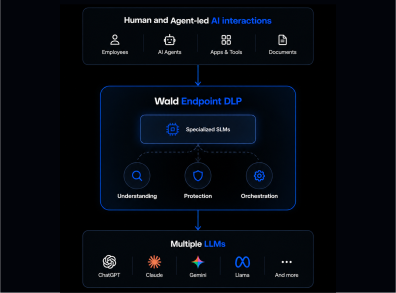
.avif)

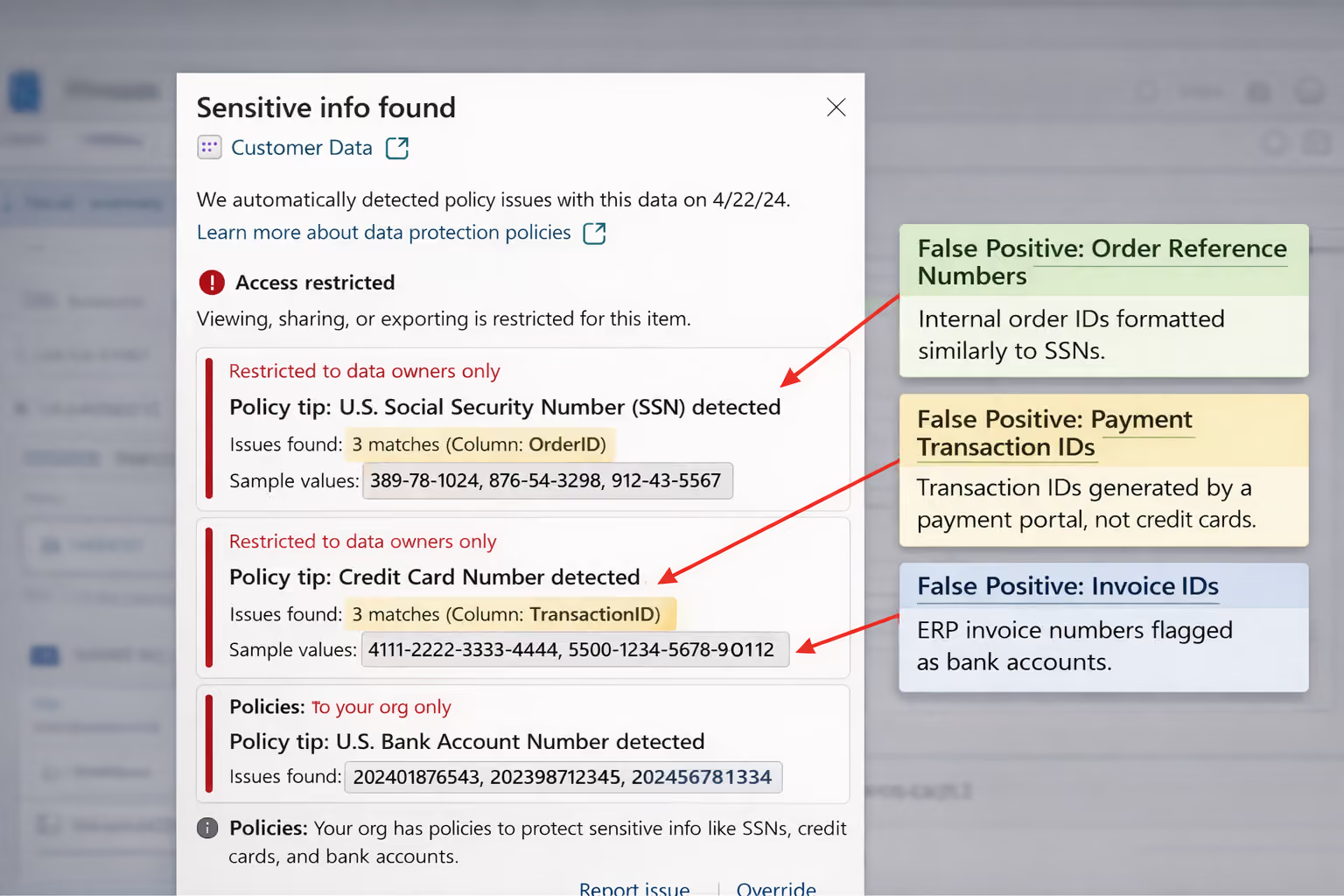
.avif)