Key Takeaways
AI governance shouldn’t be measured by the policies you write. It should be measured by the decisions your systems enforce in real time.
AI risk isn’t tied to the model. It’s created by the combination of the user, the data, the task, and the surrounding context.
As AI adoption accelerates, the biggest governance challenge isn’t visibility. It’s keeping governance fast enough to match AI’s pace of change.
The future of enterprise AI governance isn’t static compliance. It’s adaptive enforcement that turns context into action for every AI interaction.
An executive whitepaper on how AI-Native DLP differs from legacy DLP, and what it means for enterprise security strategy.
Download WhitepaperAI governance frameworks are still playing catch-up with the way enterprises use AI today.
And it's largely because traditional governance assumes systems are relatively stable.
The reality couldn't be more different. Employees now move between multiple AI models, copilots, coding assistants, browsers, autonomous agents, and APIs in the course of a single day.
The same prompt can produce different outcomes depending on the model, connected tools, user permissions, or the data it can access. Risk is no longer static, and governance can't afford to be either.
This shift has exposed a limitation in many existing AI governance approaches. While most frameworks recognize that context matters, they often stop at identifying risk instead of explaining how governance should continuously adapt as that context changes.
That's where an AI Contextual Governance Framework becomes essential.
Rather than relying on static policies or periodic reviews, contextual governance evaluates AI interactions in real time, taking into account who is using AI, what they're trying to do, what data they're accessing, which models they're interacting with, and the level of risk involved.
But context alone isn't enough.
Understanding risk doesn't reduce it. Governance only becomes effective when contextual signals are translated into enforceable controls that evolve as quickly as AI itself.
In this guide, we'll introduce you to a Context-to-Control Framework, a practical model for enterprise AI governance built around five principles: AI Footprint, AI Interaction Surface, Governance Velocity, Enforcement Coverage, and Adaptive Enforcement. Together, they provide a modern approach to governing AI systems that are continuously changing, rather than treating them as static software.
Why Traditional AI Governance Frameworks Break Down
Traditional AI governance frameworks weren't designed for environments where AI systems, users, and workflows change continuously.
Most governance models assume that once policies are defined, controls can be applied consistently across applications and reviewed periodically. That approach worked when enterprise software changed incrementally and user behavior followed predictable patterns.
Enterprise AI doesn't operate that way.
New models are released every few weeks. Employees adopt new copilots without formal onboarding. AI agents gain access to internal systems, browser extensions connect to external services, and prompts interact with different datasets depending on the task at hand.
The result is a constantly evolving operating environment where governance can no longer rely on fixed assumptions.
A policy written to govern ChatGPT today may not account for an AI coding assistant tomorrow. A rule created for a standalone chatbot may become ineffective when that same model is embedded inside an autonomous agent with access to enterprise applications.
This is the point where many organizations discover that their governance framework hasn't failed because the policies were wrong. It has failed because the environment changed faster than the framework was designed to adapt.
Traditional governance asks:
"What policy should we create?"
Modern AI governance has to ask:
"How should that policy adapt as AI changes?"
That shift is what separates static governance from contextual governance.
What Is an AI Contextual Governance Framework?
An AI Contextual Governance Framework is an approach to AI governance that evaluates AI interactions based on the context in which they occur, rather than applying the same controls to every user, model, or workflow.
Instead of treating every AI interaction as equally risky, contextual governance continuously considers factors such as:
- Who is using AI
- What they're trying to accomplish
- Which AI model or agent they're interacting with
- What data is being accessed or generated
- The sensitivity of that data
- The business risk associated with the interaction
This allows organizations to apply governance proportionally instead of universally.
For example, asking an internal AI assistant to summarize a public press release presents a very different level of risk than asking an external AI model to review proprietary source code or customer records. While both are AI interactions, they shouldn't be governed in the same way.
This is what makes contextual governance more effective than static policy enforcement. It recognizes that AI risk isn't determined by the model alone, but by the combination of the user, the task, the data, and the surrounding environment.
However, understanding context is only the first step.
Context identifies risk. It doesn't reduce it.
Without a mechanism to translate contextual signals into runtime decisions, governance remains observational rather than operational.
That's where our Context-to-Control Framework comes in.
Instead of stopping at context, it explains how organizations can transform contextual awareness into adaptive, enforceable controls across every AI interaction.
Introducing the Context-to-Control Framework
Most AI governance frameworks stop at identifying context.
They evaluate who the user is, what they're trying to accomplish, the data involved, and the level of risk associated with an AI interaction. While these signals are essential, they only answer one question:
Should this interaction be considered risky?
They don't answer the more important one:
What should happen next?
This is the missing layer in many enterprise AI governance strategies.
An organization may know that an employee is interacting with a sensitive dataset through an external AI model, but unless that contextual insight translates into an enforceable action, governance remains reactive instead of operational.
We call this the Context-to-Control Framework.
Rather than treating governance as a static set of policies, the framework continuously translates contextual signals into runtime controls. Every AI interaction is evaluated based on the user, the AI application, the underlying model, the sensitivity of the data, organizational policies, and the level of business risk before determining the appropriate action.
Instead of asking whether governance policies exist, the Context-to-Control Framework asks whether those policies can be consistently enforced as AI usage evolves.
The framework is built around five interconnected principles:
- AI Footprint defines what the organization is governing.
- AI Interaction Surface identifies where governance is required.
- Governance Velocity measures whether governance can keep pace with AI adoption.
- Enforcement Coverage evaluates how much of the AI environment is actively protected by enforceable controls.
- Adaptive Enforcement translates contextual signals into real-time decisions.
Together, these five principles shift AI governance from documentation to execution.
Pillar 1: AI Footprint
Every governance framework begins with understanding what needs to be governed.
Traditionally, organizations built inventories of applications, endpoints, cloud assets, and identities. AI introduces a new layer that isn't captured by conventional asset inventories.
We call this an organization's AI Footprint.
An AI Footprint represents the complete ecosystem of AI technologies operating across the enterprise. It includes not only approved AI platforms but also every model, copilot, coding assistant, browser-based AI tool, autonomous agent, API integration, and internally developed AI application being used across teams.
Unlike traditional software inventories, an AI Footprint isn't static.
New models are released frequently. Employees adopt new AI tools before formal governance processes catch up, also increasing Shadow AI risks. Business units experiment with specialized AI applications, while engineering teams integrate models directly into products and workflows.
As organizations scale AI, their AI Footprint expands continuously.
This expansion creates two challenges.
The first is visibility. Security and governance teams need an accurate understanding of which AI technologies are being used, where they're being used, and what enterprise data they can access.
The second is complexity. Every new AI application introduces additional interactions, permissions, integrations, and potential exposure points that governance must account for.
Without a clearly defined AI Footprint, organizations can't accurately assess risk, prioritize governance efforts, or apply consistent controls across their AI ecosystem.
Understanding the AI Footprint is therefore the foundation of contextual governance. Before enterprises can decide how AI should be governed, they first need to understand what they're governing.
Pillar 2: AI Interaction Surface
Knowing what AI exists inside the enterprise is only half the challenge.
The next big question is where governance actually needs to operate.
Traditional security focuses on protecting systems, networks, endpoints, and identities. AI introduces an entirely new layer of enterprise activity: interactions.
Every prompt submitted, response generated, tool invoked, API called, browser extension used, or autonomous agent executed creates an AI interaction. Individually, these actions may appear low risk. Collectively, they represent where enterprise AI risk is created, managed, or amplified.
We call this the AI Interaction Surface.
Unlike an attack surface, which maps the systems an attacker could exploit, the AI Interaction Surface maps every point where employees, applications, and AI systems exchange information or make decisions.
This includes interactions such as:
- An employee pasting sensitive financial data into an external chatbot.
- A coding assistant generating software using proprietary source code.
- An AI agent retrieving customer information before completing a workflow.
- A browser-based copilot summarizing confidential meeting notes.
- An enterprise LLM invoking internal APIs to complete business tasks.
Each interaction carries a different level of risk depending on the user, the data involved, the model being used, and the business context.
That means governance cannot be applied uniformly across the entire AI environment.
Instead, enterprises need visibility into their AI Interaction Surface so they can understand where governance decisions must be made, rather than simply which AI tools are installed.
The broader an organization's AI Footprint becomes, the larger its AI Interaction Surface grows. Modern governance isn't about controlling every AI application. It's about governing every meaningful interaction within that expanding ecosystem.
Pillar 3: Governance Velocity
Most organizations don't lose control of AI because they lack governance policies.
They lose control because governance evolves more slowly than AI adoption.
We call this Governance Velocity.
Governance Velocity is the rate at which an organization's policies, controls, and oversight mechanisms adapt to changes across its AI environment.
For many enterprises, AI evolves continuously.
New models are released every few weeks. Business teams adopt specialized AI applications. Engineering teams integrate new APIs into products. Autonomous agents gain new capabilities. Employees discover entirely new ways of working with AI almost daily.
Governance, however, often follows a very different timeline.
Policies are reviewed quarterly. Security assessments happen before deployment. Compliance processes rely on periodic audits. By the time governance catches up, the AI environment has already changed.
This creates a growing gap between AI Velocity and Governance Velocity.
When AI evolves faster than governance, organizations begin relying on policies that no longer reflect how AI is actually being used. Visibility decreases, exceptions become more common, and enforcement becomes increasingly inconsistent.
The goal of modern AI governance isn't to slow AI adoption.
It's to increase Governance Velocity so governance evolves at the same pace as the AI ecosystem it's designed to protect.
Organizations that achieve this shift move from reacting to AI change after it happens to continuously adapting governance as AI evolves.
Because ultimately, governance isn't defined by how many policies an organization writes.
It's defined by how quickly those policies can respond to change.
Pillar 4: Enforcement Coverage
Traditional governance measures success by the number of policies an organization has documented.
Modern governance should measure something different:
How much of your AI environment is actually protected by enforceable controls?
Ask your security team what is your organization’s enforcement coverage?
Enforcement Coverage basically measures the proportion of an organization's AI Footprint and AI Interaction Surface that is actively governed by runtime controls rather than static documentation.
This distinction matters because policies don't protect enterprise AI. Enforcement does.
For example, an organization may have clear policies restricting employees from sharing sensitive customer information with external AI models. However, if those policies rely solely on employee awareness or periodic audits, governance depends on manual compliance rather than technical enforcement.
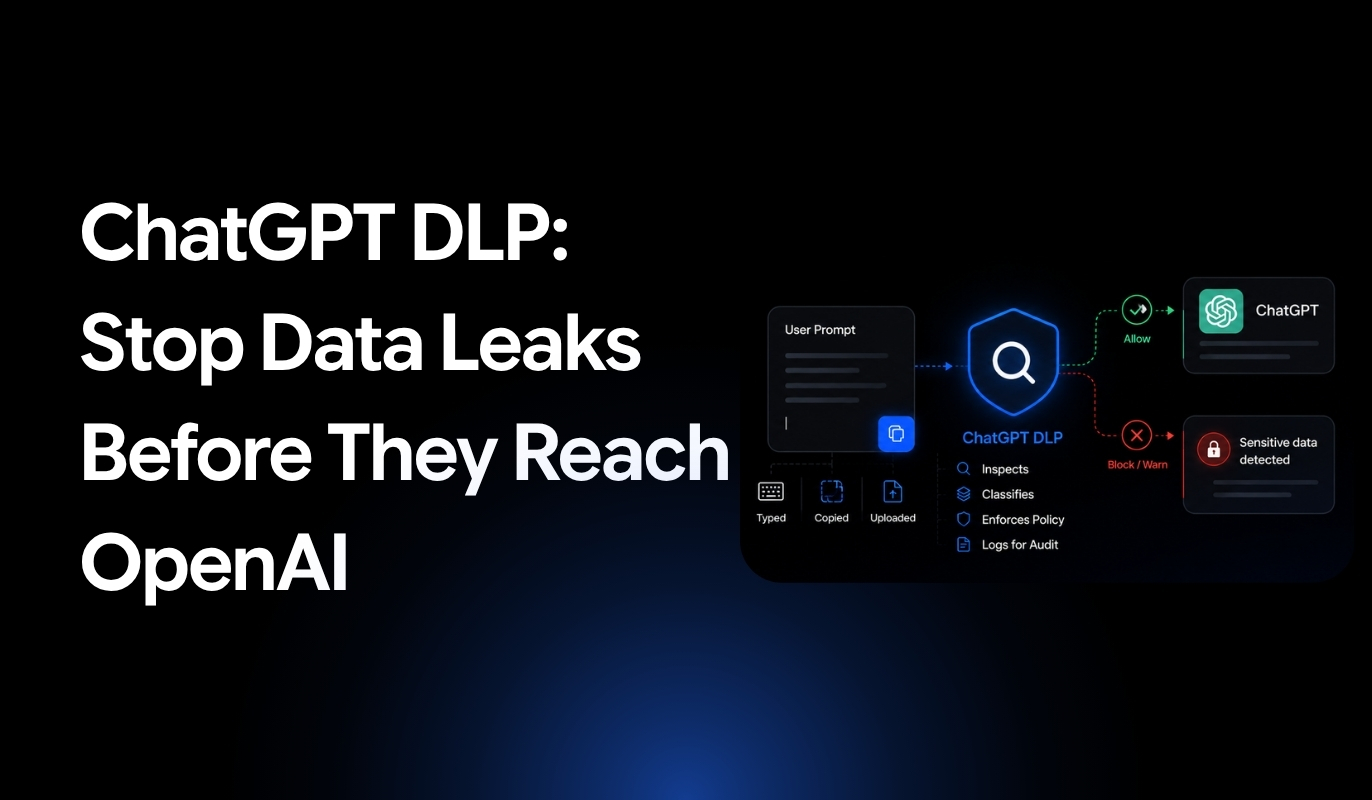
By contrast, organizations with high enforcement coverage apply controls directly where AI interactions occur. Sensitive prompts can be blocked, redirected, redacted, or logged automatically based on organizational policy without relying solely on users making the right decision.
As enterprise AI adoption grows, maintaining high enforcement coverage becomes increasingly important. Every new model, AI agent, browser extension, or workflow introduces additional interactions that must be governed consistently.
This makes enforcement coverage a far more meaningful measure of governance maturity than simply counting policies or approved AI tools.
The question has moved from whether governance policies exist to if they are enforced wherever AI is being used.
Pillar 5: Adaptive Enforcement
Every concept we've introduced so far leads to one conclusion.
Understanding context doesn't secure AI.
Acting on it does.
This is where Adaptive Enforcement becomes the operational layer of an AI Contextual Governance Framework.
Unlike static enforcement, which applies the same controls to every AI interaction, Adaptive Enforcement continuously evaluates contextual signals before determining the appropriate response.
Those signals include:
- User identity and role
- AI application or model being used
- Data sensitivity
- Business context
- Organizational policy
- Risk level
- Type of AI interaction
Based on those signals, governance can respond differently to each interaction.
For example:
- Allow an employee to summarize publicly available documents using an external AI assistant.
- Warn a developer before sharing proprietary source code with a coding assistant.
- Automatically redact sensitive customer information before it's processed by a third-party model.
- Block prompts that violate organizational policies or regulatory requirements.
The objective isn't to restrict AI usage.
It's to ensure governance adapts to the context of each interaction without slowing employee productivity.
This is the fundamental difference between static governance and adaptive governance.
Static governance assumes the same policy can apply everywhere.
Adaptive Enforcement recognizes that every AI interaction carries a different level of risk and responds accordingly.
When combined with an accurate AI Footprint, visibility into the AI Interaction Surface, sufficient Governance Velocity, and broad Enforcement Coverage, Adaptive Enforcement transforms governance from a compliance exercise into a continuous operational capability. There are AI DLP Platforms and security practices that simplify this for you.
Putting the Context-to-Control Framework Together
Each principle of the Context-to-Control Framework answers a different governance question. Individually, they solve one part of the challenge. Together, they create a governance model that continuously adapts as enterprise AI evolves.
The framework follows a logical progression.
An organization first needs visibility into its AI Footprint, understanding every AI model, copilot, agent, browser extension, and AI-powered workflow operating across the enterprise.
Once that inventory is established, the focus shifts to the AI Interaction Surface. Rather than governing applications alone, organizations begin governing the interactions where data is shared, decisions are made, and business risk is introduced.
From there, governance must keep pace with change. Governance Velocity measures whether policies, controls, and oversight mechanisms evolve as quickly as AI adoption itself. Without sufficient governance velocity, policies quickly become disconnected from real-world AI usage.
The next step is measuring Enforcement Coverage. Instead of asking whether governance policies exist, organizations assess how much of their AI environment is actually protected through runtime controls.
Finally, Adaptive Enforcement turns governance into action by evaluating every AI interaction against contextual signals and automatically applying the appropriate response.
Together, these five principles shift AI governance from static documentation to continuous decision-making.
Instead of periodically asking,
"Are our AI policies up to date?"
Organizations need to ask,
"Can our governance adapt every time AI changes?"
That's the difference between managing AI and governing it.
How to Evaluate Your Current AI Governance Framework
The questions below provide a practical way to evaluate governance maturity using the five principles of the Context-to-Control Framework.
Organizations don't need to achieve perfect maturity overnight.
The objective is to identify where governance is strongest, where it falls behind, and which capabilities need to evolve as AI adoption accelerates.
As AI ecosystems grow, governance maturity becomes less about writing more policies and more about ensuring those policies continue to operate effectively across an expanding AI environment.
Common Mistakes in AI Contextual Governance Frameworks
Many organizations recognize the need for AI governance, but their frameworks often struggle because they're built around assumptions that no longer reflect how AI is used today.
Here are some of the most common mistakes enterprises make when implementing an AI Contextual Governance Framework.
1. Governing AI applications instead of AI interactions
Most governance strategies focus on approving or blocking AI applications.
However, risk isn't created by the application alone. It's created by how employees, agents, and enterprise systems interact with AI.
The same AI model can present vastly different levels of risk depending on the data being shared, the user involved, and the business context. Effective governance therefore needs visibility across the AI Interaction Surface, not just an inventory of approved tools.
2. Treating governance as a policy exercise
Publishing an AI policy is only the starting point.
Without runtime enforcement, policies rely on employees consistently interpreting and applying governance decisions on their own. As AI adoption grows, that approach becomes increasingly difficult to sustain.
Modern governance should focus on translating policy into enforceable controls rather than documentation alone.
3. Assuming all AI interactions carry the same level of risk
Not every AI interaction should be governed in the same way.
Summarizing publicly available information doesn't require the same controls as processing proprietary source code, customer records, financial information, or regulated data.
Applying identical controls to every interaction either creates unnecessary friction or leaves high-risk scenarios underprotected.
4. Falling behind AI adoption
Enterprise AI evolves continuously.
New models, AI agents, browser assistants, and workflows are introduced far more frequently than most governance frameworks are reviewed.
When Governance Velocity can't keep pace with AI adoption, organizations gradually lose visibility into how AI is actually being used.
5. Measuring policies instead of governance outcomes
Many organizations measure governance maturity by counting policies, approved tools, or completed training programs.
These metrics say very little about whether governance is actually working.
More meaningful indicators include:
- Visibility across the AI Footprint
- Coverage across the AI Interaction Surface
- Governance Velocity
- Enforcement Coverage
- The effectiveness of Adaptive Enforcement
Ultimately, the success of an AI Contextual Governance Framework is determined by how consistently governance decisions are applied across an organization's AI environment.
Conclusion
AI governance is entering a new phase.
The challenge is no longer deciding whether AI should be governed. For most enterprises, that question has already been answered.
The real challenge is ensuring governance can evolve as quickly as the AI ecosystem itself.
As organizations expand their AI Footprint, the number of AI interactions, models, agents, and workflows will continue to grow. Static policies and periodic reviews were never designed for an environment that changes this rapidly.
That's why modern AI governance must move beyond documentation and toward continuous execution.
An effective AI Contextual Governance Framework translates contextual signals into consistent, enforceable decisions across every AI interaction.
The Context-to-Control Framework provides a practical way to make that shift by helping organizations understand what they need to govern, where governance is required, how quickly governance must adapt, how broadly controls are enforced, and how governance decisions can evolve in real time.
Because ultimately, successful AI governance isn't defined by the number of policies an organization writes.
It's defined by how consistently those policies are enforced across an AI environment that's constantly changing.
FAQs
What is an AI Contextual Governance Framework?
An AI Contextual Governance Framework is a governance model that evaluates AI interactions based on contextual factors such as user identity, data sensitivity, AI application, business purpose, and organizational risk. Instead of applying the same controls to every AI interaction, it enables governance decisions that adapt to the specific context of each interaction.
How is an AI Contextual Governance Framework different from traditional AI governance?
Traditional AI governance often relies on static policies, periodic reviews, and uniform controls. An AI Contextual Governance Framework continuously evaluates changing AI interactions and applies governance based on contextual signals, allowing organizations to respond more effectively as AI usage evolves.
Why is contextual governance important for enterprise AI?
Enterprise AI environments change rapidly as new models, AI agents, copilots, and workflows are introduced. Contextual governance helps organizations apply governance proportionally based on the user, data, AI model, and business context instead of relying on one-size-fits-all policies.
What is the Context-to-Control Framework?
The Context-to-Control Framework is a practical approach to enterprise AI governance that transforms contextual awareness into enforceable governance decisions. It consists of five principles: AI Footprint, AI Interaction Surface, Governance Velocity, Enforcement Coverage, and Adaptive Enforcement.
What is an AI Footprint?
An AI Footprint represents the complete inventory of AI technologies operating across an organization, including AI models, copilots, coding assistants, AI agents, APIs, browser-based AI tools, and internally developed AI applications.
What is an AI Interaction Surface?
The AI Interaction Surface is the collection of all interactions between users, AI systems, agents, and enterprise data where governance decisions may be required. It includes prompts, responses, tool invocations, API calls, and AI-assisted workflows.
What is Governance Velocity?
Governance Velocity measures how quickly an organization's governance policies, controls, and oversight mechanisms adapt as AI technologies, models, and workflows evolve.
What is Enforcement Coverage?
Enforcement Coverage measures how much of an organization's AI environment is actively protected through enforceable runtime controls rather than relying solely on documented policies or employee awareness.
What is Adaptive Enforcement?
Adaptive Enforcement is a governance approach that continuously evaluates contextual signals such as identity, AI application, data sensitivity, business context, and organizational policy before allowing, warning, redacting, or blocking AI interactions.