
- What it is: India's Digital Personal Data Protection Act, 2023, made operational by the DPDP Rules, 2025, notified on 13 November 2025.
- Who must comply: Any organisation processing digital personal data of people in India, including foreign companies serving Indian customers.
- What is enforceable now: The Data Protection Board is established. Core duties on notice, consent, security and breach reporting apply from 13 May 2027.
- Fines: Set per instance in the Schedule to the Act, with the highest cap reserved for security failures that lead to a breach.
- Biggest blind spot: Employees pasting customer or employee personal data into ChatGPT, Gemini or Copilot, often through shadow AI tools IT never approved.
- How Wald helps: Wald AI DLP detects personal data on the device before it reaches any AI tool, applies allow, warn or block policies, and logs AI usage for audits.
An executive whitepaper on how AI-Native DLP differs from legacy DLP, and what it means for enterprise security strategy.
Download Whitepaper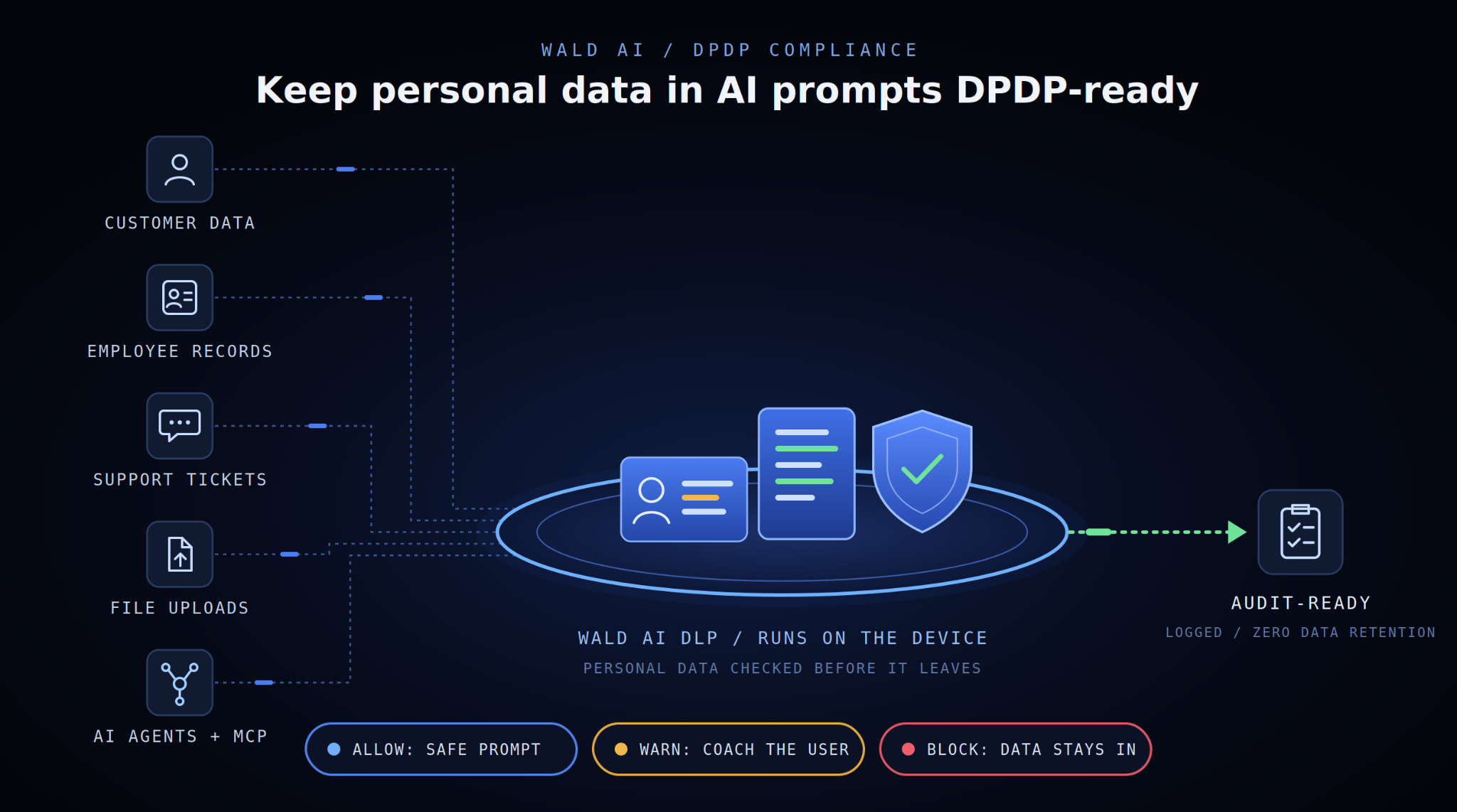
What DPDP compliance means
DPDP compliance means processing the digital personal data of people in India lawfully, for a stated purpose, with valid consent or a recognised legitimate use, and with reasonable security safeguards in place. The Digital Personal Data Protection Act, 2023 set the principles. The DPDP Rules, 2025 supplied the mechanics: what a notice must say, how consent is recorded, how fast a breach must be reported, and what logs you must keep.
For most of the last two years, DPDP was a "wait and see" law. That ended when the Ministry of Electronics and Information Technology (MeitY) notified the Rules in November 2025. If your company handles personal data of customers or employees in India, the clock is already ticking, and that data now flows through more places than most data maps show, including AI tools covered by no prompt security controls.
This guide covers who the law applies to, what is enforceable today, the fines, a practical DPDP compliance checklist, and the risk most compliance programmes still miss: employees pasting personal data into generative AI tools, the pattern behind a growing record of ChatGPT data leaks and security incidents.
Who the DPDP Act applies to
The Act applies to any organisation that processes digital personal data in India, whether the data was collected digitally or digitised later. Start by mapping your business against the four roles the law defines.
DPDP enforcement status and fines
The DPDP Act is in force and the Data Protection Board of India now exists, but most obligations on businesses apply from 13 May 2027. Here is where each part of the law stands as of October 2026.
Fines are set in the Schedule to the Act and imposed by the Board, per instance of non-compliance.
When setting a fine, the Board weighs the nature, gravity and duration of the breach, any gain or loss caused, and the steps taken to mitigate it. Documented controls are the strongest mitigation you can bring. Source: KS&K, August 2026.
The DPDP compliance checklist
Use these ten steps to move from "aware of DPDP" to "ready to be audited." They are ordered by dependency: you cannot write a valid notice for data you have not found.
Where generative AI creates DPDP exposure
Every prompt that contains personal data is processing under DPDP, and most compliance programmes have no record of it. A support agent pastes a customer complaint into ChatGPT to draft a reply. A recruiter uploads a CV to Gemini to summarise it. An analyst drops a customer export into Copilot to find churn patterns. Each one moves an Indian Data Principal's personal data to a third party.
Banning AI tools outright does not fix this. Employees move to personal devices and accounts, and the risk becomes invisible. Legacy DLP does not fix it either, because pattern matching misses personal data written in natural language, like "the patient in bed 4 is Ravi's mother." That is the gap context-aware DLP is built to close.
How Wald AI DLP helps
Wald AI DLP is a data loss prevention layer built for employee use of generative AI. It runs as an on-device agent and maps directly to the safeguards DPDP expects.
For teams that would rather give employees a sanctioned AI workspace than govern the tools they already use, Wald also offers the Wald LLM Pack. It brings ChatGPT, Claude, Gemini and other leading models into one interface, sanitises sensitive values in prompts before they reach the model provider, and runs under the same zero data retention policy.
No single tool makes an organisation DPDP compliant. Wald closes the AI gap in checklist steps 1, 6, 7 and 9: knowing where personal data flows, protecting it, detecting leaks and controlling third-party AI processing. See how Wald AI DLP works.
DPDP vs GDPR
DPDP is narrower than GDPR in scope but stricter on consent and children's data. Indian companies with EU customers can reuse much of their GDPR programme. For how GDPR treats personal data in AI prompts, see Is generative AI compliant with GDPR?
If you already run a GDPR programme, reuse your data map, DPIAs and breach playbook. Rework consent (there is no legitimate-interest basis), notices (language options) and children's data (the age is 18).
Frequently Asked Questions
What is DPDP compliance?
DPDP compliance means meeting the obligations of India's Digital Personal Data Protection Act, 2023 and the DPDP Rules, 2025. The core duties are lawful processing based on consent or a legitimate use, clear notices, reasonable security safeguards, breach reporting, and honouring data principal rights.
Is the DPDP Act in force?
Yes, in phases. The Act and the first Rules took effect on 13 November 2025. Consent Manager provisions start on 13 November 2026. Most operational obligations start on 13 May 2027.
Does the DPDP Act apply to companies outside India?
Yes, if they process personal data of people in India in connection with offering goods or services to them. A foreign company does not need an Indian office to be a Data Fiduciary under the Act.
What is a Data Fiduciary under the DPDP Act?
A Data Fiduciary is any person or organisation that decides the purpose and means of processing personal data. It is accountable for compliance, including for the work of its Data Processors.
What is a Consent Manager under the DPDP Act?
A Consent Manager is an India-incorporated entity registered with the Data Protection Board. It runs an interoperable platform where individuals give, review and withdraw consent across fiduciaries. Most businesses will integrate with Consent Managers, not become one.
What is the penalty for violating the DPDP Act?
Penalties go up to ₹250 crore per instance for failing to prevent a personal data breach, and ₹200 crore for failing to report one. Other breaches carry up to ₹50 crore.
How is DPDP different from GDPR?
DPDP covers only digital personal data, has no legitimate-interest basis, does not define a sensitive data category, and treats everyone under 18 as a child. GDPR's fine is turnover-based, while DPDP sets fixed caps per instance.
Does using ChatGPT or other AI tools create DPDP risk?
Yes. Personal data entered into an AI tool is processed by that provider. Without contracts, controls and logs, it can amount to unauthorised disclosure. AI DLP tools such as Wald detect personal data in prompts and apply allow, warn or block policies before it leaves the employee's device.