.avif)
Key Takeways
AI adoption is accelerating faster than most organizations can secure it.
Traditional DLP leaves critical gaps across prompts, AI applications, training data, and agentic workflows.
AI-native DLP adds context-aware controls that traditional security frameworks were never designed to provide.
A phased approach helps organizations discover shadow AI, enforce policies, and protect sensitive data without disrupting productivity.
The right AI DLP framework turns AI security from a reactive problem into continuous, proactive protection.
An executive whitepaper on how AI-Native DLP differs from legacy DLP, and what it means for enterprise security strategy.
Download WhitepaperAI security gaps are leaving organizations exposed to unprecedented risks. Research shows that 97% of organizations that experienced an AI-related breach lacked proper AI access controls. The situation grows more concerning when examining governance readiness: 63% of breached organizations either have no AI governance policy or are still developing one.
These statistics reveal a critical disconnect between AI adoption and security preparedness. Organizations are deploying AI systems faster than they can secure them, creating vulnerabilities that threat actors are quick to exploit.
AI DLP integration offers a path forward. When properly implemented within existing security frameworks, AI-aware data loss prevention tools can protect sensitive information throughout the entire AI lifecycle. This approach addresses the security gaps that traditional DLP solutions miss while maintaining the operational flexibility that organizations need.
This guide walks through the essential components of effective AI DLP integration. You'll learn how to assess your current security posture, implement AI-specific controls, and establish monitoring capabilities that evolve with emerging threats. The goal is building a security framework that protects against AI-related risks without hampering innovation.
Understanding AI DLP and Modern Security Frameworks
What is AI DLP and why does it matter?
Data Loss Prevention (DLP) refers to tools and strategies designed to prevent sensitive information from being exposed, leaked, or misused across endpoints, networks, and cloud platforms. AI systems demand a specialized approach because their core characteristics create security challenges that traditional DLP cannot address.
AI's data dependence, continuous learning capabilities, and probabilistic outputs create attack surfaces that didn't exist in conventional IT environments. Unlike static applications, AI systems evolve their behavior based on new inputs, making their security posture dynamic rather than fixed.
The pace of AI adoption has created a dangerous security gap. According to Cisco's 2025 AI Readiness Index, only 29% of companies believe they are adequately equipped to defend against AI threats, while just 33% have formal change-management plans for responsible AI adoption. Organizations are deploying systems whose behavior evolves, whose failure modes remain poorly understood, and whose environmental interactions can be unpredictable.
This gap exposes organizations to attack vectors that traditional IT security frameworks from NIST and ISO only partially address:
- Evasion and poisoning attacks where malicious inputs skew outputs or corrupt training data
- Model theft and inversion where attackers steal proprietary systems or reconstruct sensitive information
- Prompt injection where attackers manipulate inputs to force systems to leak data or behave maliciously
- Privacy attacks that exploit vulnerabilities to steal sensitive information processed by AI systems
- Hallucinations where systems confidently produce false outputs that erode trust or misinform users
Key components of AI-ready security frameworks
AI security and AI safety work together within a unified risk management approach. AI security protects systems from unauthorized access, availability attacks, and integrity compromise throughout the AI lifecycle. AI safety ensures AI systems behave ethically, reliably, and transparently while aligning with human values.
Cisco's Integrated AI Security and Safety Framework represents an early attempt to classify and operationalize the full spectrum of AI risks. The framework addresses adversarial threats, content safety failures, model and supply chain compromise, agentic behaviors, and ecosystem risks like orchestration abuse and multi-agent collusion.
Modern AI security frameworks distinguish themselves through five core design elements. They integrate AI threats and content harms, recognizing that adversaries exploit vulnerabilities across both domains. A security attack, such as injecting malicious instructions or corrupting training data, often culminates in safety failures like generating harmful content or leaking confidential information.
AI development lifecycle awareness accounts for how security considerations change across data collection, model training, deployment, and runtime operation. Vulnerabilities that pose little risk during model development can become critical once the model gains access to tools or interacts with other agents. Multi-agent coordination capabilities address risks that emerge when AI systems collaborate through orchestration patterns, inter-agent communication protocols, and shared memory architectures.
Why traditional DLP falls short for AI security
Legacy DLP emerged in the mid-2000s to prevent sensitive data from leaving organizations through known channels. It relied on regular expressions, keyword matching, and predefined patterns. This approach worked when data moved through predictable, file-based flows between controlled endpoints.
Generative AI breaks this model entirely. GenAI pulls data based on access permissions, summarizes it, remixes it with other information, and generates new content. Traditional DLP requires knowing which channels to monitor and depends on predefined policies for specific applications. When employees access hundreds of AI tools through personal accounts, browser extensions, and embedded features within approved SaaS applications, the attack surface exceeds anything legacy DLP was designed to handle.
Where AI-Native DLP Fits Into the Security Stack
Many organizations assume that extending existing DLP policies to AI applications is sufficient. In practice, AI interactions introduce entirely new data flows that traditional controls were not designed to inspect.
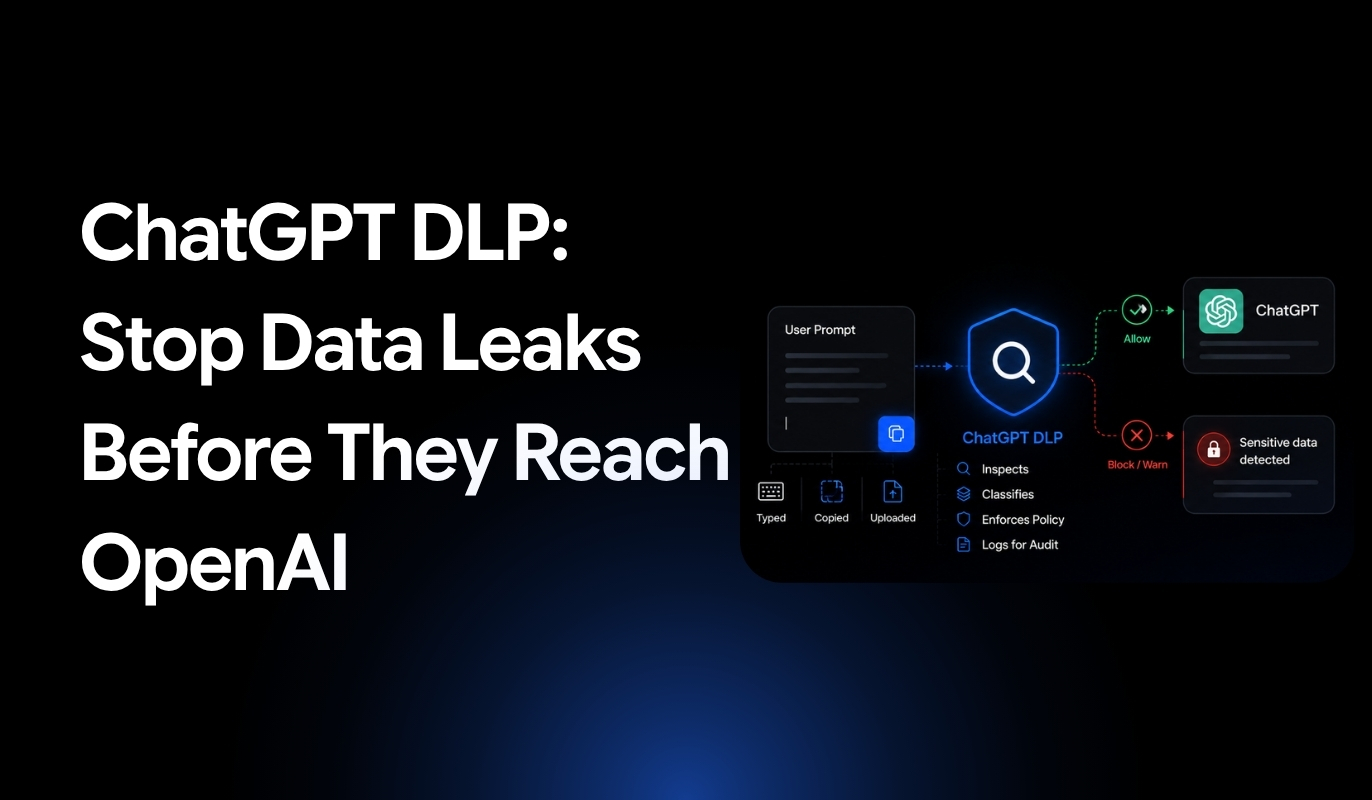
An AI-native DLP layer sits between users and AI systems, providing visibility into prompts, uploads, generated responses, and AI-driven workflows across approved and unapproved AI applications. Rather than relying solely on keywords or predefined patterns, AI-native controls can evaluate the context and sensitivity of information before it reaches an external model.
For example, solutions like Wald AI DLP help organizations identify sensitive business information, detect policy violations in real time, redact protected data before transmission, and enforce governance controls across AI assistants, AI agents, and enterprise AI platforms. This enables organizations to adopt AI securely without sacrificing productivity or creating blind spots in their existing security architecture.
The goal is not to replace existing security investments, but to extend them with controls specifically designed for AI-driven data movement.
Modern data loss prevention asks fundamentally different questions: What is this data? Who should access it? Should they access it now? How does risk change as data moves and transforms? Instead of relying on patterns or file labels, modern DLP analyzes data's true meaning and context to determine sensitivity across structured and unstructured formats.
Semantic detection replaces pattern matching by analyzing content meaning rather than using regex expressions. It can recognize that a paragraph describing an acquisition deal is confidential even without structured data patterns.
Data lineage tracking establishes the origin and context of information before it enters AI workflows, distinguishing between legitimate inputs and potential intellectual property theft. Context-aware policy enforcement enables graduated responses: allow and log for low-risk interactions, coach users for moderate risk, redact sensitive elements for higher risk, block dangerous violations, and route ambiguous cases to human review.
Assessing Your Current Security Framework for AI DLP Integration
Identify Existing Security Controls and Gaps
How well do your current security measures handle AI workloads? Most organizations discover significant blind spots when they examine their existing controls through an AI lens.
AI models behave differently than traditional applications. They evolve as they process new data, making periodic audits essential to verify system integrity and performance. Security teams need to establish regular verification processes that confirm models haven't been tampered with or corrupted by threat actors.
Model integrity verification forms the foundation of AI security assessment. Input/output analysis examines data flows and predictions for signs of adversarial manipulation or bias, while performance evaluation monitors accuracy to ensure systems continue meeting security standards. These assessments reveal whether your current monitoring tools can detect AI-specific threats.
Access controls present another critical evaluation area. Traditional frameworks focus on user permissions and network segmentation, but AI systems require controls around model modifications and training data access. Model versioning capabilities become essential for tracking changes and enabling quick rollbacks when issues arise. Incident response plans must account for AI-specific compromise scenarios, including model theft and data poisoning attacks.
Standard security frameworks weren't designed for AI training environments. Critical gaps emerge around AI-specific assets like model weights, checkpoints, and training runs. Traditional inspection points simply don't exist in accelerator fabrics. Training clusters generate extremely high-volume east-west traffic within network fabrics, reducing the effectiveness of conventional segmentation and inline inspection.
Evaluate Data Flow and AI Usage Patterns
Data flows in AI environments create unique tracking challenges. Unlike traditional applications where data follows predictable paths, AI systems continuously ingest, transform, and generate information. Static discovery tools can identify sensitive datasets in storage, but they miss the dynamic flows that create the most risk.
Understanding data provenance becomes critical. You need visibility into which upstream systems produced the data, what transformations occurred along the way, whether it's actively training production models, and if copies are being sent to unauthorized third-party services. This level of detail exceeds what most organizations currently track.
Data flow monitoring provides end-to-end traceability across AI lifecycles. Effective monitoring establishes data provenance from collection through processing, linking each dataset to specific business purposes and legal processing bases. Continuous tracking creates verifiable lineage, showing precisely how training data was derived and used. Organizations must implement systems that produce audit-ready logs, usage reports, and compliance evidence for regulatory requirements.
Map Compliance Requirements and AI Security Standards
Regulatory landscapes for AI continue evolving, but several frameworks provide immediate guidance. ISO 42001 offers a structured approach for establishing AI management systems, addressing roles, responsibilities, and accountability throughout AI development and deployment. The standard covers risk identification, assessment, and mitigation processes specific to AI, including security vulnerabilities, privacy concerns, and ethical implications.
The NIST AI Risk Management Framework emphasizes transparency and trust throughout AI implementation lifecycles. NIST continues developing technical standards that promote innovation while building public confidence in AI systems. Current priorities include standards for AI data quality, performance measurement, and governance structures essential for trustworthy AI deployment.
Determine Integration Readiness
Security integration requires honest assessment of current capabilities and gaps. Organizations need strong foundational cybersecurity measures before adding AI-specific controls, plus compliance with relevant data protection regulations. The secure-by-design approach means integrating security into AI projects from inception rather than retrofitting protections later.
Leaders must understand potential consequences if AI system integrity, availability, or confidentiality were compromised. These impacts extend beyond technical failures to include operational disruption and reputational damage. Appropriate response plans should address these broader organizational risks.
Assessment readiness comes down to a simple question: Can your current security team identify, monitor, and respond to AI-specific threats? If the answer reveals significant gaps, AI DLP integration becomes not just beneficial but essential for maintaining security posture.
Step-by-Step AI DLP Integration Process
Building effective AI DLP protection requires a structured approach that balances security with operational needs. These five steps provide a tested framework for integrating AI-aware data loss prevention into your existing security infrastructure.
Step 1: Establish AI Data Governance Policies
Your data governance foundation determines everything that follows. Start with data classification policies that clearly identify sensitive datasets - personal information, financial records, intellectual property, and any data subject to regulatory requirements.
Data ownership matters more in AI contexts than traditional IT environments. AI systems can access, process, and generate content from multiple data sources simultaneously. Establish clear ownership rights and implement role-based access controls that restrict data access to authorized personnel only.
Ethical guidelines for AI development should address fairness, non-discrimination, transparency, and accountability. These aren't just compliance requirements - they're operational necessities that prevent costly mistakes down the line.
Consent management processes ensure you can track and respect data usage permissions. Document all data transformations and quality checks performed during preprocessing. This documentation becomes critical during audits and helps you understand how sensitive data flows through your AI systems.
Step 2: Deploy AI-Aware DLP Solutions
Start in simulation mode, not full enforcement. Set policies to audit-only mode to log user behavior silently, focusing on actions involving AI platforms and endpoints. This approach prevents disrupting legitimate workflows while you learn how your organization actually uses AI tools.
Run this configuration for four to six weeks. Review alert output carefully and refine detection rules before activating any enforcement capabilities. The goal is understanding your environment before you start blocking anything.
Enable policy tips to coach users before they submit data to external models. This educates your workforce while gathering data about usage patterns. Fine-tune policies by reviewing false positives and adjusting classifier thresholds based on real user behavior.
This phased deployment approach limits the impact of misconfigured policies and gives your security team time to tune detection logic before expanding coverage to the entire organization.
Step 3: Integrate with Existing Security Tools
Your DLP solution should integrate seamlessly with existing security infrastructure. Ensure DLP logs are parsed by your SIEM and configure correlation rules to link related events. A sensitive data export combined with an anomalous login should automatically trigger a high-priority incident.
Connect with identity providers like Active Directory or Okta for user-context enrichment on alerts. This integration enables your security operations team to see not just what data moved, but who moved it, from which device, under which role, and whether that behavior matches normal access patterns.
API gateways and management platforms need monitoring for data traffic within custom applications. The goal is comprehensive visibility across all potential data paths, not just the obvious ones.
Step 4: Configure AI Security Controls
Deploy risk-based conditional access controls that adapt to threat levels and user behavior. Strong authentication mechanisms should be standard, but real-time traffic filtering provides the dynamic protection AI environments require.
Block known malicious destinations and implement custom policies to stop harmful activities like prompt injection attacks. Configure category-based blocking at the endpoint so policies remain effective against new and unknown AI tools without requiring constant manual updates.
Graduated response capabilities should match risk levels: allow and log for low-risk interactions, provide coaching for moderate risk situations, redact sensitive elements automatically, and block high-risk violations completely.
Step 5: Implement Monitoring and Detection Capabilities
Behavioral analytics help establish normal operation patterns for AI agents. Real-time anomaly detection with automated alerting ensures you catch deviations quickly, before they become incidents.
Start with a comprehensive audit to identify all existing AI agents across your environment. Implement automated discovery tools to maintain an ongoing inventory as your AI footprint expands.
Establish baseline security policies specific to AI agent security events. These policies should address the unique risks AI agents pose, including autonomous actions and cross-system data access.
Integration with broader security orchestration platforms provides unified visibility across your entire environment. This unified view helps correlate AI-related events with other security activities for faster threat detection and response.
AI Security Best Practices for Effective DLP Integration
Secure AI Training Data and Model Inputs
AI training pipelines demand more than traditional data validation. Automated schema checks and statistical tests can identify poisoned samples before they corrupt your models. Differential privacy during feature extraction prevents model inversion attacks that attempt to reconstruct individual records from training data.
Data provenance becomes critical when dealing with AI systems. Every data row should include signed metadata that records its origin, transformation history, and access events. This approach establishes verifiable lineage that security teams can audit when investigating incidents.
Input validation takes on new importance with AI systems. Thorough sanitization prevents prompt injection attacks where malicious actors manipulate model behavior through crafted inputs. Clean data leads to reliable model performance and reduces security risks.
Monitor Generative AI Security Best Practices
Current generative AI security posture reveals significant gaps. Research indicates that only 24% of generative AI initiatives include proper security measures, leaving systems exposed to data breaches.
Strong encryption protocols protect data both at rest and during transmission. Checksums and digital signatures help detect unauthorized modifications to model files and training datasets. These technical controls provide the foundation for secure AI operations.
Human oversight remains essential, particularly for high-stakes decisions or when processing sensitive information. Staff education helps teams recognize AI limitations and identify warning signs like hallucinations or flawed reasoning that could lead to security incidents.
Apply Access Controls and Authentication
Modern authentication systems can use AI to analyze user behavior patterns and detect anomalies that traditional methods miss. This behavioral analysis adds an extra security layer beyond standard multi-factor authentication.
Role-based access controls define clear boundaries around who can access AI models and training data. Pair these controls with continuous monitoring of data access activity to detect unusual patterns early.
Zero Trust principles work well with AI systems. Verify every user and device attempting to access AI resources, regardless of their network location. For AI agents specifically, asymmetric cryptography-based credentials such as JWT tokens and X509 certificates with mutual TLS provide strong authentication mechanisms.
Establish Continuous Monitoring and Response
Real-time monitoring covers multiple dimensions of AI system health. Track prediction accuracy, fairness metrics across demographic groups, input and output distribution shifts, and error rates to catch problems early.
Incident response procedures should include automated alerts for different severity levels, model rollback capabilities, and traffic redirection to backup systems. Monitor for adversarial inputs, shifts in classifier confidence, and unusual spikes in report volume.
Document your retention policies to balance security monitoring needs with privacy requirements. Clear policies help teams respond consistently during incidents.
Address Shadow AI Discovery and Management
Shadow AI usage presents growing challenges for security teams. Organizations typically discover an average of 66 generative AI applications, with 6.6 classified as high-risk per company. GenAI-related DLP incidents have increased more than 2.5 times and now represent 14% of all DLP violations.
The scope of unauthorized usage is concerning. Over 70% of organizations have employees using generative AI tools without formal approval. This creates blind spots in security monitoring and compliance reporting.
Discovery requires multiple approaches. Conduct comprehensive audits to identify unauthorized AI tools, monitor network traffic for unusual data flows, and review code repositories for unexpected integrations. Automated discovery tools can maintain ongoing inventory as new tools emerge.
Rather than blocking all unauthorized tools, establish streamlined approval processes. Create clear pathways for requesting new AI tools while maintaining security standards. This balanced approach reduces shadow IT adoption while enabling innovation.
Operationalizing and Optimizing Your AI DLP Framework
Testing and Validation of Integrated Systems
Effective AI DLP deployment requires careful validation before full enforcement. Run policies in simulation mode before enforcement to assess accuracy without blocking legitimate workflows. This approach allows security teams to observe system behavior and fine-tune detection logic without disrupting operations.
Testing with sample data validates detection quality across file uploads, copy-paste operations, and unauthorized downloads. Focus testing efforts on the most common data movement patterns within your organization to ensure coverage of real-world scenarios.
Automated security validation using breach and attack simulation tests data exfiltration controls across email, HTTP/HTTPS, network protocols, DNS tunneling, cloud storage, and collaboration apps. These simulations provide measurable insights into policy effectiveness and help identify blind spots before threat actors exploit them.
Assessment reports highlight risk scores, exposure levels, exfiltration ratios, and mitigation guidance to optimize DLP configurations. Regular testing cycles ensure that policies adapt to changing data flows and emerging attack vectors.
Managing Agentic AI vs Generative AI Security
Agentic AI presents distinct security challenges that extend beyond traditional generative AI risks. These systems inherit all generative AI vulnerabilities while adding expanded attack surfaces through Model Context Protocol servers, cascading multi-agent failures, and autonomous tool execution.
The adoption rate tells the story of urgency. According to McKinsey, 62% of organizations are experimenting with AI agents, with 23% scaling agentic systems. This rapid deployment often outpaces security considerations.
Security controls must address persistent state management, memory poisoning, tool misuse, privilege compromise, and agent-to-agent communication. Apply least model privilege, oversight mechanisms, and memory integrity protections as core ai security controls. Each autonomous action requires verification and logging to maintain security posture.
Measuring Success and Key Performance Indicators
Success metrics provide clear benchmarks for AI DLP effectiveness. Track Mean Time to Detect under 1 hour, Mean Time to Resolve under 4 hours, and false positive rates below 10%. These targets ensure rapid response while maintaining operational efficiency.
Monitor incident detection rates, policy compliance rates, data classification coverage, and blocked versus allowed transactions. These metrics reveal both security effectiveness and user impact, helping balance protection with productivity.
Calculate ROI as (Cost of Breaches Prevented + Operational Savings – Cost of DLP) / Cost of DLP × 100%. This calculation demonstrates the business value of AI DLP investments and guides future security spending decisions.
Maintaining Compliance and Updating Controls
AI security requires continuous attention and regular updates. Current deployment patterns show significant gaps: only 30% of organizations have deployed generative AI systems to production, with fewer than 48% monitoring for accuracy, drift, and misuse.
Review metrics monthly, update policies quarterly based on emerging threats, and conduct annual compliance assessments against ISO 42001 and NIST AI RMF standards. This schedule ensures that security controls evolve with the threat landscape while meeting regulatory requirements.
Regular policy updates address new AI tools, attack methods, and compliance requirements. The goal is maintaining effective protection without creating operational bottlenecks that drive users toward unmanaged solutions.
Conclusion
AI DLP integration addresses the security gaps that leave most organizations vulnerable to AI-related breaches. The statistics are clear: 97% of breached organizations lacked proper AI access controls, and 63% either have no AI governance policy or are still developing one. This guide provides the framework to join the minority of organizations that have secured their AI systems effectively.
Your success depends on methodical execution rather than rushed implementation. Start with data governance policies that classify sensitive information and establish clear ownership. Deploy AI-aware DLP solutions in simulation mode to understand your environment before enforcing policies. Integrate with existing security tools to maximize visibility and correlation capabilities.
The phased approach works. Organizations that implement graduated responses—allowing low-risk interactions while blocking high-risk violations—achieve better security outcomes with fewer disruptions to legitimate workflows. Continuous monitoring and regular policy updates keep pace with evolving AI threats.
Security frameworks must evolve with AI adoption patterns. Traditional DLP solutions cannot protect against prompt injection attacks, model theft, or adversarial inputs that target AI systems specifically. AI-aware solutions fill these gaps while maintaining compatibility with existing infrastructure.
The cost of inaction continues to rise. Organizations without AI security face data breach costs that are 18.6% higher than those with proper controls in place. Meanwhile, AI security market growth of 24.2% annually reflects the urgent demand for effective solutions.
Start implementing AI DLP integration now. Begin with assessment and governance, then progress through deployment and optimization. The security landscape will not wait for perfect readiness, but methodical implementation provides protection against the most critical risks.