

Key Takeaways
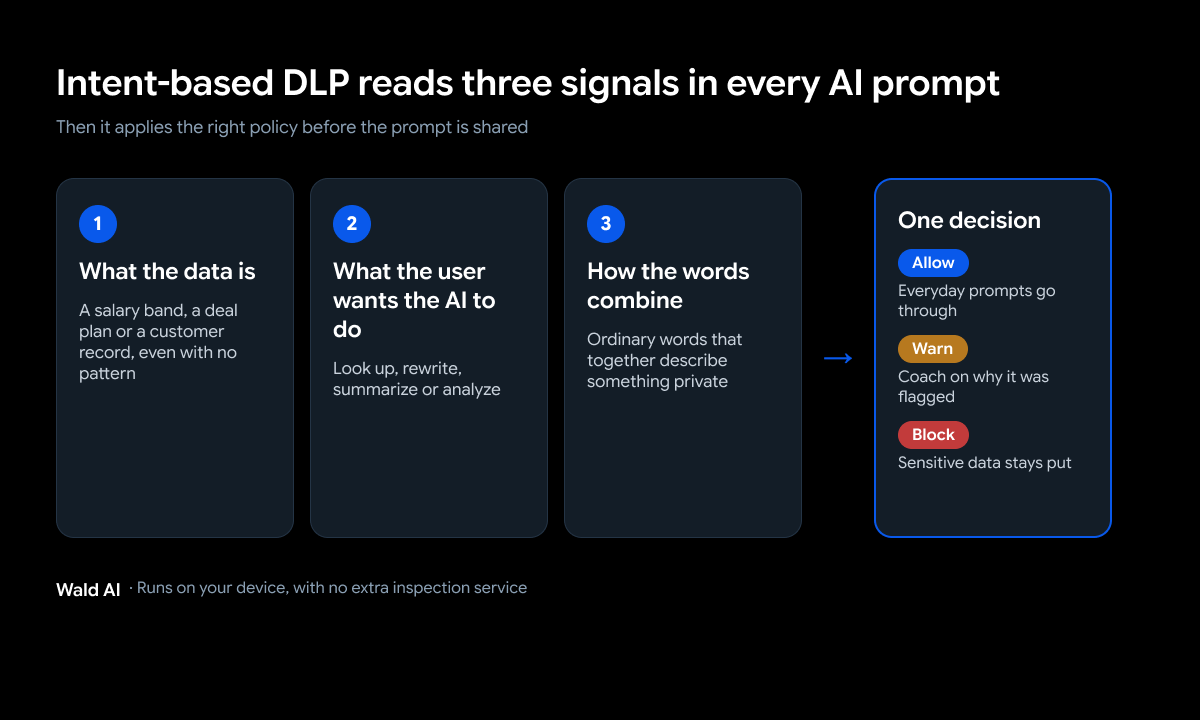
- Intent-based data loss prevention reads three signals in every prompt: what the data is, what the user wants the AI to do with it, and how the words combine.
- The same words can call for different decisions, so reading meaning cuts both missed leaks and false alarms.
- Our desktop DLP agent does this reading on the device, so prompts are not sent elsewhere to be checked.
- The decision is not just yes or no: prompts are allowed, warned or blocked, and employees are coached on why.
An executive whitepaper on how AI-Native DLP differs from legacy DLP, and what it means for enterprise security strategy.
Download Whitepaper
Two prompts reach a chatbot on the same afternoon. One asks how old a famous actor is. The other asks for an email confirming a colleague's new salary. Both contain a person's name, and a rule that watches for names treats them the same. A person reading them would not, because one is public trivia and the other is private pay data. Intent-based DLP is built to make that same distinction automatically.
Intent-based DLP is a solution that uses small language models (SLMs) on your device to spot sensitive data in prompts, understand what it means and what the user wants the AI to do, and apply the right policy before it is shared.
1. Signal One: What the Data Is
The first thing an intent-based system works out is what kind of information is in the prompt. That sounds like what older tools already do, but the difference is that it does not need a recognizable pattern to get there.
Recognizing data without a pattern
A credit card number has a shape that a rule can find. A salary band, a deal structure or a draft layoff list does not. Someone can describe a company's plans in ordinary sentences and never include a digit, a keyword or a label. Because small language models read the sentence rather than scan for strings, they can tell that a paragraph describes confidential documents even when nothing in it looks sensitive to a pattern matcher.
How we group what it finds
Once the data type is clear, it needs a place in a scheme your team can write policies against. We use the same data classification levels you would use for files, from public through restricted, so a policy for prompts lines up with the way you already think about your data. Customer records, PII and pay information land at the sensitive end, while a question about a public company lands at the other.
2. Signal Two: What the User Is Asking the AI to Do
Knowing what the data is gets you halfway. The second signal is the request, because the same piece of information carries different risk depending on what the employee wants done with it.
Summarize, draft, analyze or share
Asking an AI what a term in a contract means is a different act from pasting the whole contract and asking for a summary. The first shares almost nothing. The second hands over the document. A tool that only sees the data type misses that distinction, while one that reads the request notices that the user is asking the AI to work with the actual content.
Why intent changes the decision
This is where the name comes from. If a prompt asks the AI to rewrite a public press release, the data is harmless and the request is routine, so it goes through. If it asks the AI to restructure a private deal, the same request pattern now touches something that should not leave.
Microsoft's own guidance on DLP policy design makes a similar point: policies work better when they reflect the intent implied by an action, because most data loss happens during everyday work rather than through malice. For a small team, that matters, because the person pasting is usually trying to save time.
3. Signal Three: How the Words Combine in Context
The third signal is the hardest for rules to capture. It is the way separate words, none alarming alone, add up to something sensitive together.
Why single words and single fields mislead
"Acquire", "bank" and "Florida" are ordinary words. A sentence that joins them with a company's name, a timeline and a financing question describes a deal that has not been announced. No single term gives it away, and no list of keywords could include every combination in advance. Reading the sentence as a whole is the only way to see it.
Where this cuts false positives
Context also works in the other direction. A nine-digit order number can look like a national ID to a rule, and a note about a "patient" in a fictional story can look like health data. When the system understands the surrounding sentence, it can see that these are not what they resemble, which is why this style of detection lowers DLP false positives.
Fewer false alarms means fewer interrupted employees and fewer alerts for your team to sort. If you want the full comparison with pattern rules, our post on AI DLP covers it, and our page on context-aware DLP explains the approach in more depth.
4. Four Prompts, Four Decisions
Here is how the three signals play out on four prompts. The names are invented.
An acquisition plan: block
"Northfield Bank is in advanced talks to acquire a community bank in Florida with heavy commercial real estate exposure. How should we structure the deal to ease capital pressure next year?"
There is no ID number or keyword to catch here. The data is an unannounced deal, the request is to help shape it, and the words together describe something only a few people should know. The right policy is to block it before it leaves the device.
A customer record: block
"Review this customer's insurance application and tell me whether the stated income looks consistent." (followed by a pasted application)
This one holds customer data belonging to a real person, and the request asks the AI to analyze it. Both signals point the same way, so the prompt is blocked.
A public-information check: allow
"What year was Shopify founded, and who runs it today?"
A company name appears, which a name-based rule might flag. The data is public, the request is a simple lookup, and nothing about the combination is sensitive. The prompt goes through without any interruption, which is how a good policy should feel to the person using it.
A compensation email: warn
"Draft an email to Priya Nair confirming her new salary of $96,000 and her bonus band."
This involves salary data about a named colleague, and the request is to write something that carries it. It is a legitimate task, so a hard block may be too strict for many teams. A warning fits better: we coach the employee on why the prompt was flagged, and they decide how to proceed. Your team sets how strict each policy is, and the logs record what was detected and what action followed.
If you are starting out, a practical first step is to run the policies in monitor mode for a week or two. Your team sees which prompts would have been warned or blocked before anyone is interrupted, and can tune the settings from real examples rather than guesses.
Across the four, the system chose between allow, warn and block. It can also simply monitor, so a team can watch a new policy before enforcing it. In each case the decision came from reading the prompt, not from a list of banned terms.
5. Why the Reading Happens on Your Device
How the reading is done matters as much as what it finds. If every prompt were sent to a separate service to be checked, you would be moving the sensitive text in order to protect it.
We run multiple SLMs locally on the device, so the prompt is inspected where it is written and nothing is forwarded elsewhere for inspection. Because the models are small, there is no user-visible delay, which means employees keep working at their normal pace.
For a small team in the USA or India without a dedicated security operations group, that also means there is less infrastructure to run. Deployment uses a browser extension and a local agent that fit alongside your existing endpoint management.
Our View: Read the Meaning, Then Apply the Right Policy
We think the real weakness in older approaches is that they can only handle what someone thought to describe ahead of time. Manual policies can only address known behaviors, but AI interactions are dynamic and constantly evolving, so by the time a new exposure risk is discovered, it may be too late to configure a policy to prevent it.
Reading meaning gets around that. Instead of asking whether a prompt matches a known pattern, we ask what the data is, what the user wants done and what the words add up to, then apply the right policy. It is the idea behind semantic DLP, applied at the moment a prompt is written. We built Wald AI around this approach so that teams can use ChatGPT, Claude and other tools freely while sensitive data stays protected.
Up for a challenge?
Conclusion
Intent-based DLP asks a more human question than a pattern rule does: what is this prompt, and what is the person trying to do with it. Reading the data, the request and the context together lets it allow the harmless, warn on the borderline and block what should not leave, with fewer false alarms along the way. If you want to see how that looks on your own team's prompts, see Wald AI in action.
Frequently Asked Questions
What is intent-based DLP?
Intent-based DLP is a solution that uses small language models on your device to spot sensitive data in prompts, understand what it means and what the user wants the AI to do, and apply the right policy before the prompt is shared.How
How is intent-based DLP different from regex-based DLP?
Regex-based tools look for fixed patterns such as card or ID numbers. Intent-based DLP reads the meaning of the whole prompt, so it can catch sensitive content that has no pattern and ignore harmless text that happens to look like one.
Does intent-based DLP reduce false positives?
Yes. Because it understands the surrounding sentence, it can tell an order number from an ID or a fictional story from real records, so fewer harmless prompts are flagged.
Does intent-based DLP slow down AI tools?
It should not. The models run on the device and are small, so employees see no noticeable delay when they send a prompt.
What does intent-based DLP do when it flags a prompt?
It applies the policy you set: allow, warn or block. When a prompt is flagged, we coach the employee on why, so they learn what not to share.